The Equality Act (2010) is a UK law that is intended to protect people from discrimination, harassment and victimisation.
This is to ensure that everyone is treated with dignity and respect.
The Equality Act (2010) is about ensuring equality and fair treatment for all.
Before the Equality Act (2010) there were more than 100 pieces of other legislation that included details around protecting people from discrimination, harassment and victimisation.
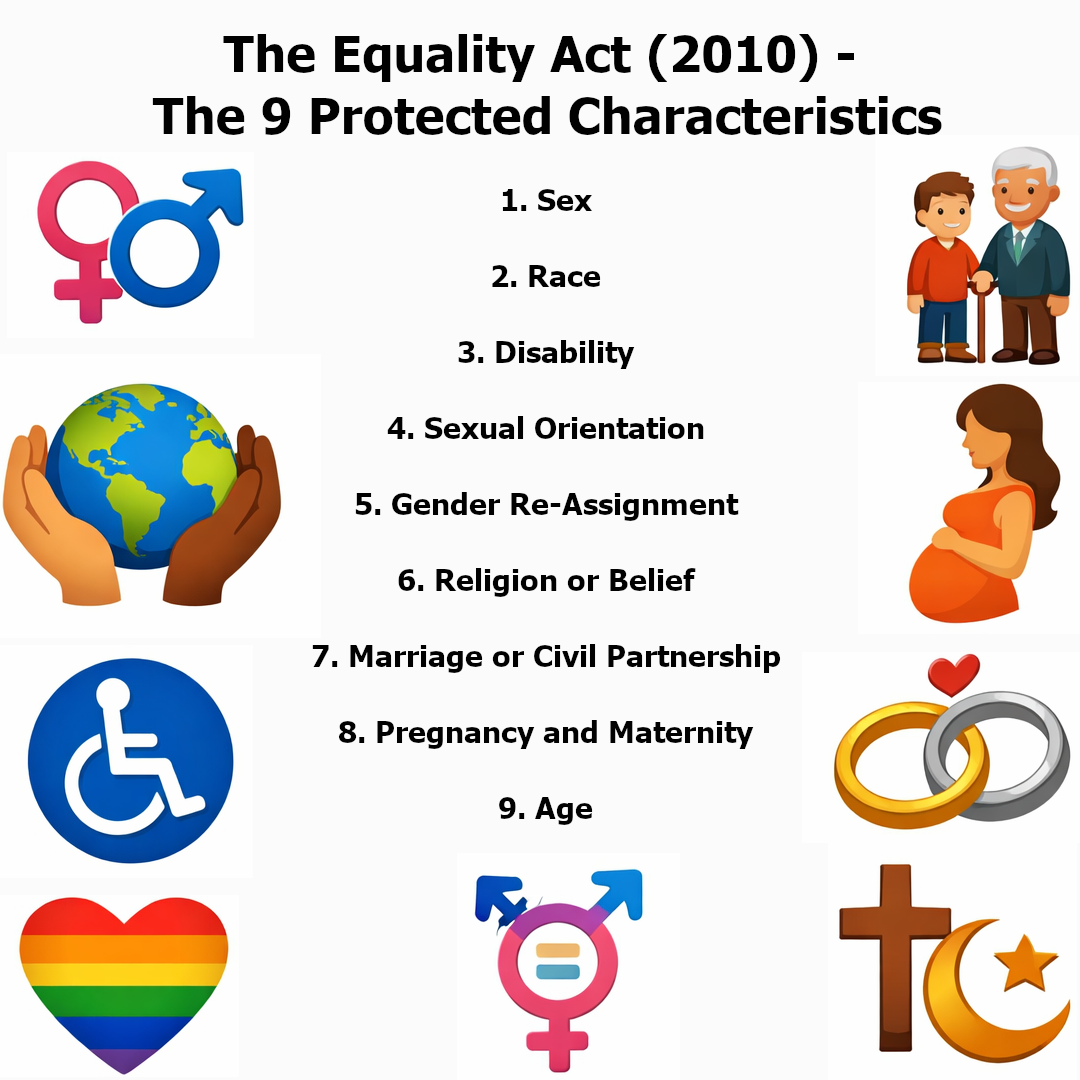
The Equality Act (2010) starts by outlining the 9 protected characteristics:
Sex
Race
Disability
Sexual Orientation
Gender Re-Assignment
Religion or Belief
Marriage or Civil Partnership
Pregnancy and Maternity
Age
Next the act goes on to define what is prohibited, including:
Direct discrimination of anybody with a protected characteristic.
Indirect discrimination of anybody with a protected characteristic.
Harassment of anybody with a protected characteristic.
Victimisation of anybody with a protected characteristic.
Equality Act (2010) applies to all public organisations, all private organisations and all third sector organisations, making it all encompassing.
It covers accessing or buying services, buying of products, all education establishments, the NHS, Social Care (plus all other local authority services), employment (all aspects) and pensions.
It places a responsibility on all organisations to make reasonable adjustments for anybody with a protected characteristic and outlines the potential legal consequences for not adhering to this legislation.
I am choosing to write about the Equality Act (2010) now because a certain right-wing political party is planning to abolish this Act and the legal protections it provides if the party gets into power. Scarily, this political party appears to be getting increasingly popular with every day that passes. It is looking like this political party might get into power at the next general election.
So I thought I would use this platform to explain what the Act offers and hopefully help people realise why it is important for every one. Regardless of whether you have a protected characteristic or not.
This is the second blog post in a series titled Wonderful Websites. The first post focused on General Health websites and can be read here. This post focuses on the most wonderful websites for mental health and mental illness.
1. Mind’s website is a treasure trove of mental health and mental illness information. It has an A-Z listing of mental health conditions, information about treatments, advice on how to support someone with mental illness, legal advice, urgent help advice and stories of people with mental illness.
CALM offers support for men who are feeling low or in crisis. They campaign for a change in culture, encouraging men to talk about how they are feeling and aim to eliminate the stigma of men seeking help due to mental illness. They hope to prevent as many male suicides as possible and also offer support for those affected by suicide.
3. SANE is a mental health charity credited with the Black Dog Campaign and the #EndTheStigma hashtag. The phrase black dog comes from Winston Churchill who described his depression as a black dog. SANE has also worked with Ruby Wax who coined the term Black Dog Tribe.
4. Head Meds tells you everything you ever wanted to know about medications for mental illness. It also gives information about conditions and shares people stories of mental illness. What I particularly like about this website is that it tells you how the medications affect sex, alcohol, weight, sleep and just about everything else.
A useful website that I always visit before medication reviews or at times when there’s discussions about changing my medication.
5. Bipolar UK has a great online eCommunity. I use it all the time and find it a very useful resource. People on the eCommunity are friendly and share their experiences around a wide range of topics.
The eCommunity goes a long way to making you feel less isolated and reassures you that you’re not the only one to be experiencing what you are. They also have support groups that are run by volunteers who are people living with bipolar. I used to go to a local group before it shutdown and found it invaluable on my road to recovery.
6. The Samaritans offer support by telephone, in person, email or by writing to them. Their telephone number and email is open 24/7/365, being a lifeline to people in a mental illness crisis.
7. Time To Change aims to end mental health discrimination. They do so by education in schools and by supporting employers. They have a wealth of information online including myths/facts, conditions, how to support your friend and a quiz to test your knowledge on mental health.
8. The Mental Health Foundation’s website has some informative publications which you can download or order a printed copy. Their vision is for everyone in the UK to have good mental health.
9. Anxiety UK has been around since the 70s and provides a wide range resources around anxiety. It’s website is informative, they offer an info line, a text service and training to organisations and companies.
Are there any wonderful websites for mental health and mental illness that I’m missing? If so, please leave a comment.
In the next post in my Wonderful Websites series I’ll be listing shopping websites.
Blog soon,
Antony
Support
I recognise that people visiting this page/post might want to know where they can get support. If you require support around your mental health, addiction or physical health, see this Support page here.
Here are some of the most difficult questions in life, along with my current partial answers to them. None of these complex questions have simple answers. If you have a better answer than the one I have, or would like to share your answer to these questions, please leave a comment below.
Who am I?
Who I am is fluid rather than fixed and changes constantly. It encompasses my thoughts, feelings, intentions, actions, omissions, behaviours and my soul. Who I am changes as quickly as each encompassed element can change.
What is consciousness?
Consciousness is a result of billions of neurons in the brain firing electrical signals to other neurons. Our body allows us to sense the world (through taste, sight, touch, smell, sound and psychic intuition) and then create thoughts and feelings based on the now, memory and past experiences, dreams and hopes for the future.
What’s the meaning of life?
I have no idea what the meaning of life is. But I’ve got a feeling that it’s different for every life. I do know that you should decide on the purpose or ideally purposes of your life.
Purposes may include: dedication to family/friends, goals/achievements of your own, contribution to the wellbeing of others, learning/studying/growth, to create or destroy, to consume and enjoy, to travel, to adventure and experience, to improve humanity, to love, the list goes on and on.
Where does creativity come from?
Perhaps the question should read: what inspires creativity? A large number of things can inspire creativity, including: nature, research, other people’s creative works (art, music, literature, sculpture, etc.), curiosity, questions, past experiences, daily life, failures, logic/illogic, other people’s ideas, emotions, procrastination, through play, again the list goes on and on.
Does God exist?
Pagans are polytheistic, meaning that they worship many Gods and Goddesses. I personally believe that these Gods and Goddesses represent humanistic aspects of a Divine Energy.
This Divine Energy is infinitely complex and incomprehensible by the limited human mind. This Divine Energy is within everything that ever was, is and will ever be. It is timeless, interconnects everything and keeps the universe in balance through constant creation, change and destruction.
Why do bad things happen to good people?
We all have a sense of fair play. When we see bad things happen to good people, we notice it as it feels unfair. We notice it more because the person is a good person. But life events are simply what they are.
Sometimes bad things appear at random and sometimes they are methodological. They can be difficult to accept and it is normal to feel a sense of injustice and unfairness.
Reframing your thoughts to acknowledge that bad things happen regardless of whether a person is good or not is a way to balance your thinking. It is also useful in breaking the association between behaviours (being a good person) and negative life events (the bad things).
What happens after we die?
The cells, tissues and organs in your body die (necrosis). Your body decays until the point that only your skeleton is left (skeletonisation).
But when most people ask this question, they are referring to what happens to the soul after death. Well most believe in heaven or an afterlife of some sort. Others believe in reincarnation (being reborn as another person, animal or plant).
I personally believe in both an afterlife and reincarnation. I think that your soul is energy and is released from your body on your death. It travels to another plane of existence (the astral plane).
The astral plane is like an afterlife but not like a traditional version of heaven. You are reunited with other souls that you have known (possibly over several lifetimes and the times in-between). You have the choice of if and when (although there is no concept of time in this place) you want to be reincarnated.
The purpose of being reincarnated is so that you can grow as a soul, but also so you can do some of the things that only physical entities can do (such as enjoy food, music, dance, sex).
What is love?
Poets, Writers, Musicians and Artists have all been exploring what love is and how it is expressed since humans were first able to feel and think. I think any type of love starts with vulnerability, connection and intimacy. From there it grows into trust, warmth and attachment.
For me there are different types of love:
Love shared with friends. Familiarity, shared interests, shared values and loyalty.
Love shared with family. Familiarity, growing together, mutual respect and unconditional acceptance.
Love shared with a lover. Romance, possibility, comfort, sensuality and sex. (I should note here that I am single.)
Unexpressed love. Fantasy, a crush, desire and longing.
Have I met Mr/Mrs Right?
How the heck should I know? But I would ask yourself: Does he/she make you laugh? Can you tell them anything? Does he/she build you up and support you? Does he/she add something to your life? Does he/she have their own life, with their own friends, dreams and ambitions? What do your friends and family honestly think about them and you as a couple?
Hopefully answering these questions will give you more insight.
Can love last a lifetime?
Yes. As long as both partners continue to grow independently as well as growing together. And as long as they continue to love one another. I believe love can last, not just a lifetime, but into the afterlife and beyond.
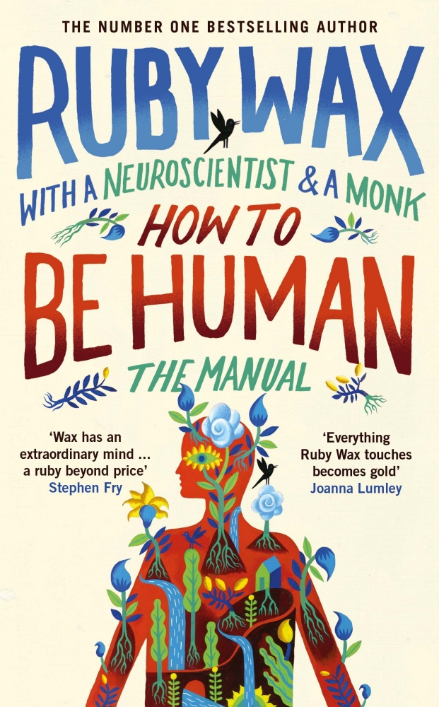
Ruby Wax’s latest book is called How To Be Human – The Manual. It’s insightful, funny, warm and engaging. A pleasure to read. It’s like somebody is pouring wisdom into your head while you’re having a chat with them.
Each chapter covers a topic and is wittily written by Wax. For each chapter Wax has consulted with Ash Ranpura, a Neuroscientist and Gelong Thubten, a Buddhist Monk.
At the end of each chapter are fascinating transcripts of these discussions.
Interspersed throughout How To Be Human Wax shares some of her own mental illness story.
So what exactly does Wax cover in How To Be Human? Pretty much everything. Here is each chapter title: