harassment

The Equality Act (2010) Explained
Reading Time: 2 minutes
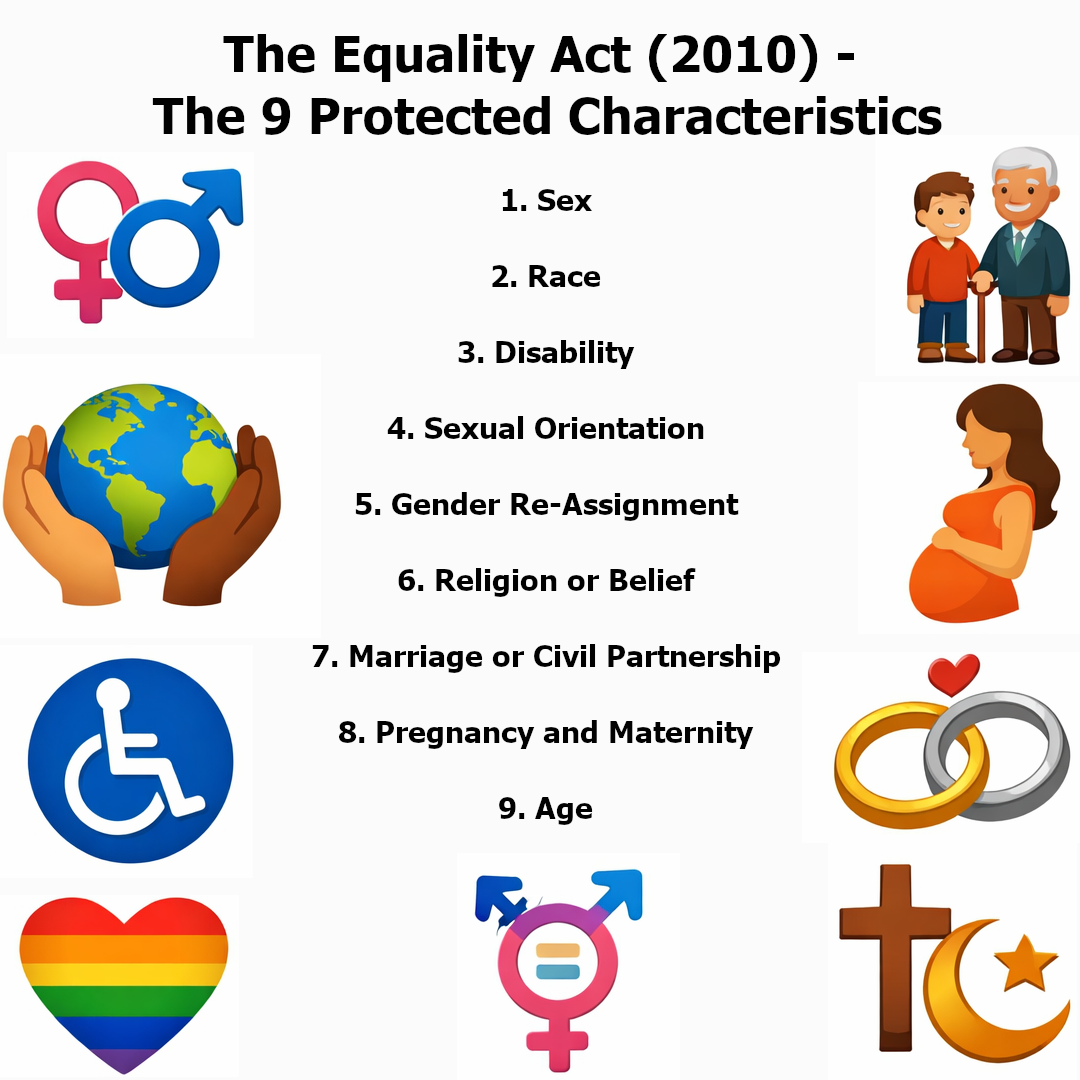
Click on image for full-size.

The Equality Act (2010) is a UK law that is intended to protect people from discrimination, harassment and victimisation.

This is to ensure that everyone is treated with dignity and respect.

The Equality Act (2010) is about ensuring equality and fair treatment for all.

Before the Equality Act (2010) there were more than 100 pieces of other legislation that included details around protecting people from discrimination, harassment and victimisation.

The Equality Act (2010) starts by outlining the 9 protected characteristics:

  1. Sex
  2. Race
  3. Disability
  4. Sexual Orientation
  5. Gender Re-Assignment
  6. Religion or Belief
  7. Marriage or Civil Partnership
  8. Pregnancy and Maternity
  9. Age

Next the act goes on to define what is prohibited, including:

  • Direct discrimination of anybody with a protected characteristic.
  • Indirect discrimination of anybody with a protected characteristic.
  • Harassment of anybody with a protected characteristic.
  • Victimisation of anybody with a protected characteristic.

Equality Act (2010) applies to all public organisations, all private organisations and all third sector organisations, making it all encompassing.

It covers accessing or buying services, buying of products, all education establishments, the NHS, Social Care (plus all other local authority services), employment (all aspects) and pensions.

It places a responsibility on all organisations to make reasonable adjustments for anybody with a protected characteristic and outlines the potential legal consequences for not adhering to this legislation.

I am choosing to write about the Equality Act (2010) now because a certain right-wing political party is planning to abolish this Act and the legal protections it provides if the party gets into power. Scarily, this political party appears to be getting increasingly popular with every day that passes. It is looking like this political party might get into power at the next general election.

So I thought I would use this platform to explain what the Act offers and hopefully help people realise why it is important for every one. Regardless of whether you have a protected characteristic or not.

If you enjoyed this blog post, you might also like my post The Human Rights Act (1998) Explained.

Write soon,

Antony
Share on Social Media:
Gay, Political, Thinking, , , , , , , , , , , , , , , , , , , , , , , , , , , , , , , , ,

Lesbian, Gay, Bisexual and Trans (LGBT) People in Employment Today

Reading Time: 3 minutesLesbian, Gay, Bisexual and Trans (LGBT) people in employment today have more acceptance and more equality than ever before. But have we reached a point were a persons sexuality isn’t important? Were their ability to do the job is paramount?

In this blog post I will discuss an article entitled Why it’s still not ‘Mission Accomplished’ for LGBT workers by Matthew Todd for Totaljobs. First the positives:

total-jobs-LGBT-Rights-1
LGBT people have more acceptance and equality today, than ever before.
Image from & copyright Total Jobs @ GIPHY.

LGBT people in employment today have more acceptance and more equality than ever before. This has been helped by the wider society acceptance. It has also been helped by employers working with organisations such as Stonewall to learn and understand LGBT employees and to have more inclusive working practices.

total-jobs-LGBT-Rights-2
Employers are working with organisations like Stonewall to understand LGBT people and have better working practices to include LGBT employees.
Image from & copyright Total Jobs @ GIPHY.

But for good and smart employers it’s about more than just acceptance and inclusion. It’s about valuing employees as individuals and celebrating the diversity of their workforce. This in turn increases productivity and leads to better outcomes (including bigger profit margins for private sector organisations) according to research studies quoted in this BBC article: Why it’s important to be yourself at work and this Infographic.

So acceptance, inclusion, valuing employees as individuals and celebrating diversity of LGBT employees is a win-win situation. Employees are happier and feel more secure. Employers get increased productivity and better outcomes.

total-jobs-LGBT-Rights-3
Acceptance, inclusion, valuing employees as individuals and celebrating diversity of LGBT employees is a win-win situation.
Image from & copyright Total Jobs @ GIPHY.

But according to Todd it’s not all positive. He cites surveys that report that some LGBT people still experience bullying and/or harassment at work and that some LGBT people feel that some workplaces have been/are unwelcoming.

I can only speak of my own experiences. My experiences of being an LGBT person in employment has been very positive for the fast majority of the time.

But I have experienced bullying and harassment because of my sexuality and/or gender (as a Nurse who happens to be male). Three or four times in my career, which for me is three or four times too many. Each time by an individual employee and each time I felt unable to challenge their attitude or behaviour because of the situation I was in.

Still I have observed a massive change in attitudes and cultures both in the workplace and outside of it during my career. I think that if someone attempted to bully or harass me in the workplace today, that one of my colleagues would challenge it before I had chance to.

What do you think of Lesbian, Gay, Bisexual and Trans (LGBT) people in employment today? Please leave a comment below.

Blog soon,

Antony


I aim for posts on this blog to be informative, educational and entertaining. If you have found this post useful or enjoyable, please consider making a contribution by Paypal:


Share on Social Media:
Gay, Life, , , , , , , , , , , , , , , , , , , , ,
Scroll to Top
×