Local Authories

The Equality Act (2010) Explained
Reading Time: 2 minutes
Click on image for full-size.

The Equality Act (2010) is a UK law that is intended to protect people from discrimination, harassment and victimisation.

This is to ensure that everyone is treated with dignity and respect.

The Equality Act (2010) is about ensuring equality and fair treatment for all.

Before the Equality Act (2010) there were more than 100 pieces of other legislation that included details around protecting people from discrimination, harassment and victimisation.

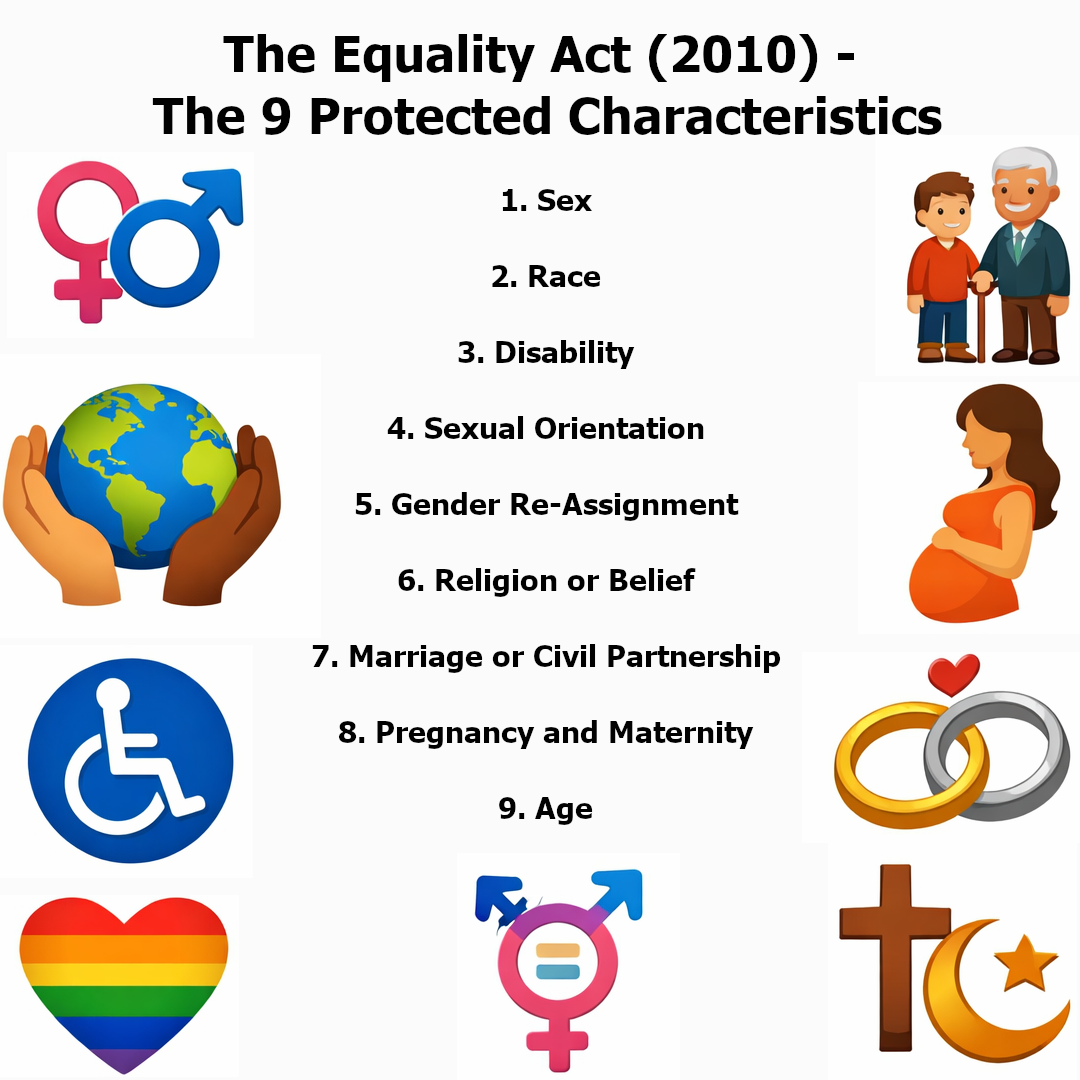
The Equality Act (2010) starts by outlining the 9 protected characteristics:

  1. Sex
  2. Race
  3. Disability
  4. Sexual Orientation
  5. Gender Re-Assignment
  6. Religion or Belief
  7. Marriage or Civil Partnership
  8. Pregnancy and Maternity
  9. Age

Next the act goes on to define what is prohibited, including:

  • Direct discrimination of anybody with a protected characteristic.
  • Indirect discrimination of anybody with a protected characteristic.
  • Harassment of anybody with a protected characteristic.
  • Victimisation of anybody with a protected characteristic.

Equality Act (2010) applies to all public organisations, all private organisations and all third sector organisations, making it all encompassing.

It covers accessing or buying services, buying of products, all education establishments, the NHS, Social Care (plus all other local authority services), employment (all aspects) and pensions.

It places a responsibility on all organisations to make reasonable adjustments for anybody with a protected characteristic and outlines the potential legal consequences for not adhering to this legislation.

I am choosing to write about the Equality Act (2010) now because a certain right-wing political party is planning to abolish this Act and the legal protections it provides if the party gets into power. Scarily, this political party appears to be getting increasingly popular with every day that passes. It is looking like this political party might get into power at the next general election.

So I thought I would use this platform to explain what the Act offers and hopefully help people realise why it is important for every one. Regardless of whether you have a protected characteristic or not.

If you enjoyed this blog post, you might also like my post The Human Rights Act (1998) Explained.

Write soon,

Antony
Share on Social Media:
Gay, Political, Thinking, , , , , , , , , , , , , , , , , , , , , , , , , , , , , , , , ,

Wonderful Websites – General Health

Reading Time: 2 minutes

wonderful-websites-image This is the first blog post in a series titled Wonderful Websites. This post focuses on the most wonderful websites for general health.

1. NHS Choices is crammed with health information. Information on health conditions, treatments, medications, public health issues, carers right, services, practically everything you could ever want to know about health and healthcare in the UK. Delivered by the NHS you can be assured of correct information that is up to date and based on research and evidence.

It has some great online tools such as: BMI Calculator, Mood self-assessment, Sleep self-assessment and many more.

2. Patient.info has a A-Z list of articles written by doctors, information videos, a symptom checker and an active online community. On more than one occasion while at work in the NHS, I’ve seen doctors checking this valuable website.

3. NetDoctor is similar to Patient.Info, but with more of a focus on healthy living and healthy eating.

4. eMC (Medicines.org.uk) is a useful website for looking up information about medicines.

I use British National Formulary (BNF) but the medical terminology can be difficult for some from a non-medical/non-nursing background to understand; this is why eMC made it on this list instead of the BNF.

5. Office of National Statistics – Health and Social Care is the best place to find statistical information about health. It is regularly updated based on data from the NHS, Local Authories and other Government Departments.

6. National Institute of Clinical Excellence (NICE) provides pathways, guidelines and advice across the UK for best possible evidence-based healthcare. The guidance they provide is developed by groups of clinical experts who provide experience of what works in practice and by examining and analysing research.

If you want to know what care you or a relative or friend should be receiving and check that it’s high quality visit NICE’s website.

7. Health For Teens I found while doing research for this post. It’s specifically aimed at teenagers and looks appealing. They even create content in consultation with young people. I think the name of the website maybe off-putting to young people though – but this is just my personal opinion.

Are there any health websites that you think are useful that aren’t on the list? If so leave a comment below and let me know.

The next post in the Wonderful Websites series will look at websites for mental health and mental illness.

Write soon,

Antony

mental-health-wisdom-banner


I aim for posts on this blog to be informative, educational and entertaining. If you have found this post useful or enjoyable, please consider making a contribution by Paypal:


Share on Social Media:
Health, The Web, , , , , , , , , , , , , , , , , , , , , , , , , , , ,
Scroll to Top
×