equality and diversity

The Equality Act (2010) Explained
Reading Time: 2 minutes
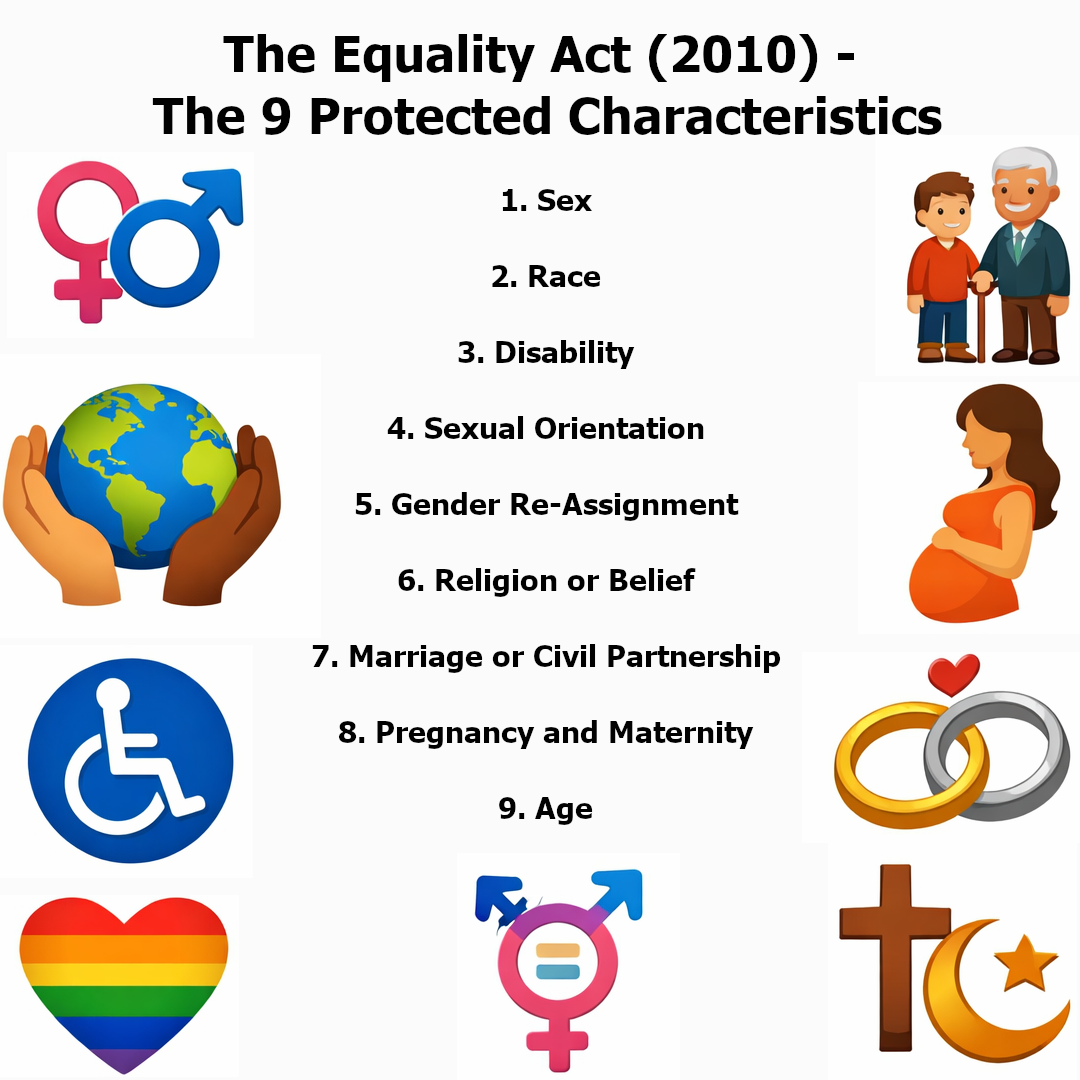
Click on image for full-size.

The Equality Act (2010) is a UK law that is intended to protect people from discrimination, harassment and victimisation.

This is to ensure that everyone is treated with dignity and respect.

The Equality Act (2010) is about ensuring equality and fair treatment for all.

Before the Equality Act (2010) there were more than 100 pieces of other legislation that included details around protecting people from discrimination, harassment and victimisation.

The Equality Act (2010) starts by outlining the 9 protected characteristics:

  1. Sex
  2. Race
  3. Disability
  4. Sexual Orientation
  5. Gender Re-Assignment
  6. Religion or Belief
  7. Marriage or Civil Partnership
  8. Pregnancy and Maternity
  9. Age

Next the act goes on to define what is prohibited, including:

  • Direct discrimination of anybody with a protected characteristic.
  • Indirect discrimination of anybody with a protected characteristic.
  • Harassment of anybody with a protected characteristic.
  • Victimisation of anybody with a protected characteristic.

Equality Act (2010) applies to all public organisations, all private organisations and all third sector organisations, making it all encompassing.

It covers accessing or buying services, buying of products, all education establishments, the NHS, Social Care (plus all other local authority services), employment (all aspects) and pensions.

It places a responsibility on all organisations to make reasonable adjustments for anybody with a protected characteristic and outlines the potential legal consequences for not adhering to this legislation.

I am choosing to write about the Equality Act (2010) now because a certain right-wing political party is planning to abolish this Act and the legal protections it provides if the party gets into power. Scarily, this political party appears to be getting increasingly popular with every day that passes. It is looking like this political party might get into power at the next general election.

So I thought I would use this platform to explain what the Act offers and hopefully help people realise why it is important for every one. Regardless of whether you have a protected characteristic or not.

If you enjoyed this blog post, you might also like my post The Human Rights Act (1998) Explained.

Write soon,

Antony
Share on Social Media:
Gay, Political, Thinking, , , , , , , , , , , , , , , , , , , , , , , , , , , , , , , , ,

Supergays Around The World – A Truly Inspirational TED Talk Video

Reading Time: < 1 minute

Hi all,

I want to share with you this truly inspirational TED Talk video about Supergays around the world. This video shows positively what life is like for LGBT people around the world. Enjoy and be inspired:

Click here to display content from TED.
Learn more in TED’s privacy policy.


Blog soon,

Antony


I aim for posts on this blog to be informative, educational and entertaining. If you have found this post useful or enjoyable, please consider making a contribution by Paypal:


Share on Social Media:
Gay, Happiness & Joy, Inspiration, Life, Love & Relationships, , , , , , , , , , , , , , , , , ,

A List of Qualities in People that INSPIRE Me

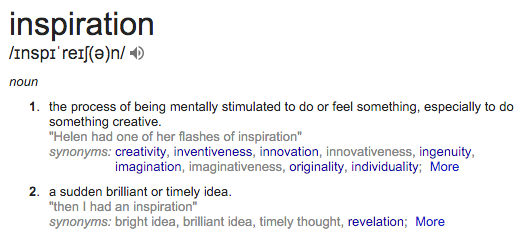
Reading Time: 2 minutesAccording to Google inspiration is defined as:

inspiration-definition
Google’s Definition of Inspiration

Back in 2008, I wrote a blog post about People that inspire me. I could add so many people to that blog post.

But instead I decided to look at the qualities in people that inspire me. Here’s my list of qualities that those people display:

  • Accepting.
  • Authentic.
  • Balanced in their thinking.
  • Battle their inner demons.
  • Believe in fairness and equality.
  • Brings joy to others.
  • Can have a presence on entering a room or blend into the background in social situations.
  • Captivating Story Teller.
  • Careful in their actions.
  • Cares about others.
  • Comfortable with themselves.
  • Confident yet humble.
  • Connects emotionally with others.
  • Creative.
  • Describes their own thoughts & feelings through words well.
  • Determined.
  • Diplomatic.
  • Dislikes injustice.
  • Empathetic.
  • Enthusiastic.
  • Flawed.
  • Funny.
  • Generous.
  • Good communicator.
  • Has others following them.
  • Honesty.
  • Humorous.
  • Independent.
  • Influences others.
  • Intelligent.
  • Is a Collaborator.
  • Is a Doer.
  • Is a Dreamer.
  • Is Grateful.
  • Kindness.
  • Knows when, who and why to ask for help.
  • Makes others feel comfortable.
  • Makes others laugh.
  • Motivational.
  • Non-judgemental.
  • Occasional vulnerable.
  • One-step ahead of others.
  • Open minded.
  • Optimistic.
  • Passionate.
  • Patient.
  • Positive.
  • Relaxed in new situations.
  • Self-aware.
  • Sensitive.
  • Shares their Knowledge and wisdom.
  • Sincere.
  • Stands up for the rights of others.
  • Supports & helps others.
  • Unconventional.
  • Values community.
  • Vibrant.
  • Wants a better society for all.
  • Wants others to reach their potential.
  • Willing to fight for a cause.
  • Wise.
  • Works hard.

I’m sure there’s many other qualities that could be added to the list. I also know that as well as people, many other things inspire me. Things such as music, books, films, paintings, nature, animals and expressions of love to name but a few.

What qualities do you admire in the people that inspire you? Feel free to share by leaving a comment below.

Blog soon,

Antony

mental-health-wisdom-banner


I aim for posts on this blog to be informative, educational and entertaining. If you have found this post useful or enjoyable, please consider making a contribution by Paypal:


Share on Social Media:
Inspiration, Life, Thinking, , , , , , , , , , , , , , , , , , , , , , , , , , , , , , , , , , , , , , , , , , , , , , , , , , , , , , , , , , , , , , , , , , , , , , , , , , , , , , , , ,

Book Review: Family Pride by Michael Shelton

Reading Time: 2 minutes

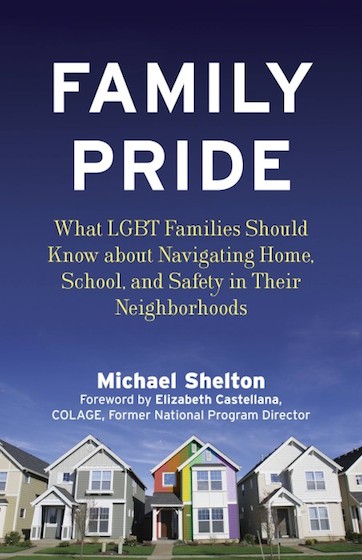
Family Pride Michael Shelton Book Cover Family Pride by Michael Shelton is written like a research article and has an extensive list reference list. Shelton highlights early on that there is a lack of representation of ethic minorities and economically disadvantaged LGBT families in the research. The book is clearly structured and styled as an educational textbook. No definition of an LGBT family is made or attempted; probably because LGBT families are so diverse in their make up and scope. Just like ‘straight’ families.

Shelton interviewed some LGBT parents and even some of their children from across America for this book. I would have enjoyed reading more of these interviews; particularly around their coping strategies for dealing with homophobia, perceived hertrosexism and subtle prejudices. I would have enjoyed reading about these LGBT families hopes for the future.

Family Pride starts with an introduction, explaining the history of gay rights movement and the extreme rightwing (anti-gay) response to this agenda. How the progress of gay rights movement has had an unintended backlash on LGBT families and put many of them in the spotlight in their communities.

I should point out, at this point, that this book is completely Americanised and lacks any international perspective. However many of the issues faced by LGBT families in America will apply to LGBT families in the UK.

Then Family Pride gives a comprehensive review of the issues LGBT families face including:

  • Internalised homophobia.
  • Stages of coming out as an LGBT to children, families and the community.
  • The facade of the perfect family.
  • Issues in schools such as the other same-sex parent not being recognised and bullying of the children by other children (and potentially some of the school staff).
  • Access and engagement with physical and mental health services.
  • The ability to access and enjoy leisure activities (including the all American Summer Camps).
  • Religious Institutions.
  • and the Police & Legal System.

In the conclusion there’s a small section dedicated to how to improve attitudes and acceptance of LGBT families, which will enable better community integration and to give LGBT families a sense of belonging.

Overall Family Pride has good, evidenced-based content. The writing style could have been more engaging and I felt that Shelton over-explained his point at times. This book is ideal for Students or Practitioners in the disciplines of Social Work, Nursing, Mental Health, Youth Work, Housing, the Police, Prison Officers and other public service institutions. It will give Students and Practitioners an awareness of the issues LGBT families face with accessing and engaging with institutions in a way that is dignified, respected and valued.

Family Pride by Michael Shelton is available to buy on Amazon.

I recently interviewed two LGBT parents for The Gay UK; so you might like to read FEATURE: Coming Out to The Kids – Paul’s Story and FEATURE: Coming Out to The Kids – Linda’s Story.

Review soon,

Antony

mental-health-wisdom-banner

Share on Social Media:
Amazon, Books & Authors, Gigs & Shows, Reviews, , , , , , , , , , , , , , , , , , , , , , , , , , , , , , , , , , , ,
Scroll to Top
×