relationships

The 7 Love Languages Theory by Dr Gary Chapman

Reading Time: 3 minutes

Dr Gary Chapman is an American Minister who came up with The 7 Love Languages Theory.

Dr Chapman theorised that we all have 1 or 2 ways in which we show our love to others and that we prefer others to show their love for us in these same ways.

Dr Chapman called these expressions of love ‘languages’ and suggested that there are 7 of these love languages:

The 7 Love Languages

  1. Words of Affirmation.
  2. Quality Time.
  3. Receiving Gifts.
  4. Acts of Service.
  5. Physical Touch.
  6. Shared Experiences.
  7. Emotional Security.

It should be noted here that Dr Chapman originally suggested only the first 5 love languages, adding the 6th & 7th love languages later.

Dr Chapman theorised that when couples have difficulties in their relationship it is because they are expressing their love for one another in their own preferred love language, rather than the language that their partner prefers. Let’s look at these love languages in more detail:

1. Words of Affirmation

People who prefer the words of affirmation love language want their partner to compliment them, praise them and say positive things about them and their relationship to them regularly. They value words and what is said or written over actions.

2. Quality Time

People who prefer this love language want to complete activities and share experiences with their partner often. If they perceive that a partner is giving too much of their attention and time to others or to working, their partner may feel neglected or unloved.
3. Receiving Gifts

People who prefer the receiving gifts love language, like presents, but that doesn’t mean that they are materialistic. Often these people don’t care about the cost of the gifts. It’s more about their partner thinking of them, appreciating them and providing evidence through a small gift.

4. Acts of Service

Acts of Service always reminds me of the saying: Actions speak louder than words. People who prefer this love language will complete selfless acts of service to demonstrate their love for a partner and want their partner to do the same for them.

5. Physical Touch

People who prefer this love language require regular physical contact with their partner to express their love and in return feel loved. Physical touch is not about intimacy or sex, but instead any sort of physical contact with their partner. Such as: holding hands, hugs, resting their hand of their partner’s leg and kissing.

6. Shared Experiences

For people who have shared experiences as their preferred love language, they must engage in regular activities, experiences and adventures that are fully shared with their partner in order to express their love and to feel loved by their partner. People who prefer this love language will always be planning their next shared experience with their partner.

7. Emotional Security

For people who prefer the emotional security love language, they show and feel loved if they and their partner feel safe, can fully trust one another and are given reassurance when required. For these people, how they feel is extremely important and they value honesty and kindness greatly.

Conclusion

Dr Chapman’s love languages theory is worth knowing about. It could be used to navigate some difficulties in some relationships. It could even be used to strengthen some relationships. But Dr Chapman’s theory doesn’t consider external factors that could cause difficulties in a relationship. Two things are clear: Both people and relationships are complex and multifaceted.
Blog soon,

Antony

I write about love, in all its forms, and how it contributes to people’s happiness in my book FINDING YOUR HAPPINESS:
Share on Social Media:
Love & Relationships, , , , , , , , ,

Relationship Red Flags

Reading Time: < 1 minute

I’ve been thinking a lot about romantic relationships recently.

Relationships can be complex. Having two (or more) individuals each with their own wants, needs and desires requires good communication to navigate the labyrinth of potential issues.

I am famously single, due to the fact I grew up around abusive relationships.

But here are some red flags that would make me run for the hills:

  • Manipulation – Getting you to think or feel a certain way. Particularly negative thoughts or feelings such as feeling inadequate, guilty, shame or fearful.
  • Any sort of Unjustified Blame.
  • Controlling behaviour – Getting you to act in a way that suits the other. This includes not allowing you to spend money or wear certain clothes.
  • Disrespect – Including put downs or insults.
  • Oppression – Preventing an individual from expressing opinions or views.
  • Any sort of abuse – Physical or verbal. Nobody has a right to abuse another.
  • Using Sex, Money or Anything Else to alter the power balance in an individual’s favour. This includes denial unless an individual complies with what the other wants.
  • A lack of anything positive – A relationship should help you to grow as a person and this requires support and positivity.
  • Alcohol or Drug use – Usually to mask historic trauma. The individual part taking in these behaviours needs to address the trauma and begin to heal
  • Isolating – You from family and friends.
  • Too Serious, Too Soon- Wanting to move in, get joint bank accounts, etc early on in the relationship.
  • Wanting to spend every waking minute with you.
  • Excessive jealousy.

Blog soon,

Antony

mental-health-wisdom-banner
Share on Social Media:
Love & Relationships, Thinking,

The Healthy Relationship Checklist

Reading Time: 5 minutes
relationship-gender-symbols
Relationship Gender Symbols. Copyright © Antony Simpson, 2018.

How do you know if you’re in a healthy relationship or not?

Find out more below.

If you are in a healthy relationship you should tick most of the boxes on the checklist below:
Unticked Box You can do things independently, without getting a hard time from your partner. You can explore interests, have hobbies, etc.
Unticked Box You can communicate openly and honestly with your partner without negative judgement or fear.
Unticked Box You never have to hide anything from your partner.
Unticked Box You get support from your partner when you are vulnerable.
Unticked Box Your partner encourages and supports you in everything that you do.
Unticked Box You have shared your dreams and hopes with your partner.
Unticked Box You and your partner have shared ambitions for your life together.
Unticked Box You feel safe: physically, mentally and emotionally.
Unticked Box You have regular contact with friends and family members.
Unticked Box Your partner never makes you feel bad for spending time with others.
Unticked Box Your partner always shows you respect.
Unticked Box You and your partner laugh together.
Unticked Box You and your partner listen to one another.
Unticked Box You and your partner both approach the relationship as a learning experience.
Unticked Box Your relationship adds something to both you and your partner’s life.
Unticked Box Your partner speaks to you with kindness.
Unticked Box Your friends and family honestly think your relationship is a healthy one.
Unticked Box Your relationship started with vulnerability, connection and intimacy.
Unticked Box You would use these words to describe your relationship: trust, warmth and attachment.
Unticked Box Your partner never belittles you.
Unticked Box Neither your partner or yourself displays contempt for the other. No eye rolling. No squinting at them as if to say what are you talking about?
Unticked Box You don’t feel controlled or manipulated.
Unticked Box Your partner is never aggressive or violent towards anyone or anything. This includes: you, any children and any pets or animals.
Unticked Box Your partner knows where the line is and doesn’t cross it. Either accidentally or purposefully.
Unticked Box You feel equal to your partner in the relationship.
Unticked Box You like the way you grown and changed while you’ve been in the relationship.
Unticked Box You and your partner express appreciation and admiration for one another.
Unticked Box You have fun together.
Unticked Box Your partner offers comfort, love and support when you’re upset, stressed or fearful.
Unticked Box You make decisions jointly.
Unticked Box You are intimate. By intimate I mean hugs, cuddles, kisses, holding hands, being close to one another and sex.
Unticked Box You and your partner don’t argue constantly.
Unticked Box Your partner loves and likes you when you look and feel at your worst.
Unticked Box Your family and friends like your partner.

If you think or feel that you maybe in an unhealthy or abusive relationship, the following websites have useful information on:

Blog soon,

Antony

More Content From Antony

Here are the books that Antony has published:

Share on Social Media:
Love & Relationships, Thinking, , , , , , , , , , , , , , , , , , , , , , , , , , , , , , , , , , , , , , , , ,

Book Review: How To Be Human – The Manual by Ruby Wax

Reading Time: < 1 minute

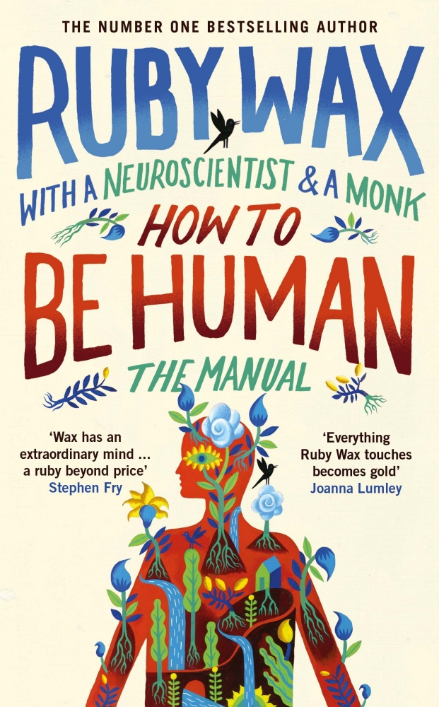
Ruby Wax’s latest book is called How To Be Human – The Manual. It’s insightful, funny, warm and engaging. A pleasure to read. It’s like somebody is pouring wisdom into your head while you’re having a chat with them.

Each chapter covers a topic and is wittily written by Wax. For each chapter Wax has consulted with Ash Ranpura, a Neuroscientist and Gelong Thubten, a Buddhist Monk.

At the end of each chapter are fascinating transcripts of these discussions.

Interspersed throughout How To Be Human Wax shares some of her own mental illness story.

So what exactly does Wax cover in How To Be Human? Pretty much everything. Here is each chapter title:

  • Evolution
  • Thoughts
  • Emotions
  • The Body
  • Compassion
  • Relationships
  • Sex
  • Kids
  • Addiction
  • The Future
  • Mindfulness Exercises
  • Forgiveness

How To Be Human builds on the strong foundations of Wax’s two previously published books: Sane New World – Taming the Mind, which I have reviewed here and A Mindfulness Guide for the Frazzled, which I have reviewed here.

You can also learn more about Wax by reading her autobiography How Do You Want Me?, which I have reviewed here.

How To Be Human is available to buy on Amazon and at all good book shops.

Review soon,

Antony

mental-health-wisdom-banner
Share on Social Media:
Amazon, Books & Authors, Reviews, , , , , , , , , , , , , , , , , , , , , , , , , , , , , ,
Scroll to Top
×