Health

Let Me Explain About The Monetising

Reading Time: 3 minutes

Let me explain about the monetising…

Dear Reader,

I have always used my website/blog to share my great free content and promote my brilliant paid content. My paid content consisting of: my books, articles and short stories.

But I have recently added a Support Antony page, listing all the ways you can support me and my creative works. I wanted to take a moment of your time to explain.

6 Months of Vasculitis HELL!

A couple of years ago, I was diagnosed with a progressive and life shortening disease called Vasculitis:

Vasculitis is the name of a group of conditions that cause inflammation of the blood vessels.

Inflammation is your immune system’s natural response to injury or infection. It causes swelling and can help the body deal with invading germs.

But in vasculitis, for some reason the immune system attacks healthy blood vessels, causing them to become swollen and narrow.
(Quote from: NHS, 2023)

There’s no other way for me to describe the last 6 months, than being Vasculitis Hell. I’ve had several flare ups and an 8 week nasal infection that was resistant to a number of different antibiotics.

During this time, my Vasculitis Fatigue has gotten significantly worse. I am told by the specialist team caring for me, that although the fatigue will fluctuate from day-to-day, it isn’t going to get any better. That it will be ever present, regardless of whether I am in an active flare up or in remission.

Throughout this time, I’ve worked full time (40 hours per week), plus travel time (10 hours per week). I’ve even managed to maintain some regular blog posting and promoting of my books. I’ve also just about managed to maintain the basics – eating, bathing and sleeping.

But my quality of life has been non-existent. I’ve been constantly physically, mentally and emotionally exhausted. I’ve repeatedly had to cancel social plans. I’ve ended up taking some time off work sick and had an increased number of medical appointments.

Its took me 6 months to realise: What I am doing is not sustainable. Especially since the Vasculitis fatigue has worsened. I estimate that I probably get 10-20 productive hours per week and when I’m working 40 hours, plus 10 hours travel, I just can’t do it any longer. Working at double my capacity is rapidly deteriorating my physical and mental health.

After much discussion with family and friends, I’ve made the difficult decision to stop working for a while. Being kind and fair to myself: I have probably carried on working full time for far too long. Now, my body and mind are telling me that I just can’t do it any more.

This decision is going to result in some major financial and life changes. But I no longer have the choice to carry on, I just can’t do it.

FREE and PAID Support

With all the above in mind, I need to make it easy as possible for anyone that wants to support me to do so. Which is why I’ve added the Support Antony page. The page includes a list of FREE and PAID ways to support me. Every action taken to support me is greatly appreciated.

I feel a deep sense of gratitude towards and appreciation for everyone that has supported me in the past, that supports me now, or chooses to do so in future.

My Very Best Wishes,

Antony
Share on Social Media:
Health, Money / Finances, , , , ,

Vasculitis Fatigue

Reading Time: 3 minutes

Fatigue is severe physical, mental & emotional exhaustion. Fatigue is unfortunately something people with Vasculitis, which includes me, experiences. Fatigue can be present whether or not a person’s vasculitis is in remission or an active flare up.

Vasculitis is also a progressive disease, meaning that meaning that it gets worse as time progressive, although progression can be slowed down with medical treatments.

Recently, I’ve been off work for 3 weeks due to sickness, caused by a Vasculitis flare up and the increased fatigue that it has caused. There have been days that I have slept for 18 hours. It has made me recognise how limited my energy, motivation and time is.

In Finding Your Happiness, I explain that energy using The ‘Spoons’ Theory:

The ‘Spoons’ Theory by Christine Miserandino

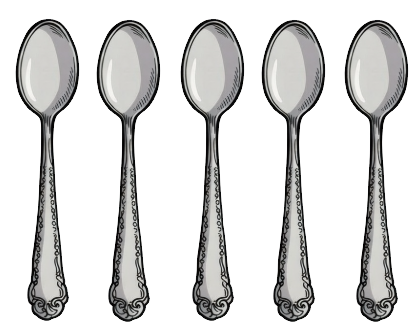
Your energy and motivation are limited resources. A good metaphor for explaining this concept is The ‘Spoons’ Theory by Christine Miserandino. Each spoon below is one unit of your daily energy.

Your energy and motivation are limited resources. A good metaphor for explaining this concept is The ‘Spoons’ Theory by Christine Miserandino. Each spoon below is one unit of your daily energy.

Each activity that you complete in a day costs you one or more spoons, depending on the effort, energy and motivation it requires. To explain this metaphor, let’s imagine that every activity takes one spoon. You wake up at the start of your day with 12 spoons. Here’s how you use your spoons:

  1. You wake up.
  2. You wash your face.
  3. You make breakfast.
  4. You eat your breakfast.
  5. You get dressed.
  6. You brush your teeth.

At this point you have already used half of your spoons and you’ve not even made it through the morning yet.

    1. You get ready for work.
    2. You travel to work.
    3. You work.
    4. You travel home.
    5. You make tea.
    6. You have a bath.

    Now you have run out of spoons. You have two options: You can go to bed and rest, which will give you more spoons. Or you can decide to borrow spoons from tomorrow.

    Due to the demands in life, you may opt to borrow spoons from tomorrow. But then you risk getting trapped in a cycle of constantly borrowing spoons from tomorrow.

    As the days pass and you borrow more and more spoons, you’ll reach a point where there aren’t any left to borrow from tomorrow. You’ll be exhausted and burnt out.

    The Spoon Theory has been adopted by people who are neurodiverse and people with chronic illnesses. But it can actually be applied to all. You. Me. Everyone we know.

    (From: Finding Your Happiness by Antony Simpson)

    I have had to accept my number of spoons is significantly less than other people. I went back to work this week, doing a shorter work week (4 days, rather than 5 days) and by Friday I felt exhausted. Working this number of hours, with the energy that it takes is unsustainable for me in the long term.

    I have worked since being 15 years old. I was brought up that it is not just good for me to work, but also is how I contribute to others in society. However, there are other ways to contribute.

    So right now, I’m thinking about what my plans for my future are and dealing with the emotions associated with the fact that working full time is completely unsustainable for me.

    Blog soon,

    Antony

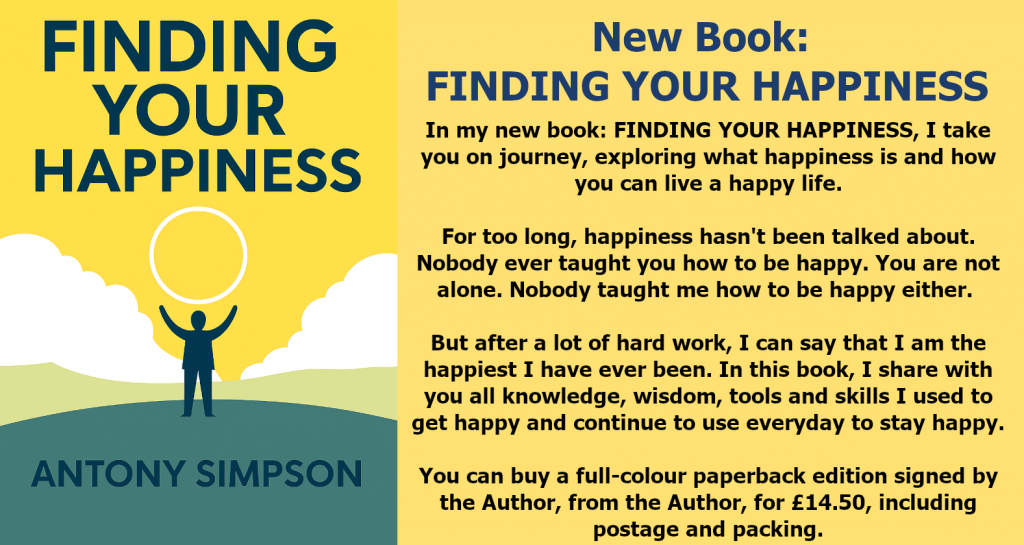
    Click the Image to be taken to Square to purchase the book.
    Share on Social Media:
    Health, , , , , , , ,

    Famous People with Type 1 Diabetes

    Reading Time: 3 minutes
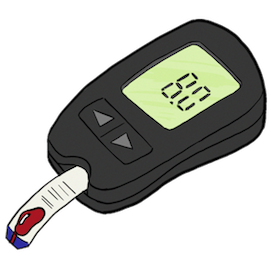
    (Illustration by Sye Watts,
    Copyright © Antony Simpson 2014)

    I was diagnosed with type 1 diabetes 19 years ago (in January 2007). I remember feeling really overwhelmed and isolated. Type 1 Diabetes is:

    “a serious autoimmune condition that occurs when your immune system mistakenly attacks beta cells within the pancreas, which then stop producing insulin. As a result, glucose levels in your blood start to rise, and your body can’t function unless you replace the insulin.”

    From: BreakThrough T1D UK, last accessed: 13/06/26.

    A type 1 diabetes diagnosis is life changing. Most people grieve for the loss of their health, whilst trying to learn to manage this complex medical condition. At times, managing Type 1 Diabetes can feel like a full-time job.

    Despite around 270,000 people in England (NHS England – 2024, last accessed: 13/06/26) being diagnosed and living with Type 1 Diabetes, many people can still feel isolated and alone.

    So I decided to create a list of famous people with Type 1 Diabetes. Hopefully it will make someone feel less alone and realise that anyone can be diagnosed with Type 1 Diabetes. It doesn’t matter a person’s age, gender, ethnicity, sexuality, social class or religion.

    Famous People with Type 1 Diabetes

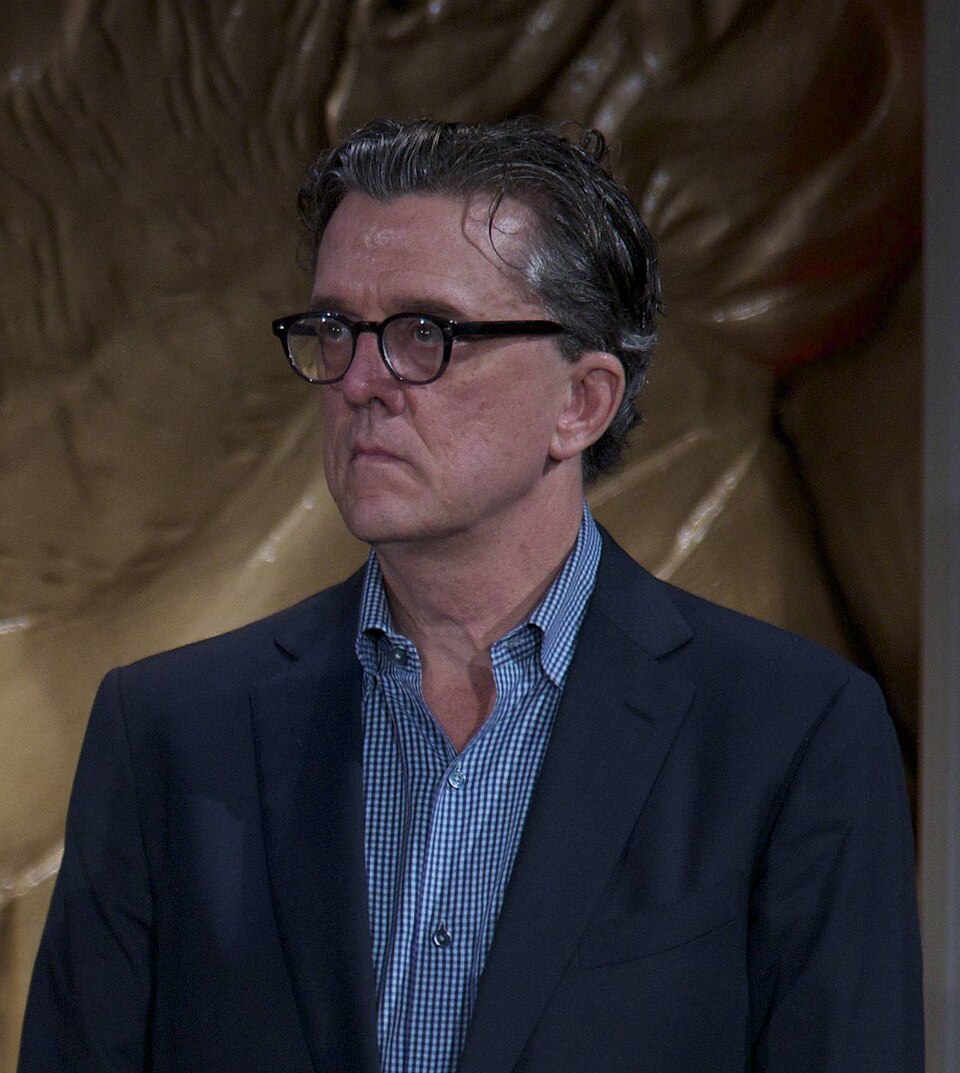
    Kurt Andersen
    Author, USA.
    According to Wikipedia.
    Image From & Copyright © Wikipedia, 2013.

    James Lance Bass
    Singer/Actor, USA.
    According to Wikipedia.
    Image From & Copyright © Wikipedia, 2014.

    Elinor Crawley
    Actress, Wales, UK.
    According to Wikipedia.
    Image From & Copyright © Wikipedia, 2015.

    Nick Jonas
    Singer, USA.
    According to Wikipedia.
    Image From & Copyright © Wikipedia, 2019.

    Theresa May
    Politician & Former Prime Minister, UK.
    According to Wikipedia.
    Image From & Copyright © Wikipedia, 2024.

    Charlotte Regan
    Film Director, UK.
    According to Wikipedia.
    Image From & Copyright © Wikipedia, 2023.

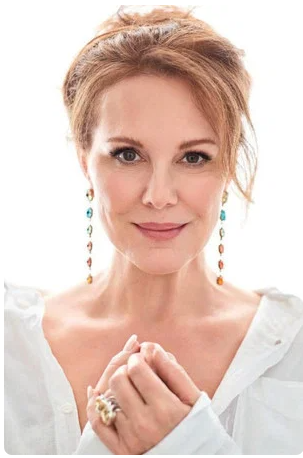
    Elizabeth Perkins
    Actress, USA.
    According to Wikipedia.
    Image From & Copyright © TMPD, 2026.

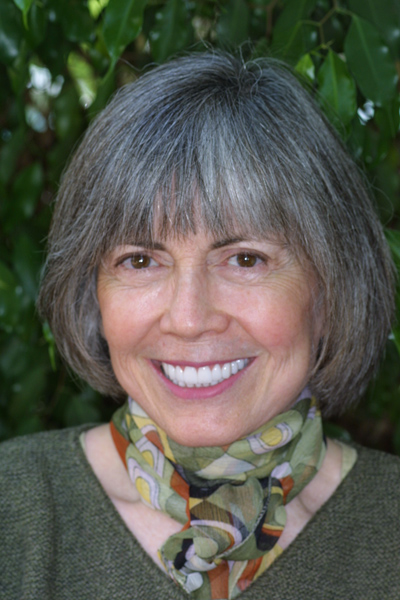
    Anne Rice (Deceased)
    Author, USA.
    According to Wikipedia.
    Image From & Copyright © Wikipedia, 2006.

    Lila Moss
    Model, UK.
    According to BreakThrough T1D AU.
    Image From & Copyright © KM Agency, 2006.

    Ed Gamble
    Comedian, UK.
    According to BreakThrough T1D AU.
    Image From & Copyright © Ed Gamble, 2026.

    An even more comprehensive list of famous people diagnosed with Type 1 Diabetes, mostly populated by people from the USA, can be found on Wikipedia here.

    If you enjoyed this post, you might like my: All Diabetes Type 1 Content page.

    Blog soon,

    Antony

    Share on Social Media:
    Health, Thinking, , , , , , , , , , , , , , , , , , ,

    Parts of the ‘Self’ – A Short Extract From FINDING YOUR HAPPINESS

    Reading Time: 3 minutes

    Here is a small extract from my book FINDING YOUR HAPPINESS:

    A core aspect to finding your happiness is to understand who you are, what drives you and most importantly: What will make you happy. These are unique to the individual, just like your fingerprints.

    Parts of the ‘Self’

    Everyone has different parts of the ‘Self’ that make up the whole of who they are. The different parts of your Self include:

    ★ The Physical Self – your body.
    ★ The Mental Self – your thoughts.
    ★ The Emotional Self – your emotions.
    ★ The Spiritual Self – your soul.

    All these parts contribute to who you are and are interconnected.

    All of these parts contribute to your behaviour – what you say and do.

    Your spiritual self or soul is perhaps the most mysterious of all the parts. We know very little about souls. What is their purpose? How do they operate? The truth is that nobody can answer these questions with absolute certainty.

    There are plenty of theories about souls. Just look at the many religious and spiritual systems in the world today. I personally believe that any work we do to understand our spiritual self, helps us to more deeply understand the universe and how everything is interconnected.

    The interaction between these different parts of the Self, the influence they have on one another and our behaviour is very complex and constantly changing.

    But a couple of example scenarios here will help you to understand that the different parts of your Self can and do influence one another:

    Example Scenario 1: Anxiety

    A really good example of the interaction between the different parts of the Self in action, is the state of anxiety. Anxiety starts through a trigger. A trigger is an event or experience that causes something to happen.

    Imagine you have been triggered. In your mind anxious thoughts start to form. Then you start to feel the emotion of fear. Your physical self responds to these thoughts and emotions. Your heart beats faster, you become more alert and your appetite decreases.

    In the scenario above, your thoughts influenced your emotional state. Then your physical body responded to both your thoughts and your emotional state.

    It is important to know that just because you’re currently focused on one part of your Self, it doesn’t mean that the other parts are inactive.

    Let’s look at another example scenario to illustrate my point:

    Example Scenario 2: Exercise

    Imagine you have gone for a run. Your physical self is firing on all cylinders – your heart beats fast, your lungs inhale oxygen rapidly and your muscles propel you forwards. But as you run, the other parts of your Self are not inactive.

    In your mind, you may be thinking about events earlier in your day. You may think about something that triggers your emotions. These thoughts or emotions may cause you to run faster, run slower or stop running altogether.

    To summarise, all parts of your Self (Physical, Mental, Emotional & Spiritual) interact with one another. They can influence one another. This in turn can influence your behaviour – what you say, do and omit to do.

    In terms of happiness, it is really important to consider each part of your Self. Happiness can only be achieved when all parts of you are working in tandem with one another. All parts of your Self must be in a state of unity.

    You can read more in my book FINDING YOUR HAPPINESS, which is available to buy on Amazon here.

    Blog soon,

    Antony

    Learn more about lifetime Fanatic membership.
    Share on Social Media:
    Amazon, Books & Authors, Happiness & Joy, Health, Life, , , , ,
    Scroll to Top