
The Equality Act (2010)

The Equality Act (2010) Explained
Reading Time: 2 minutes
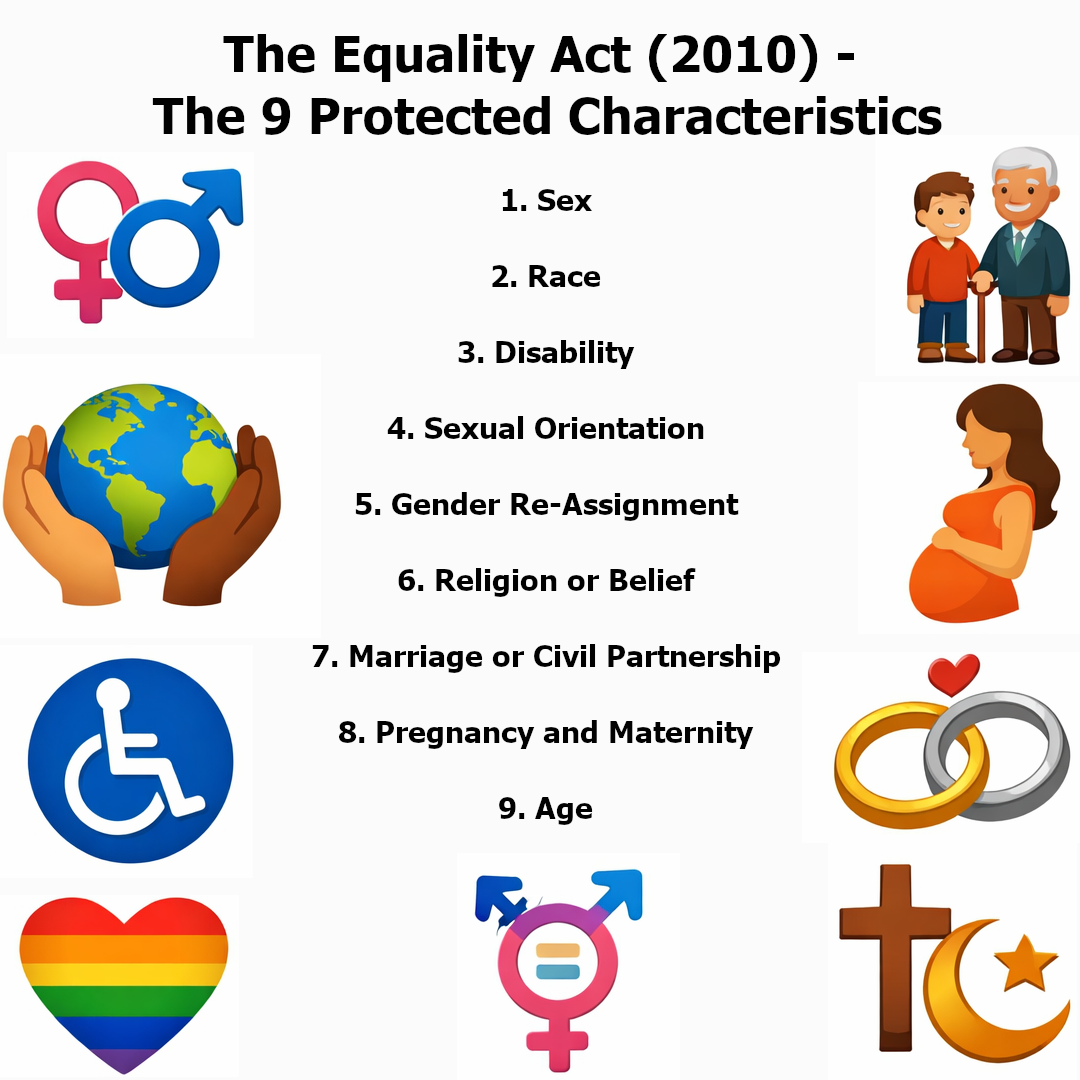
Click on image for full-size.

The Equality Act (2010) is a UK law that is intended to protect people from discrimination, harassment and victimisation.

This is to ensure that everyone is treated with dignity and respect.

The Equality Act (2010) is about ensuring equality and fair treatment for all.

Before the Equality Act (2010) there were more than 100 pieces of other legislation that included details around protecting people from discrimination, harassment and victimisation.

The Equality Act (2010) starts by outlining the 9 protected characteristics:

  1. Sex
  2. Race
  3. Disability
  4. Sexual Orientation
  5. Gender Re-Assignment
  6. Religion or Belief
  7. Marriage or Civil Partnership
  8. Pregnancy and Maternity
  9. Age

Next the act goes on to define what is prohibited, including:

  • Direct discrimination of anybody with a protected characteristic.
  • Indirect discrimination of anybody with a protected characteristic.
  • Harassment of anybody with a protected characteristic.
  • Victimisation of anybody with a protected characteristic.

Equality Act (2010) applies to all public organisations, all private organisations and all third sector organisations, making it all encompassing.

It covers accessing or buying services, buying of products, all education establishments, the NHS, Social Care (plus all other local authority services), employment (all aspects) and pensions.

It places a responsibility on all organisations to make reasonable adjustments for anybody with a protected characteristic and outlines the potential legal consequences for not adhering to this legislation.

I am choosing to write about the Equality Act (2010) now because a certain right-wing political party is planning to abolish this Act and the legal protections it provides if the party gets into power. Scarily, this political party appears to be getting increasingly popular with every day that passes. It is looking like this political party might get into power at the next general election.

So I thought I would use this platform to explain what the Act offers and hopefully help people realise why it is important for every one. Regardless of whether you have a protected characteristic or not.

If you enjoyed this blog post, you might also like my post The Human Rights Act (1998) Explained.

Write soon,

Antony
Share on Social Media:
Gay, Political, Thinking, , , , , , , , , , , , , , , , , , , , , , , , , , , , , , , , ,

2023 – The Year of Antibiotics

Reading Time: 2 minutes

For most of 2023, I’ve been unwell with bacterial infections. I’ve had an infected knee, an abscess on my arm, pneumonia, a dental abscess, tonsilitis and sinusitis. As my mum would say: I’m surprised you don’t look like an antibiotic, with the amount you’ve taken.

Here is a list of antibiotics I’ve taken in 2023:

It is known that people living with Type 1 Diabetes, like me, have a weakened immune system. But to spend the majority of the year fighting bacterial infections and taking antibiotics is exhausting.

I’ve been trying really hard with the self-care including: regularly washing my hands, getting plenty of rest and sleep, drinking plenty of fluids, eating well, getting vaccinated for COVID-19 (plus boosters). I’ve even tried taking Vitamin C supplements. But nothing has seemed to make any difference. It’s like my white blood cells see bacteria coming and decide to go for a nap instead of fighting. Either that, or my immune system is made up of passivists, rather than warriors.

Every time I get an infection, it spikes my blood sugars. They go high and as much as I try to manage this by eating less and injecting more insulin, managing diabetes feels like having a full time job, on top of having a full time job and out of work commitments.

These regular periods of illness have affected my work and home life. I’m so lucky that Type 1 diabetes is classed as an unseen disability under The Equality Act (2010), otherwise I’d probably be out of a job.

I’ll be really honest, 2023 for me has been about managing illness after illness, whilst trying to maintain my employment. These two tasks haven’t left room for doing the things that I like to do, such as reading, writing, seeing friends and family, etc. That’s why the blog has been pretty quiet as of late.

Being on these different antibiotics has also got me worried. I’ve noticed that some of them haven’t been as effective for me as they previously have been at dealing with bacterial infections. Antibiotic resistance is something I’m noticing and with no new antibiotics on the horizon, what’s going to happen when antibiotics stop working altogether?

Blog soon,

Antony

Share on Social Media:
Health, , , , , , , , , , , , , , ,
Scroll to Top
×