respect

Dealing With People That Feel Entitled Or Are Always The Victim

Reading Time: 3 minutes

Recently, in day to day life, I’ve come into contact with a number of people that seem to feel entitled to preferential treatment or are always the victim. I always try to be compassionate and kind to everyone I meet, no matter how people treat me. I often remind myself: Antony, you don’t know what this person is going through, or what challenges they are facing at this moment.

The Definitions of Entitled & Victim

To better explain the people I’m writing about and how these people think, feel and behave (what they say and do), here are the definitions of entitled and victim:

Definition: entitled

– assuming or acting as though one has an innate right or claim to wealth, success, recognition, etc..

(From: Dictionary.com, last accessed: 02/11/26.)

Definition: victim

– one that is subjected to oppression, hardship, or mistreatment

(From: Merriam-Webster, last accessed: 02/11/26.)
mental-health-wisdom-banner

Compassionate & Kind

My approach with all people is to be compassionate and kind. But I’ve noticed that people that act entitled or are always victims don’t mimic my approach. Instead their sense of entitlement behaviours, or their perceived victimhood gets worse. Sometimes to the point where they can get rude, disrespectful or even go on a verbal rant or attack (often without a justifiable cause).

It feels like my compassion and kindness are mistaken for weakness. It feels like these people see an opportunity to socially misbehave and do so. I’ve realised that by being polite, compassionate and kind, it enables some people to behave in an entitled way or create new situations where they can become the victim.

I’ve made the important decision to change my approach with people that are acting entitled or always the victim.

Minimise Contact/Interactions, Match Their Attitude & Hold Them to Account

My new approach has three steps:

  1. Minimise Contact/Interactions – To reduce the opportunities they have to misbehave socially. Often they come across as selfish and unable to consider anyone else’s point of view.
  2. Match Their Attitude – How they treat me, will now be how they get treated. There is no excuse for rudeness or for them to be disrespectful. They will now get off me: a taste of their own medicine.
  3. Hold Them to Account – People that are entitled or always the victims often manipulate, change or lie about events, so that their narrative reinforces their sense of entitlement or victimhood status. On more than one occasion, I have fallen foul of this. So in future, I will hold these people to account and call them out on their misrepresentations of, changes to, or lies about events that involve me.

Are You Acting Entitled or Always The Victim?

A post like can trigger some people to question whether they act entitled or are always the victim. For this reason, I want to point out here, that if you have the self-awareness to question your thoughts, feelings or behaviours, you are highly unlikely to be displaying these behaviours.

If You Do Act Entitled or are Always The Victim

If you do act entitled or are always the victim, I would recommend therapy to explore why and look at changing your thoughts, feelings and behaviours.

I would also recommend reading my books: Mental Health Wisdom and Finding Your Happiness. Acting entitled or always being the victim can lead to mental illnesses and will definitely not lead you being very happy.

Other Content

If you liked this post, you might like:

Take Care,

Antony

Support

I recognise that people visiting this page/post might want to know where they can get support.
If you require support around your mental health, addiction or physical health, see this Support page here.
Share on Social Media:
Rants, Thinking, , , , , , , , , , , , ,

The Equality Act (2010) Explained

Reading Time: 2 minutes
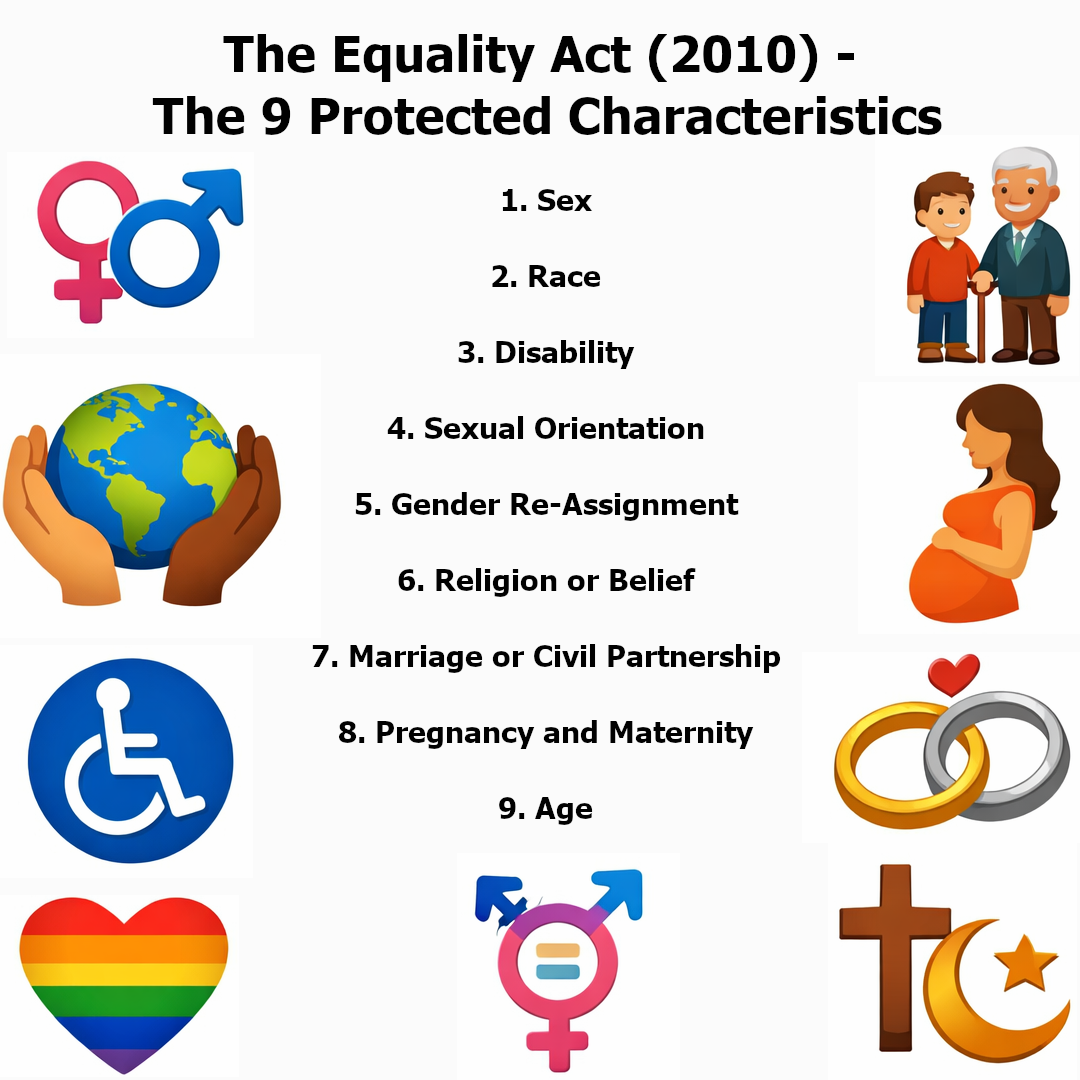
Click on image for full-size.

The Equality Act (2010) is a UK law that is intended to protect people from discrimination, harassment and victimisation.

This is to ensure that everyone is treated with dignity and respect.

The Equality Act (2010) is about ensuring equality and fair treatment for all.

Before the Equality Act (2010) there were more than 100 pieces of other legislation that included details around protecting people from discrimination, harassment and victimisation.

The Equality Act (2010) starts by outlining the 9 protected characteristics:

  1. Sex
  2. Race
  3. Disability
  4. Sexual Orientation
  5. Gender Re-Assignment
  6. Religion or Belief
  7. Marriage or Civil Partnership
  8. Pregnancy and Maternity
  9. Age

Next the act goes on to define what is prohibited, including:

  • Direct discrimination of anybody with a protected characteristic.
  • Indirect discrimination of anybody with a protected characteristic.
  • Harassment of anybody with a protected characteristic.
  • Victimisation of anybody with a protected characteristic.

Equality Act (2010) applies to all public organisations, all private organisations and all third sector organisations, making it all encompassing.

It covers accessing or buying services, buying of products, all education establishments, the NHS, Social Care (plus all other local authority services), employment (all aspects) and pensions.

It places a responsibility on all organisations to make reasonable adjustments for anybody with a protected characteristic and outlines the potential legal consequences for not adhering to this legislation.

I am choosing to write about the Equality Act (2010) now because a certain right-wing political party is planning to abolish this Act and the legal protections it provides if the party gets into power. Scarily, this political party appears to be getting increasingly popular with every day that passes. It is looking like this political party might get into power at the next general election.

So I thought I would use this platform to explain what the Act offers and hopefully help people realise why it is important for every one. Regardless of whether you have a protected characteristic or not.

If you enjoyed this blog post, you might also like my post The Human Rights Act (1998) Explained.

Write soon,

Antony

Share on Social Media:
Gay, Political, Thinking, , , , , , , , , , , , , , , , , , , , , , , , , , , , , , , , ,

Book Review: Us by David Nicholls

Reading Time: 2 minutes

In Us Douglas Petersen discovers that his wife Connie will also be leaving him when their son Albie leaves for University.

Douglas decides to make their last family holiday together a trip of a lifetime by organising what he dubs ‘The Grand Tour’. The journey will take them across Europe and Douglas hopes that along the way he and Connie are drawn closer together and that he finally wins the respect of his son.

Everything about Us was predictable including the perspective, pacing and plot.

Douglas’ perspective was used with him flicking between the present ‘Grand Tour’ and the past to tell the story of his life. His past contains a pretty boring single life, a love romance with the wonderful but flawed Connie who seemed to settle for him and his awkward and difficult relationship with his arty son Albie.

The pacing was reasonable using the travelling to new destinations on ‘The Grand Tour’ to keep it moving along.

The plot was totally predictable, not once was there a plot twist that was unexpected. The reader is likely to become frustrated at just how predictable it is. The ending felt like it hadn’t been thought through by David Nicholls and that he had been lazy.

I pre-ordered Us because it is by David Nicholls, the same Author that wrote the exceptional One Day. I really wanted to like Us, but up to the same standards as One Day it was not.

Overall Us by David Nicholls was OK, it’s the sort of book you’ll only read once and wont change your life. It is available to buy on Amazon.

If you liked this post, you might like my All Books & Literature Content or my Book Lists pages.

Review soon,

Antony

Share on Social Media:
Amazon, Books & Authors, Reviews, , , , , , , , , , , ,
Scroll to Top
×