The Rainbow Pride Flag: Who designed it? What do the different colours symbolise? And how has the design evolved over time?

I remember the first time I saw the Rainbow Pride Flag (image left). I was a young gay man and it was at a local LGBT youth project I attended. I had recently come out to some close family and friends.

As I got a little older, I began to go to the gay pubs/clubs in my local city, meeting other Lesbian, Gay and Bisexual (LGB) people. The Rainbow Pride Flag was prominently displayed on both the outside and inside of every gay pub/club/business there. In these settings, I felt safe. I felt free to be my whole self, with no fears about how other people might react. I felt I was with my tribe. With people that were the same as me.
Ordinarily, in the outside world, I would monitor my voice and behaviour closely. I’d be hypervigilant for danger, always noticing the people around me, the environment and constantly scanning for the subtle signs that I might be in danger. Often, I considered multiple exit routes and what I might say to someone if they became verbally or physically abusive towards me. I’d also consider who, out of the strangers around, might help me, if I needed it.
My fear was very real. I’ve had experiences in the past where the risk of harm from strangers, just because of my sexuality, was very real. These experiences, along with hearing experiences from others, made me very cautious. I felt that hiding my sexuality, rather than it being noticeable, kept me safer. This fear for my safety even influenced what I chose to wear and how I styled my hair.
Being gay has always been part of who I am. But sadly, not all people like or accept gay people.
The Rainbow Pride Flag quickly became a symbol to me that represented: safety and that I was free to be my full true authentic self. I knew that I could breathe, relax and enjoy myself in any setting that had the flag on display. I never took that for granted. When I was leaving these settings, I knew was going back into a potentially hostile world.
I recently realised that I knew practically nothing about the Rainbow Pride Flag. I have displayed it, using its symbolism to hopefully make others feel safe and welcome. So I made the decision to do some research and learn more about the flag. In this post, I share with you what I learned:
1. Who designed The Rainbow Pride Flag?
The Rainbow Pride Flag was designed by Gilbert Baker, Lynn Segerblom, James McNamara and other gay rights activists in San Francisco, USA. Gilbert Baker was friends with and influenced by Harvey Milk, a very famous gay civil rights activist.
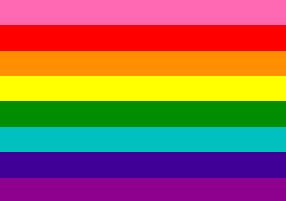
The Rainbow Pride Flag first appeared in 1978 at the San Francisco Gay Freedom Day Parade and was quickly adopted as a symbol for and by the LGBT community. The original flag had 8 colours, including hot pink, like below:
Some people have suggested that Baker and the other designers used the rainbow colours due Judy Garland. Judy Garland played Dorothy in The Wizard of Oz film and sung the song ‘Over The Rainbow.’ She later became somewhat of an icon in the gay community. Some in the LGB community would ask others: Are you a friend of Dorothy? This was a coded message, disclosing their sexuality and asking if they were also in the community.
However, Baker, in an interview in 1985 denied any association with Judy Garland, Dorothy or The Wizard of Oz. He reported that designers chose rainbow colours “because of its associations with the hippie movement of the Sixties.” Baker also noted that the use of this design dated all the way back to ancient Egypt.
The Rainbow Pride Flag was designed to be a symbol of the gay civil rights movement that was taking place in the USA at the time. The design has evolved over time, as has what the flag means to the LGBT community, allies and the general population. It is an extremely powerful symbol for the LGBT community.
It could be argued that the Rainbow Pride Flag has become much, much more than the original designers expected or could even have imagined.
2. What do the different colours on the flag symbolise?
Overall the flag was a symbol (and in some areas remains one) around equal civil rights and protections for LGBT people. The genius behind the deign of The Rainbow Pride Flag is that different individuals or community can attribute their own meaning to it. For example, as an individual to me it symbolises safety and being free to be my authentic self, as explained in my story above.
It is reported that each colour on the original 1978 Rainbow Pride flag symbolised something specific. The colours on the flag and are what they are reported to symbolise is well reported on the internet. The colours on the original 1978 flag are said to symbolise:
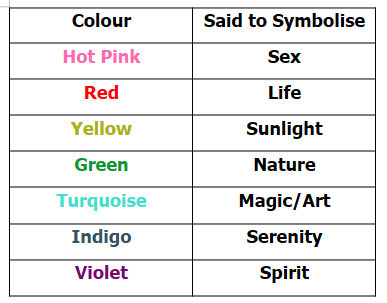
During my research, I could find no credible reference to confirm or deny that the designers had specific symbols in mind for the specific colours that make up the flag.
It could be that they did, equally that they did not. It could be that these symbols were created or decided on at a later date, by the designers or practically anyone else and at some point, they just started getting reported as fact. We just don’t know for sure and likely never will.
3. How has the design of The Rainbow Pride Flag evolved over time?
The first design change of The Rainbow Pride Flag occurred towards the end of 1978. Harvey Milk was assassinated and this led to a massive increase in demand for the Rainbow Pride Flag.
The customers were likely LGBT people who wanted to support the gay civil rights movement, knowing that they already faced discrimination, harassment and sometimes physical assault. Harvey Milk’s murder likely made people think that this could happen to anyone of them and that they need to be politically active for rights and protections.
Some sales of the flag may have also come from allies, people who identify as hetrosexual (straight), but agreed that LGBT people should have the same rights and protections as everyone else.
In November 1978, due to the increased demand, the manufacturer was struggling to get hold of enough hot pink material to make the flags and complete orders. So Baker, tweaked the design, removing the hot pink colour.
Some time in 1979, Baker decided to remove Turquoise as he needed an even number of colours (6 rather than 7) as part of his pride parade plans to places two colours on each lampost repeatedly along the parade route.
Baker then adjusted the design of the Rainbow Pride Flag in 2017, making it a nine stripped flag. The turquoise stripe was back, along with a lavender stripe. Baker is said to have added the lavender stripe to symbolise diversity and reportedly did so due to the election of a certain orange President the year before.
There have also been a large number of organisations across the world that have adapted Baker’s designs, adding to or changing the design slightly. There are too many variations to list them all here and I would no doubt miss some out. So I have only included details of the original Rainbow Pride Flag’s evolution here.
4. A Powerful Symbol
Over time, The Rainbow Pride Flag has become an extremely powerful symbol for LGBT people in a number of places in the world. It has helped the community to be acknowledged, listened to and in many places respected. Although this hasn’t happened everywhere.
Today, many public institutions, private companies and charities recognise Pride Month in June and actively promote celebration of their customers/staff/others who are part of the LGBT community.
In some places attitudes towards LGBT people have improved and we have definitely gotten more legal rights/protections in many places. But there is still more work to be done. Both from a civil rights persepctive and to help others to understand some of the challenges and difficulties experienced by LGBT people.
5. Other Content You Might Like
If you enjoyed this post, you might like:
- Article: Influential UK Gay Men.
- Article: The History of Gay Marriage in the UK.
- Short Story: Soulmates.
- All Love, Relationships & Gay Community Content page.
- Blog Post: The Heartbreaking Story of Matthew Shepard.
Write soon,
Antony
More Content From Antony
Here are the books that Antony has published: