Made short videos for three 5 star written reviews of FINDING YOUR HAPPINESS (the first is here, the second and third are here) into short videos to further promote the book.
Added Related Videos and Related Images sections to all of my book’s pages.
Added a CAPTCHA to my newsletter form to prevent bots from signing up and updated some server settings so that the newsletter would continue to send to readers.
Updated the contact form due to server security changes.
Updated my books banner to reflect FINDING YOUR HAPPINESS:
Made another short review video for a 5 star review on Amazon, which you can watch on Youtube here.
Added Related Videos and Related Images sections to all of my topic content pages, where I have related videos and images.
I recently learned about the existence of substack. Substack is a platform that allows anyone to share creative content, including: written articles, images, audio (such as podcasts) and videos with the world. It allows people to subscribe to content creators accounts, in a model that allows both free and paid subscriptions.
Substack’s unique selling point (I hate that phrase!) seems to be that it is easy for creators to grow an audience and to make money from the content they create. Substack boasts that it only takes 10% of creators earnings from paid subscribers, giving the content creators 90% of their earnings. As substack is currently free for content creators to use, it means that substack only make money when content creators do.
As a Writer, I can see the advantages of substack, which include:
It is currently FREE, there is no monthly subscription cost, meaning that content creators won’t be left out of pocket. This means that content creators won’t have to pay for domain names, hosting, etc.
It appears quick and easy for content creators to set up, use and maintain.
No technical knowledge required by the content creators – no knowledge of website design and functionality.
It has features that are designed to grow a content creator’s audience, such as notification of new content to subscribers.
Substack claim tens of millions of content consumers every week, which in theory means a massive audience. However, they don’t state how many paid subscribers they have on the platform.
It allows a variety of different types of content in one post.
Substack allows quick reactions (love heart icon) to content, re-posting/sharing content on the platform and discussion via comments.
But substack also has a number of disadvantages, which include:
Substack isn’t the only company to have this idea. Patreon is its direct competitor, who have been around longer (Patreon launched in 2013, substack launched in 2017). In some cases Patreon takes less of a percentage of subscription earnings from content creators than substack.
The market for paid content through a subscription is uncertain. As is the amount of money that content creators could make. When I refer to content here, I refer to content that is not of an adult-only nature (by this I mean not pornographic). It is safe to say the market for adult-only content exists and that some content creators are currently making good money from this sort of content. However even with this sort of content, some content creators are saying that the market is saturated and that they are making less money than they used to.
Substack is a business with costs and a pressure to make a profit. This could mean that at some point it stops being free and content creators get a monthly subscription fee, even if content creators aren’t making any money from the platform.
Substack could may also decide to look for other ways to generate revenue, including but not limited to advertising.
Substack could go out of business and creators could loose the platform and possibly some or all of the content they created.
Substack allows any creator to post any content. This means that content posted on substack will have less credibility with the audience and may erode the content creators credibility and reputation.
Substack doesn’t have any quality controls. This means that content could be factually incorrect, biased, misleading or completely inappropriate.
Substack has a history (at least according to Wikipedia) of not taking enough steps to protect users data due to privacy breach in 2020 and then a security breach in late 2025.
Substack lacks the ability for content creators to customise much of how their content is viewed. This might not be that important for written words, but could be incredibly important for other types of content.
Substack appears to let AI generated content on its platform, which will significantly impact human content creators. AI content may also make a number of content consumers avoid the platform all together.
For both content creators and content consumers there are more disadvantages to using substack, than advantages. But in order for me to justify my opinion that substack won’t replace WordPress, I need to write about WordPress.
WordPress (WordPress.com & WordPress.org) was launched in 2003 as a blogging platform. It has grown and developed over the years. Today 40-60% of all websites use WordPress.
I have used WordPress for my personal blog and website since 2008, although I remember experimenting with it well before then. WordPress can do everything that substack can, although some functions/features would require plugins.
WordPress initially started as a community platform, but as it grew it became more commercialised as it pivoted towards business users. This brought paid themes and paid plugins. Later, it brought paid subscriptions for some themes and plugins, paid on either a monthly or annual basis.
The choice WordPress developers and other non-official developers made to pivot towards businesses meant that they could earn money from their work, which you could liken to a content creator. This is great, they should be paid for their work.
But it means that the core WordPress platform, without any of the paid themes or plugins is limited for content creators. Content creators, especially those trying to build an audience that are willing to pay for their content (like myself) just don’t have the money to spend to get the functionality/features currently being offered for free by platforms like substack.
I am a Writer. I write this blog, books, articles and short stories. I write this blog because I enjoy writing. Writing this blog is a hobbie and I am happy to give away the content for free.
But my more substantial content like my books, articles and short stories, take me a considerable amount of time, energy and work to create. I believe that they have monetary value and that it is fair to ask for a small amount of money in return for them.
I am truly appreciative of everyone who reads something that I write, whether that be on my blog, or through one of my books, articles or short stories.
But the WordPress platform, without the paid plugins makes it difficult or in some cases impossible for content creators to:
Help you to find your audience.
Help you to grow your audience.
Help you to keep in touch with your audience.
Help you to take payments for products (whether that be physical or digital).
Help you to offer subscription services.
WordPress has dominated the market when it comes to Writers, for a number of years. But one of my hopes, is that services like substack cause WordPress developers to add some functionality/features into the platform that address some of the difficulties faced by content creators who can’t afford to buy the paid plugins.
Conclusion
I use the WordPress platform through a self-hosting company and have a domain name to help people to find my website. This costs me £25 per month. But due to the lack of functionality/features in the WordPress platform (without paying more money for plugins), this website costs more to run than any money I’ve ever generated through it.
But despite WordPress’ limitations, I think it will be around long after substack is a distant memory. Substack appears very good at marketing to content creators. But to me its business model seems to have far too many flaws. Their business model is based on an idea that people are willing to pay for content. But there isn’t any good data on:
Whether people are willing to pay for content.
What sort of content people are willing to pay for.
The number of people who are willing to pay for content.
How much people are willing to pay (or can afford to pay given the global economy) for content.
If substack can generate enough income to not only meet the costs of operating, but also make a profit.
The impact AI will have on content creators and their audiences.
I HATE how commercial WordPress is becoming! What went wrong? It started out as a community-based blogging platform. Now everything is about business and money and it stinks!
A good example of this is Jetpack. Jetpack is a plugin that recorded statical data about visitors and views. It used to be free and did these lovely annual reports.
Now the services provided by Jetpack, including their Stats has in the latest update become a paid model. Not just a paid model, but a subscription service – like money is no object. Sure it’s fine if you have a business and are making money.
But for a small author and blogger like me, let’s be clear: This website costs me more than it has ever earned me. But I keep it running, at a personal cost to me for my enjoyment. It’s a leisure activity.
So today, it was Bye, Bye Jetpack. I’ve removed and deleted the plugin. I encourage other bloggers to do the same. Let’s not give in to their financial demands and instead opt with our fingers and delete plugins and themes demanding money with their Dashboard banners.
It’s not just Jetpack. EVERY theme and plugin now expects you to pay, usually a subscription service, for regular updates.
Honestly if there were an alternative community-based platform, similar to WordPress’ past, that focused on development to improve user experience, rather than making developers rich, I’d switch. But there isn’t right now, meaning that at least for now I’m stuck with WordPress.
Blog – Yes blog, writing for pleasure, not to make money, soon,
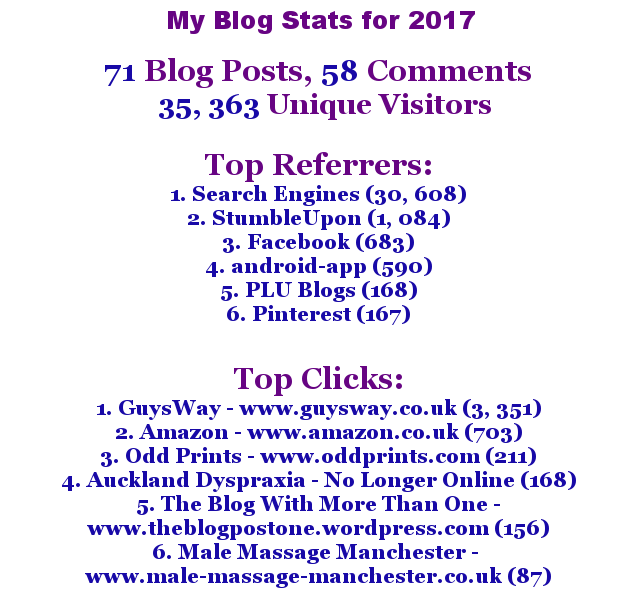
Lets have a look on how they compare against My Blog Stats for 2016. The number of blog posts was 71 in 2017 and 82 in 2016, meaning a decrease of 11 posts. However the number of comments have increased by 23 comments, with 58 comments made in 2017 versus 35 comments made in 2016.
In 2016 my blog had 1, 811, 905 hits. I don’t have data for 2017 due to switching hosting providers partway through the year. However the number of unique visitors in 2017 increased by 8,863 (35, 363 in 2017 versus 26, 500 in 2016).
The top referrer in both 2016 and 2017 was search engines. However in 2017 StumbleUpon past Facebook. Android-app remained in fourth place in 2017 as it was in 2016.
Twitter dropped off the Top Referrers list in 2017, which was disappointing as I increased tagging of relevant users, used hashtags better and tried to engage more with people on Twitter. But it was replaced with PLU Blogs which I listed my blog on as a bit of an experiment. It was also replaced by Pinterest another site that I had experimented with in 2017.
This year (2018!) I would like to exceed the number of posts written in 2017. I’d like the comments to remain high, as well as the hits and unique visitors to continue to increase.