Is the Social Contract in the UK Broken?
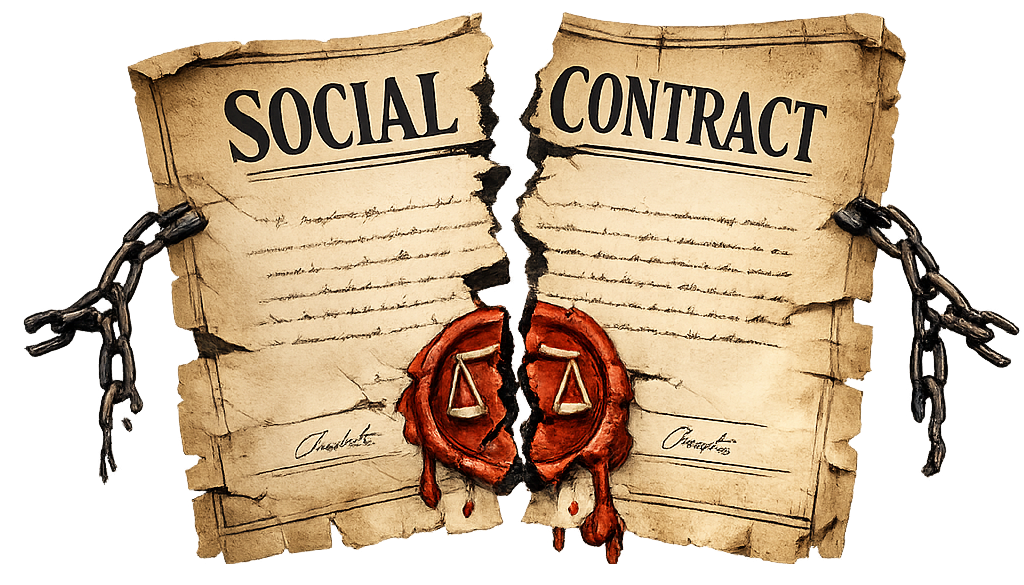
A social contract is an implied agreement between The Government / Members of Parliament (MPs) / Institutions and The People. Both sides of the agreement have rights, responsibilities and expectations. But is the social contract in the UK broken?
To answer this question, we need to discuss the expectations of each of the group’s people:
The People are Expected to:
- Work and/or contribute to society in other ways.
- Pay taxes.
- Abide by the law.
- To be treated with dignity, fairness, equality & respect.
- To treat others with dignity, fairness, equality & respect.
- To exercise their rights to vote, petition and protest, if they choose to do so.
The Government / MPs / Institutions are Expected to:
- To keep citizens (The People) safe – usually achieved through the Military and the Police.
- To ensure all of The People have access to shelter (housing), food, water and appropriate clothing. To ensure that these basic survival needs are affordable.
- To ensure of of The People have access to the NHS, safe and high quality healthcare. This ensures that the majority of the population are in good health.
- To ensure that children / young people and vulnerable adults have access to Social Care services that keep them safe and support them.
- To ensure all of The People have opportunities to learn through education establishments, libraries and apprenticeships. This develops a knowledgeable and skilled workforce for all of society.
- To be financially responsible, ensuring the economy grows and benefits all. This includes ensuring employment opportunities for working-age people, ensuring pension schemes for the elderly and Welfare (benefit payments for: people on low wages, unemployed people, people who need extra support due illness or disability, support for families with children and support towards the cost of housing).
- To develop, support, maintain and ensure accessibility for all of The People to key infrastructure such as water sanitation, waste disposal/recycling, energy/power systems, roads/public transportation and telephone / communication systems.
- To create new laws for the good of The People.
- To ensure that there is a system for individual people that brake laws, which includes both justice / consequences and rehabilitation. In the UK, this is through the Police, the Courts, Prisons and Probation services.
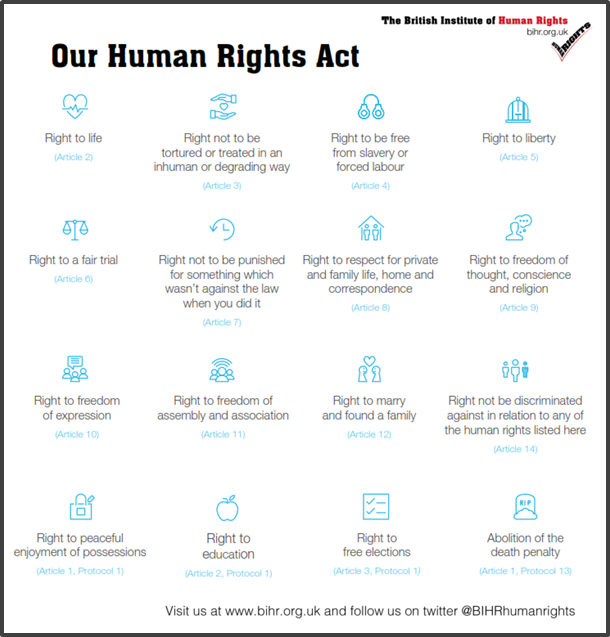
- To ensure that all institutions adhere to Human Rights, are accessible and don’t discriminate or harass any of The People.
- In Parliament, to represent and act in the best interests of both The People in the communities that elected them and the larger UK society.
- To promote good diplomatic relationships globally and to advocate for / encourage peace.
I understand that the The Government / MPs / Institutions have a large number of complex expectations to meet. However, in the last few decades, it feels like on every single one of these expectations The Government / MPs / Institutions are failing to deliver. Not only are they failing to meet expectations right now, but it also appears that they are setting society up for further failures in the future.
In the last few decades, The Government / MPs / Intuitions have appeared to work for a select group of people within The People: the wealthy elite (see rising wealth inequality).
My opinion is that everything is broken. The social contract is broken, politics is broken, all public services are broken. It feels likes society in the UK is disintegrating right in front of my eyes.
This week Andy Burnham won the by-election in Ashton-In-Makerfield, Wigan. At one time, this would of given me hope. Andy Burnham is an experienced politician and to give credit where it is due, he was the Health Minister when I started my career as a Student Nurse.
Back in 2004 – The Labour Party’s bursey for Nurses scheme enabled me to go to University to become a Nurse. I was the first person in my family to go to University. The policy documents, ideas and follow through actions whilst Andy Burnham was Health Minister were good.
One basic but excellent idea I remember for the NHS, is calculating how many Nurses the NHS would need in the next 3 years. They then doubled the number of training places to ensuring we had enough Nurses qualifying at the right time.
I do have reasons not to hope for too much, or put my complete faith and trust in Andy Burnham as a Prime Minister though.
Before I list these, I want to say that what I’ve heard so far from Andy Burnham seems promising. Bringing back public transport, utilities and energy into Government ownership would not only go along way to addressing the cost of living crisis, but would also ensure the Government’s wealth security for future generations.
My reasons for not putting too much hope, faith or trust in Andy Burnham include:
- Josh Simons was the former MP for Ashton-In-Makerfield in Wigan. Josh appeared to well respected and liked locally, but suddenly gave up his seat to make way for Andy Burnham. This makes it feel like political game playing and acting in self-interest, rather than in the interests of The People. I am almost expecting that Josh Simons will get a peerage to the unelected House of Lords. Not because he earned it, not because The People will benefit, but because Andy Burnham promised him, in return for giving up his elected seat.
- It is rumoured that the proposed Clean Air Zone (CAZ) was Andy Burnham’s idea when he was Mayor of Greater Manchester. I should make clear that Andy Burnham now denies this, stating that it was the previous Conservative Government’s idea. But this doesn’t ring true for me. Before the CAZ, there was a proposal for a Congestion Charge for Greater Manchester. This would have reduced traffic, as only people with the money could afford to drive into the city centre. However the majority of The People in Greater Manchester voted to reject the idea of a congestion charge. The CAZ to me feels like another way Andy Burnham tried to implement this idea. It also doesn’t feel right that The Conservative Party would bring in a charge for motorists for ‘clean air’ or that they would want it to cover the whole of Greater Manchester.
- Another rumour relating to the proposed CAZ was that either a company that Andy Burnham’s wife owns or works for got paid £100m for all of the signage. I have never read anywhere that Andy Burnham has acknowledged this rumour or responded to it. Sometimes, silence from politicians makes me feel that they are covering their back, not saying anything to avoid incriminating themselves. If Andy Burnham was involved, influenced or was even aware of his wife’s involvement, this feels like a very real conflict of interests. What was done about this? We don’t know, because the rumour hasn’t been acknowledged, confirmed or denied.
- If the Greater Manchester Combined Authority, which the perception is that Andy Burnham was the leader of, did pay £100m for signage, that’s feels like a lot of tax payer’s money that has been wasted for a scheme that never materialised.
- Even if Andy Burnham has all the best of intentions and only wants to serve The People, there is a chaotic Labour Party and a whole political system set up that seems pretty happy with the status quo. Can Andy Burnham have the influence, charisma, ideas, motivation and energy to make the transformational change required?
I have never wanted for any one to prove my concerns about them wrong as I do about Andy Burnham right now. I want the social contract back. I want a fair and good society.
If you look at the collapse of every empire in history, they all have one thing in common. They happened (at least in part) because their ruling class (those with power) stopped serving The People and started serving either themselves, the wealthy elite or both.
What are your thoughts? Leave a comment below.
Write soon,
Antony
More Content From Antony
Here are the books that Antony has published, click any cover to learn more: