Nurse

DOOMED! & My Vasculitis Tongue

Reading Time: 6 minutes

DOOMED!

I don’t know much about Vasculitis.

But I need to know: What comes next? How will my Vasculitis progress?

At a recent clinic appointment with a Renal Consultant, I asked the above questions. The Consultant stirred more intensely at his computer screen, avoiding eye contact. I waited. I wanted some answers. But instead he ignored my questions and moved on to asking about something else.

This wasn’t the first time this had happened to me. A few weeks before, I had seen the Specialist Nurse in her clinic and asked the same questions. She had looked down at her hands and given practically no answers or useful information – instead offering to refer me to a Psychologist.

Months before, I had asked the same questions to my Vasculitis Consultant, who had also avoided eye contact and gave some vague information about Rituximab infusions.

But being a Registered Nurse, I have seen this reaction by Doctors and Nurses to these sort of questions before. When I worked in an A&E Department, patients who were doomed!, destined to die, usually pretty soon, who asked these questions got the same reaction. Eye contact avoided by the Doctors and Nurses. No answers to the questions asked or useful information given.

I do understand the two Consultant’s and the Specialist Nurse’s reactions to my questions. Most Doctors and Nurses go into their professions to heal; to either make people better or to keep people alive for as long a time as possible. We live in a time where all people, including Doctors and Nurses have high expectations of healthcare. Good healthcare has made the occurrences of young deaths very rare.

So imagine being a Doctor or a Nurse and knowing that you could do very little to meaningfully extend a patient’s life due to a disease. That at best, you might minimally slow down its progression. This is sadly the case with Vasculitis.

Now imagine that this patient asks the questions above. These questions are uncomfortable for Doctors and Nurses, because of the wide array of thoughts and emotions they trigger within them. Doctors and Nurses generally don’t want to lie to their patients. Nor do they want their patients to become hopeless, sad, angry or upset.

It takes a great deal of courage, skill, awareness of the patient and themselves for any Doctor or Nurse to have this sort of extremely uncomfortable conversation.

Given all of the above, it is understandable that the two Consultants and the Specialist Nurse have reacted in the ways in which they have. However, in my case, I would prefer we navigate this uncomfortable conversation, so I have answers, know what to expect and have more information.

How You React

There is this very famous quote:
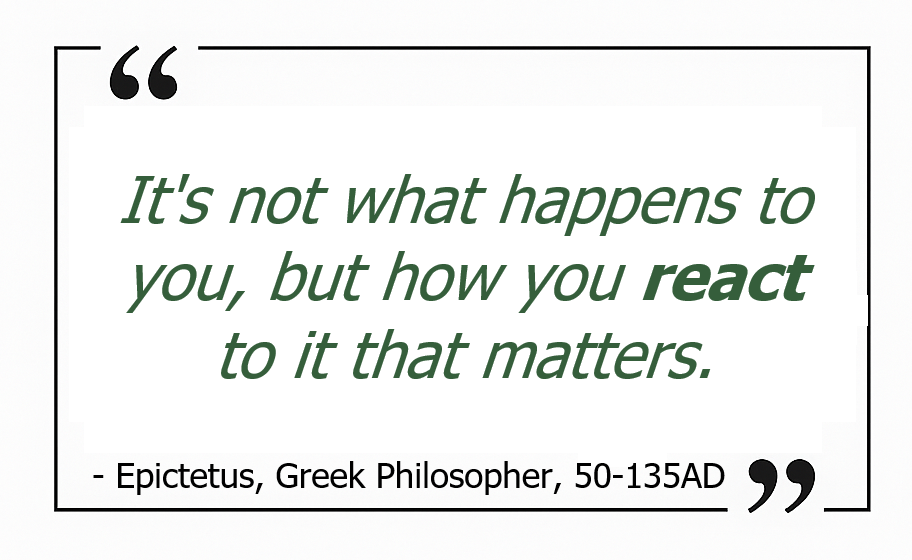
I can’t remember where I first heard this quote, but it is very true statement and the quote has always stayed with me. Everyone reacts to what happens to us through our thoughts, emotions and behaviours (what we say and what we do).

Here are my thoughts regarding the way the two Consultants and the Specialist Nurse have reacted to my questions:

  1. I would prefer to have the uncomfortable conversation and in doing so, gain answers and more information. That way I can prepare for and plan for the progression of my Vasculitis.
  2. Although I regularly experience fatigue/exhaustion, swelling and pain, I am grateful that I do have 10-15 productive hours and that the pain is not currently agony and unmanagable.
  3. I am okay with dying. Everyone dies. Would I have liked more time? Of course. Most people would. But very few people get to choose when their life comes to its end. Death is part of The Cycle of Life.
  4. That I need to make the best use of the limited time I have left alive.
  5. That I want to prepare the people that I love for my death. This won’t eliminate or lessen any grief they feel, but will hopefully eliminate any trauma that could be caused by the shock of an unexpected death. My Darling Baby Brother unexpectedly died in 2011, the trauma caused by the shock took me 5 years to deal with. This delayed my grieving for loosing him.
  6. An appreciation for how valuable and precious time is, as a limited resource.
  7. I’ve been thinking about legacy, what it means and what mine could be, see below.

I have also developed a desire and the motivation to experience happiness and joy as often as possible for as long as I live.

      A Note About Legacy

      A legacy is essentially what you leave behind when you die. It can be physical things such as possessions/property/money, or less tangible things like memories/values/impacts on others or a combination of both. After a great deal of thought, I realised something:

      My legacy will be decided by those that carry on living after I’m gone.
      It is not something for me to decide on and certainly nothing I need to influence.

      Realising this was a great relief, as I realised that there is nothing I need to say or do around this.

      Emotionally, I feel:

      • Fearful about my future for a number of different reasons.
      • Sad about the things I will not get to experience/create.
      • Sad that people that I love will have to grieve. Although, I do acknowledge that there is nothing I can do to prevent this and that it is a natural reaction to loss.
      • Guilt that Vasculitis symptoms and side effects of treatments will reduce my ability to be physically, mentally and emotionally present as much as I would like for the people that I love.
      • Guilt for not being well enough to contribute to all the communities that I am part of.
      • Guilt & Shame feeling like I am letting people down, for not meeting their expectations.
      • Guilt & Shame about the help/support/care I may need from others in the future.
      • Embarrassment for some of my symptoms and the limitations these symptoms cause.

      After I was diagnosed with Vasculitis I did feel angry and depressed, however, with time, I have been able to let both of these emotions go and they have been replaced with acceptance for the circumstances I find myself in.

      Behaviour-wise, I am taking each day as it comes, one day at a time. Vasculitis symptoms fluctuate, meaning that the severity of symptoms and what I am able to say and do varies greatly. I’m currently doing what I can, when I can.

      My Vasculitis Tongue

      Vasculitis is a rare disease and as such information available online is limited. There are also a number of different types of Vasculitis, each having slightly differing symptoms. Vasculitis can also vary in severity from person to person and at different points during the diseases’ progression. A great source of information is the charity Vasculitis UK.

      I’m documenting my experiences living with Vasculitis on this blog for two reasons. The first reason is that it helps me. The second reason is that it might potentially inform or help other people experiencing the same.

      With this second reason in mind, I want to share with you this AI generated image (based on a photo of my own tongue) to illustrate what a tongue affected by Vasculitis can look like:

      I have chosen to use an AI generated image, rather than an actual photo due to embarrassment about how my tongue currently looks. I do appreciate that I have no valid reason to feel this way, but nevertheless it is how I feel. I can assure you that although it is AI generated it is an accurate representation. The signs of Vasculitis being present in both the centre top of the tongue (deep red lines) and either sider of the tongue (lighter red lines).

      Initially, I noticed the lines, but there wasn’t any real swelling or pain. However more recently, pain has started to be present and it does make it more challenging to eat hot foods and drink hot drinks.

      What’s Next?

      I am informed that my recent blood results did not indicate that my Vasculitis is currently active, however I am having flare ups of symptoms very regularly, indicating that the blood results may not be giving a fully accurate picture, or that there maybe something else going on.

      So I have had an MRI scan with contrast, am for an urgent ENT Review and in the meantime I continue to take photos of the facial swelling and state of my tongue and report my symptoms to both the Vasculitis Specialists and my GP.

      Write soon,

      Antony

      Other Content

      If you liked this post, you might like:

      Support

      I recognise that people visiting this page/post might want to know where they can get support.
      If you require support around your mental health, addiction or physical health, see this Support page here.

      Share on Social Media:
      Health, Life, Thinking, , , , , , , , , , , , , ,

      Is the Social Contract in the UK Broken?

      Reading Time: 5 minutes

      A social contract is an implied agreement between The Government / Members of Parliament (MPs) / Institutions and The People. Both sides of the agreement have rights, responsibilities and expectations. But is the social contract in the UK broken?

      To answer this question, we need to discuss the expectations of each of the group’s people:

      The People are Expected to:

      • Work and/or contribute to society in other ways.
      • Pay taxes.
      • Abide by the law.
      • To be treated with dignity, fairness, equality & respect.
      • To treat others with dignity, fairness, equality & respect.
      • To exercise their rights to vote, petition and protest, if they choose to do so.

      The Government / MPs / Institutions are Expected to:

      • To keep citizens (The People) safe – usually achieved through the Military and the Police.
      • To ensure all of The People have access to shelter (housing), food, water and appropriate clothing. To ensure that these basic survival needs are affordable.
      • To ensure of of The People have access to the NHS, safe and high quality healthcare. This ensures that the majority of the population are in good health.
      • To ensure that children / young people and vulnerable adults have access to Social Care services that keep them safe and support them.
      • To ensure all of The People have opportunities to learn through education establishments, libraries and apprenticeships. This develops a knowledgeable and skilled workforce for all of society.
      • To be financially responsible, ensuring the economy grows and benefits all. This includes ensuring employment opportunities for working-age people, ensuring pension schemes for the elderly and Welfare (benefit payments for: people on low wages, unemployed people, people who need extra support due illness or disability, support for families with children and support towards the cost of housing).
      • To develop, support, maintain and ensure accessibility for all of The People to key infrastructure such as water sanitation, waste disposal/recycling, energy/power systems, roads/public transportation and telephone / communication systems.
      • To create new laws for the good of The People.
      • To ensure that there is a system for individual people that brake laws, which includes both justice / consequences and rehabilitation. In the UK, this is through the Police, the Courts, Prisons and Probation services.
      • To ensure that all institutions adhere to Human Rights, are accessible and don’t discriminate or harass any of The People.
      • In Parliament, to represent and act in the best interests of both The People in the communities that elected them and the larger UK society.
      • To promote good diplomatic relationships globally and to advocate for / encourage peace.

      I understand that the The Government / MPs / Institutions have a large number of complex expectations to meet. However, in the last few decades, it feels like on every single one of these expectations The Government / MPs / Institutions are failing to deliver. Not only are they failing to meet expectations right now, but it also appears that they are setting society up for further failures in the future.

      In the last few decades, The Government / MPs / Intuitions have appeared to work for a select group of people within The People: the wealthy elite (see rising wealth inequality).

      My opinion is that everything is broken. The social contract is broken, politics is broken, all public services are broken. It feels likes society in the UK is disintegrating right in front of my eyes.

      This week Andy Burnham won the by-election in Ashton-In-Makerfield, Wigan. At one time, this would of given me hope. Andy Burnham is an experienced politician and to give credit where it is due, he was the Health Minister when I started my career as a Student Nurse.

      Back in 2004 – The Labour Party’s bursey for Nurses scheme enabled me to go to University to become a Nurse. I was the first person in my family to go to University. The policy documents, ideas and follow through actions whilst Andy Burnham was Health Minister were good.

      One basic but excellent idea I remember for the NHS, is calculating how many Nurses the NHS would need in the next 3 years. They then doubled the number of training places to ensuring we had enough Nurses qualifying at the right time.

      I do have reasons not to hope for too much, or put my complete faith and trust in Andy Burnham as a Prime Minister though.

      Before I list these, I want to say that what I’ve heard so far from Andy Burnham seems promising. Bringing back public transport, utilities and energy into Government ownership would not only go along way to addressing the cost of living crisis, but would also ensure the Government’s wealth security for future generations.

      My reasons for not putting too much hope, faith or trust in Andy Burnham include:

      1. Josh Simons was the former MP for Ashton-In-Makerfield in Wigan. Josh appeared to well respected and liked locally, but suddenly gave up his seat to make way for Andy Burnham. This makes it feel like political game playing and acting in self-interest, rather than in the interests of The People. I am almost expecting that Josh Simons will get a peerage to the unelected House of Lords. Not because he earned it, not because The People will benefit, but because Andy Burnham promised him, in return for giving up his elected seat.
      2. It is rumoured that the proposed Clean Air Zone (CAZ) was Andy Burnham’s idea when he was Mayor of Greater Manchester. I should make clear that Andy Burnham now denies this, stating that it was the previous Conservative Government’s idea. But this doesn’t ring true for me. Before the CAZ, there was a proposal for a Congestion Charge for Greater Manchester. This would have reduced traffic, as only people with the money could afford to drive into the city centre. However the majority of The People in Greater Manchester voted to reject the idea of a congestion charge. The CAZ to me feels like another way Andy Burnham tried to implement this idea. It also doesn’t feel right that The Conservative Party would bring in a charge for motorists for ‘clean air’ or that they would want it to cover the whole of Greater Manchester.
      3. Another rumour relating to the proposed CAZ was that either a company that Andy Burnham’s wife owns or works for got paid £100m for all of the signage. I have never read anywhere that Andy Burnham has acknowledged this rumour or responded to it. Sometimes, silence from politicians makes me feel that they are covering their back, not saying anything to avoid incriminating themselves. If Andy Burnham was involved, influenced or was even aware of his wife’s involvement, this feels like a very real conflict of interests. What was done about this? We don’t know, because the rumour hasn’t been acknowledged, confirmed or denied.
      4. If the Greater Manchester Combined Authority, which the perception is that Andy Burnham was the leader of, did pay £100m for signage, that’s feels like a lot of tax payer’s money that has been wasted for a scheme that never materialised.
      5. Even if Andy Burnham has all the best of intentions and only wants to serve The People, there is a chaotic Labour Party and a whole political system set up that seems pretty happy with the status quo. Can Andy Burnham have the influence, charisma, ideas, motivation and energy to make the transformational change required?

      I have never wanted for any one to prove my concerns about them wrong as I do about Andy Burnham right now. I want the social contract back. I want a fair and good society.

      If you look at the collapse of every empire in history, they all have one thing in common. They happened (at least in part) because their ruling class (those with power) stopped serving The People and started serving either themselves, the wealthy elite or both.

      What are your thoughts? Leave a comment below.

      Write soon,

      Antony

      More Content From Antony

      Here are the books that Antony has published, click any cover to learn more:

      Share on Social Media:
      Political, Thinking, , , , , , , , , , , , , , , , , , , , , , , , , , , , , , , , , , , , , , , , , , , , , , , , , , , , , , , , , , , , , , , , , , ,

      Lucy Letby: A Miscarriage of Justice?

      Reading Time: 7 minutes

      Lucy Letby was a Neonatal Nurse at Countess of Chester Hospital, an NHS run hospital in Cheshire, UK.

      Letby was accused of and convicted of 7 counts of murder and 8 counts of attempted murder of neonatal infants whilst working on the Neonatal Unit at the hospital. Letby was sentenced to life in prison without the possibility of parole.

      Many years ago, as a Student Nurse, I completed a placement on a Neonatal Unit. With this limited experience I couldn’t understand how practically Letby would be able to do what they were suggesting she did. A Neonatal Unit is a very busy place: Lots of Nurses, Doctors, Health Care Assistants, Other Healthcare Professionals, Parents, etc. There are always other people around.

      I was never alone with any neonate for more than 2 minutes. Even if I were, I could be seen by other staff through windows at all times. Some of what Letby is accused of would require longer than 2 minutes to execute, so it just didn’t make sense to me.

      I had a gut feeling that in the case of Letby, that something wasn’t right. As more details of Letby’s crimes were reported in the media, this only added to my doubts are her guilt.

      So I decided to learn all I could. What I discovered is truly shocking. Here is what I learned:

      1. Nobody ever saw Letby harm any neonate.

      2. Nobody has given any possible motives as to why Letby would want to harm or murder neonates. The Police don’t even explore possible motives, in fact, they actively avoid discussing this in the documentaries I’ve seen.

      3. Staff at the hospital became alarmed after a spike in neonatal deaths on the unit.

      However the unit has a number of problems including:

      • A lack of suitably qualified and experienced staff – it is reported that Letby was one of only two full time qualified Neonatal Nurses on the unit. Remember this is for a unit that operates 24/7/365.
      • The unit was admitting neonates that were much more complex than staff could care for safely and effectively.
      • Team working on the unit was poor. This included poor communication and a poor level of trust between the professions.
      • Consultant Ward Rounds only took place twice a week, rather than twice a day as is standard practice on other neonatal units. Consultants were unavailable out of hours and Nurses reported that it was often to difficult to find a doctor when one was required.
      • Taps were contaminated. Sewage came up from drains in the sinks. This led to outbreaks of serious and potentially life threatening infections.

      Despite all of the above, Cheshire Police did not explore or examine what was happening on the neonatal unit as part of their investigation.

      3. Dr Stephen Brearey, Dr John Gibbs, Dr Ravi Jayaram and another doctor (not named publicly for legal reasons apparently) suggested to Cheshire Police that Letby could be harming/murdering neonates, without any evidence.

      Their main reason for suspecting Letby was that she always seemed to be around when incidents happened. This was unsurprising when you consider the staffing levels of the unit, that she was one of the most qualified and experienced Neonatal Nurses and was available to pick up additional shifts due to having no other responsibilities outside of work (apart from caring for her cat).

      4. Cheshire Police launched their investigation but needed an expert medical review of suspicious cases to establish if neonates had been intentionally harmed/murdered or if there could be other causes for harm or death.

      Around this time, Dr Dewi Evans, a retired Paediatrician approached the Police offering to provide his medical experience and expert opinions in exchange for being paid. It is reported that in less than 10 minutes of reviewing the first case he declared that harm/death had been intentional.

      It is also reported that Dr Dewi Evans told the Police that he had “never lost a case.” This suggests that he wanted to find intentional harm/murders, rather than providing a balanced and evidence-based medical opinion.

      Dr Dewi Evans went on to review all suspicious cases and classify them, without ever giving a rationale for why some cases were put in his ‘intentional harm/death’ category and others in ‘harm/death by other causes.’ His expert testimony in court likely led to Letby’s conviction.

      However Dr Dewi Evans was a Paediatrician and not a Neonatologist. In one case he quoted a research paper by Dr Shoo Lee (a recently retired Neonatologist from Canada). The research paper was from over 30 years ago. Dr Dewi Evans drew the completely wrong conclusion from the research paper and cited it as evidence of intentional harm towards one of the neonatal cases he reviewed.

      Dr Shoo Lee heard about Letby’s case and how his research had been used after Letby’s trial and conviction.

      Dr Shoo Lee was concerned about the misuse of his research paper and concerned that this evidence might have been used to wrongly convict Letby. He assembled a panel of 14 internationally respected Neonatologists. They worked in pairs, reviewing the case notes for each suspicious case of neonatal harm/death.

      If the pair of Neonatologists didn’t agree on the cause or contributing factors of harm/death in a case, a third Neonatologist would be brought in to review the case to aid in discussion and reaching an agreement.

      Dr Shoo Lee and the other 14 Neonatologists did this at their own expense produced a comprehensive report. Dr Shoo Lee and the team of 14 Neonatologist found that in all cases, there was no evidence of intentional harm or murder.

      5. Police appeared to assume Letby was guilty, without the evidence to support this assumption. In interview footage released, Police Officers repeatedly asked Letby to provide them with an alternative explanation for harm/death caused to neonates if she didn’t do it. In the UK it is the Police Officer’s responsibility to prove guilt, beyond reasonable doubt, not for someone accused of a crime to have to prove their innocence.

      6. Police Officers reported that Letby was “very compliant,” but have also made comments that on occasions Letby said “no comment” and this increased their conviction that she was guilty. In court it was suggested that Letby repeatedly said “no comment” when questioned, which could be an indicator of guilt.

      However, according to people who’ve read the transcripts of Letby’s interviews the amount of times that Letby said “no comment” in interviews was greatly exaggerated by both Police Officers and the Crown Prosecution Service in court.

      It should be noted her that Letby is entitled to say “no comment,” may have been advised to do so by legal counsel. It appears that Police Officers jumped to an assumption that Letby was guilty and did not consider other possibilities. Police Officers are supposed to keep an open mind and discover the truth.

      7. Police Officers appeared to assume Letby must be guilty because she couldn’t remember details of neonatal cases from years ago. Police Officers were suspicious and appeared to assume Letby must be guilty because she couldn’t remember requested details of neonatal cases from years ago.

      As a Registered Nurse I couldn’t provide details of cases I worked on a few year ago. This is due to the number of patients I’ve seen since and the general passage of time.

      Being unable to remember specific details of cases, without access to clinical notes, is not an indicator of guilt, but an indicator of being human.

      8. Evidence against Letby was manipulated so that it was factually incorrect when presented at trial. This included:

      • Showing a duty chart evidencing that Letby was always on shift when all the incidents happened. This chart deliberately excluded incidents where Letby wasn’t on shift. This manipulated duty chart was visually powerful. However, if the incidents where Letby wasn’t on shift had been included, it wouldn’t have shown any pattern what so ever.
      • Use of swipe card data to access the unit was used. Even though everyone on the unit was aware of the code to the backdoor, which allowed entry without swiping an ID card.
      • In a search of Letby’s home on one occasion Police found notes Letby had written. The Crown Prosecution Service pointed to specific comments Letby wrote such as “I did it.” “I wasn’t good enough.” and “I’m evil.” The Crown Prosecution Service stated that these comments were a confession. Yet they failed to mention other comments Letby wrote such as “I’m innocent.” and “I’ve done nothing wrong.” The Crown Prosecution Service failed to mention that Letby was mentally ill due to the stress of being under investigation in court. Or that Letby had also been advised to write down any and all thoughts by a Counsellor provided by the hospital’s Occupational Health Department.

      9. Letby’s defence team didn’t present any Expert Medical Witnesses to challenge Dr Dewi Evans’ testimony or suggest an alternative narrative. Nobody really knows why Letby’s defence team didn’t do this. But there are reports from people that were in court of utter shock and disbelief that they didn’t present any expert medical witnesses. One of the most compelling arguments of Letby’s guilt was the medical evidence provided by Dr Dewi Evans.

      10. Voices that felt Letby was being wrongly accused and that she was innocent were silenced. It is reported that some Nursing colleagues and even her Unit Manager felt that Letby was being wrongly accused, yet they were silenced by the hospital trust. These were some of the people who worked closely with Letby and their voices should have been heard.

      Miscarriage of Justice? My Thoughts:

      After careful consideration of all the above, I am convinced that Letby’s convictions are a miscarriage of justice. I suspect that in time, all will come to think this. But what will have been the impact of this miscarriage of justice?

      Letby has already lost everything: Her freedom, her vocation, her privacy, her ability to ever lead a normal life.

      But the impact is much bigger than that. People will trust institutions like the Police, the Crown Prosecution Service, the Courts and the NHS significantly less. There will be a number of public inquires to try to understand what happened in Letby’s case, to learn from it, so it doesn’t happen again. But the damage will have been done.

      Trust once gone, is very difficult for institutions to regain. It may take several generations for people to forget the abuse of power and serious errors in judgement in the Letby case. But for this to happen, it relies on institutions not abusing their power in the future.

      The impact of the Letby case could be used positively. Some ideas for this include:

      • To improve standards in neonatal and maternity care in the NHS. I think the conversation around this has already started to happen as a result of this case.
      • Used to re-examine the role of leaders within public institutions. We should consider how they are accountable for their organisations, what values they should have and what culture they should foster.
      • Cause reflection and discussion around every aspect of the criminal justice system. What its purpose? How it should operate? Etc.
      • Used to reconsider the appeals process for convictions.
      • Used as an example of how institutions and professionals within them shouldn’t operate.
      • Used to develop critical thinking within all public institutions.

      Write soon,

      Antony

      mental-health-wisdom-banner
      Share on Social Media:
      Thinking, , , , , , , , , , , , , , , , ,
      Scroll to Top
      ×