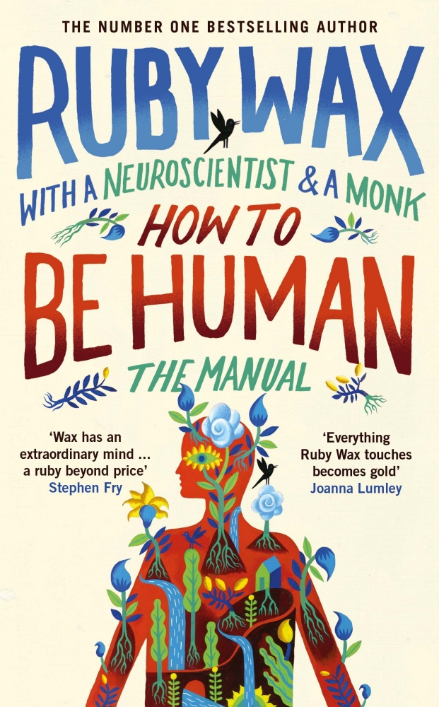
Ruby Wax’s latest book is called How To Be Human – The Manual. It’s insightful, funny, warm and engaging. A pleasure to read. It’s like somebody is pouring wisdom into your head while you’re having a chat with them.
Each chapter covers a topic and is wittily written by Wax. For each chapter Wax has consulted with Ash Ranpura, a Neuroscientist and Gelong Thubten, a Buddhist Monk.
At the end of each chapter are fascinating transcripts of these discussions.
Interspersed throughout How To Be Human Wax shares some of her own mental illness story.
So what exactly does Wax cover in How To Be Human? Pretty much everything. Here is each chapter title:
A Street Cat Named Bob is the uplifting and inspirational story about James, a man who is vulnerably housed and a recovering drug addict who discovers a rather remarkable cat.
The ginger tom, which James names Bob, is in a sorry state when he finds him. Bob has bald patches, is thin and has an infected abscess on his back leg.
As James nurses Bob back to health (with a little help) they develop a close relationship, becoming dependent upon one another. Readers will fall in love with Bob and James in equal measure.
James assumes that once Bob is well, he will leave. But Bob doesn’t. In fact he does quite the opposite.
James is working the streets of London. First busking and later selling The Big Issue magazines. Bob starts following him to work in the mornings, crossing busy roads and jumping on buses. So James ends up buying him a lead. But Bob often prefers to travel on James’ shoulder.
Bob is smart, inquisitive and a good judge of people. Many people take a liking to Bob and that helps to humanise James to them. James also learns to trust other people because of Bob. But the streets of London can be tough at times and not everyone acts out of kindness or compassion. In A Street Cat Named Bob Bowen tells the story of the tribulations and triumphs Bob and he face on the streets.
Astute readers will be left with some concern for Bowen when they finish reading A Street Cat Named Bob. Bowen values his friendship with Bob greatly. It comes across as the only significant relationship Bowen has. But the average indoor cat only lives for around 15 years (human years). So how is Bowen going to respond to the eventual death of his close friend? And will he be at risk of relapsing on to drugs or alcohol to manage his feelings of grief? I sincerely hope not.
A Street Cat Named Bob is a easy and enjoyable read, made so by Bowen’s warm and friendly tone. It’s a relatively short book at just 279 pages. It will leave readers feeling all warm and fuzzy on the inside. It is a must read for any animal lovers or anyone into sociology.
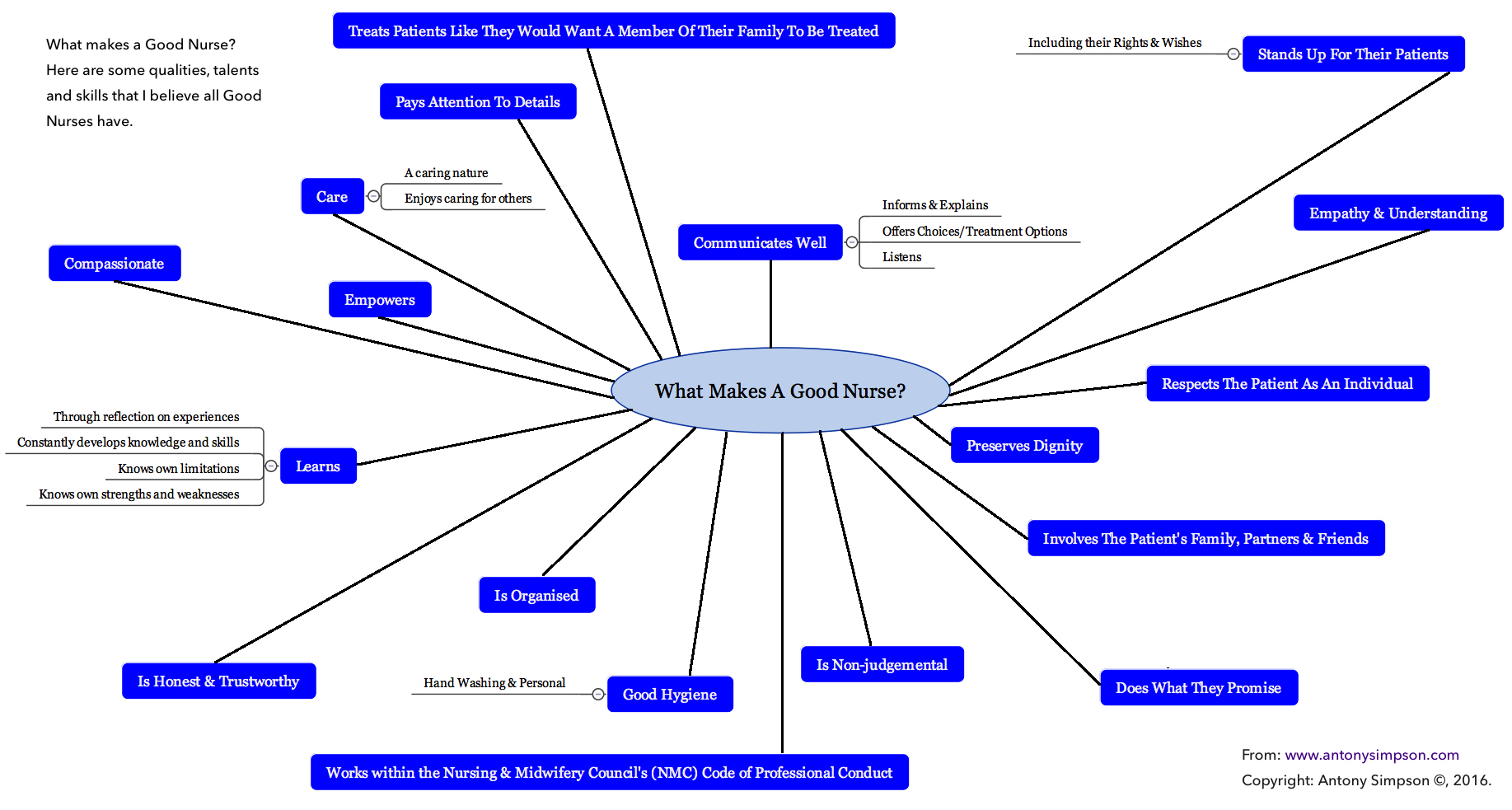
In my day job, I’m a Nurse. I had an experience recently that made me ask the question: What makes a Good Nurse?
I started with a mind map of my ideas (click on the Image for Full Size Image):
Mind Map: What Makes A Good Nurse?
Despite the size of the mind map, there were loads of other qualities, talents and skills that I simply couldn’t fit on the mind map. These include:
A Sense of Humour
Patience
A Holistic Approach to care.
An understanding of and interest in Biology (Anatomy & Physiology), Sociology & Psychology.
Basic Life Support – Skills in Cardiopulmonary Resuscitation (CPR).
An understanding of public health and health promotion.
An understanding of key issues: addiction, smoking cessation, mental health and obesity.
Knowledge of both hospital and community services including: what services offer, how they operate and how patient’s can access them.
Works Well in a Team.
Has Leadership Skills.
Aware of legislation relevant to patient care, safeguarding and other legislation related to their field of practice.
Has three goals: to prevent patients from getting sick/unwell, to make sick patients well again, and to keep patients as well & healthy as possible.
A Good Nurse needs to have so many qualities, talents and skills. No one person will have everyone of the qualities, talents and skills listed here. But I’ve worked with some fabulous Nurses that have come pretty close.
Nurses work in teams, which is where skill mix comes into play. Having a team of Nurses with a good mix of qualities, talents and skills means excellent patient care. This is because most, if not all of these qualities, talents and skills are met by the Nursing team as a whole.
Is there a quality, talent or skill you think a Good Nurse needs to have that isn’t on the mind map or list above? If so, please leave a comment below.
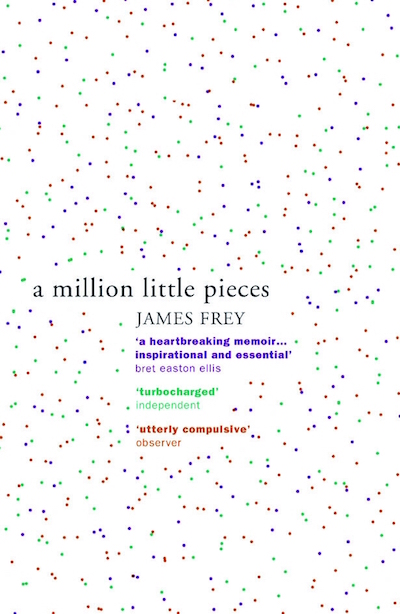
A Million Little Pieces by James Frey is addictive like crack cocaine. Once you pick it up and start reading, you’ll find it near impossible to put back down.
From the back cover:
Aged just twenty-three, James Frey had destroyed his body and his mind almost beyond repair. When he enters a rehabilitation centre to try to reclaim his life, he has to fight to determine what future, if any, he has. His lack of self-pity, cynicism and piety gives him an unflinching honesty – a fearless candour that is at once charming and appalling, searing and darkly funny.
(From: Frey, 2004)
Frey takes the reader on his rollercoaster of a journey to recovery from alcohol and drug addiction. It starts with him waking up on a plane with no memory of how he got there, what happened to his face or where he’s going.
A Million Little Pieces is set during Frey’s stay in rehab; is well paced and has plenty of tension, conflict and resolution. Both internally and externally. He recalls memories of his dysfunctional and chaotic alcohol and drug using past.
Stylistically A Million Little Pieces lacked speech marks, but this was possibly deliberate. Not having speech marks was a noticeable stylistic change to the normal layout of a book. Frey was probably using this to subtly hint that his story wasn’t like the story of most people. Frey’s lack of dialogue tags was generally acceptable, but on the odd occasion where Frey had written a scene with a group of people, it did get difficult to establish who had said what.
Towards the end of A Million Little Pieces it began to feel fictional. As I was coming to the end of the book and had enjoyed reading it, I decided to look into other books that Frey had written.
A Million Little Pieces was commercially hugely successful both in the US and internationally after being featured on the Oprah Winfrey Show. But then The Smoking Gun revealed in an article titled ‘A Million Little Lies’ that some of Frey’s claims around his criminal past didn’t match up with court records. Oprah had to respond to these revelations and interviewed Frey on a few occasions.
I can understand while some people felt lied to, as A Million Little Pieces was promoted and marketed as a memoir.
But I wasn’t in the slightest bit surprised that some of A Million Little Pieces was fact and some was fiction. Because that’s how it read. Who wouldn’t change some of their past if they had the chance? Don’t we all do that all the time? Change things to make them sound better or worse than they actually are with the aim of making our stories more interesting to our friends, family, co-workers, etc. Can we really blame Frey for doing the same for the reader?
Regardless A Million Little Pieces is still a great read. Worth reading if you are interested in addiction, crime, alcohol, drugs, rehab and recovery. Just hold on is a phrase often repeated in the book and was a phrase that I adopted when I was suffering from severe clinical depression.
I recognise that people visiting this page/post might want to know where they can get support. If you require support around your mental health, addiction or physical health, see this Support page here.