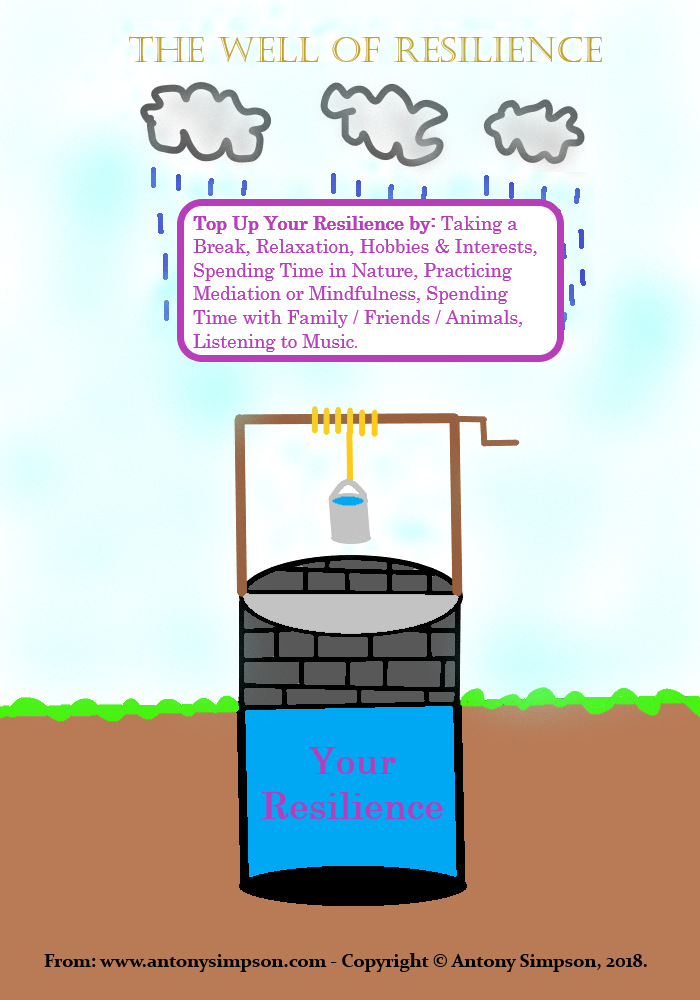
Resilience or emotional resilience is our ability to deal with adverse events in life that cause pressure or stress. I like to think of resilience as being like water in a well:
We only have so much resilience within us, like there is only so much water in a well. Adverse events cause us to use our resilience water by the bucket loads. But there is good news.
We can make it rain to add more resilience water to the well or just top it up a little at any time. We can do this by: Taking a Break, Relaxation, undertaking Hobbies & Interests, Spending Time in Nature, Practicing Meditation or Mindfulness, Spending Time with Family / Friends / Animals and Listening to Music.
How do you top up your well of resilience? Leave a comment below and let me know.
This is the second blog post in a series titled Wonderful Websites. The first post focused on General Health websites and can be read here. This post focuses on the most wonderful websites for mental health and mental illness.
1. Mind’s website is a treasure trove of mental health and mental illness information. It has an A-Z listing of mental health conditions, information about treatments, advice on how to support someone with mental illness, legal advice, urgent help advice and stories of people with mental illness.
CALM offers support for men who are feeling low or in crisis. They campaign for a change in culture, encouraging men to talk about how they are feeling and aim to eliminate the stigma of men seeking help due to mental illness. They hope to prevent as many male suicides as possible and also offer support for those affected by suicide.
3. SANE is a mental health charity credited with the Black Dog Campaign and the #EndTheStigma hashtag. The phrase black dog comes from Winston Churchill who described his depression as a black dog. SANE has also worked with Ruby Wax who coined the term Black Dog Tribe.
4. Head Meds tells you everything you ever wanted to know about medications for mental illness. It also gives information about conditions and shares people stories of mental illness. What I particularly like about this website is that it tells you how the medications affect sex, alcohol, weight, sleep and just about everything else.
A useful website that I always visit before medication reviews or at times when there’s discussions about changing my medication.
5. Bipolar UK has a great online eCommunity. I use it all the time and find it a very useful resource. People on the eCommunity are friendly and share their experiences around a wide range of topics.
The eCommunity goes a long way to making you feel less isolated and reassures you that you’re not the only one to be experiencing what you are. They also have support groups that are run by volunteers who are people living with bipolar. I used to go to a local group before it shutdown and found it invaluable on my road to recovery.
6. The Samaritans offer support by telephone, in person, email or by writing to them. Their telephone number and email is open 24/7/365, being a lifeline to people in a mental illness crisis.
7. Time To Change aims to end mental health discrimination. They do so by education in schools and by supporting employers. They have a wealth of information online including myths/facts, conditions, how to support your friend and a quiz to test your knowledge on mental health.
8. The Mental Health Foundation’s website has some informative publications which you can download or order a printed copy. Their vision is for everyone in the UK to have good mental health.
9. Anxiety UK has been around since the 70s and provides a wide range resources around anxiety. It’s website is informative, they offer an info line, a text service and training to organisations and companies.
Are there any wonderful websites for mental health and mental illness that I’m missing? If so, please leave a comment.
In the next post in my Wonderful Websites series I’ll be listing shopping websites.
Blog soon,
Antony
Support
I recognise that people visiting this page/post might want to know where they can get support. If you require support around your mental health, addiction or physical health, see this Support page here.
First educate yourself around mental illness. Mental health charities Mind and SANE both have informative websites.
Second: You must look after yourself. You can’t support anyone else if you are not well physically, mentally or emotionally. You may find my blog post 10 Easy Ways to Improve Your Mental Health useful.
On to the practical advice to support someone with mental illness:
Stay in contact with them. Ask them how they would like you to keep in contact. Some may may prefer phoning or seeing; whereas others may prefer messaging or texting.
Unconditional love and care. Let them know that you love them unconditionally and care for them deeply. Don’t have any expectation that they will reciprocate.
Listen to what they say and don’t assume anything.
Ensure that there are no distractions when you are with them or on the phone to them. Put your phone on silent and make sure any loud children are pets are out of the way (if you have them).
Offer practical support. Go shopping for them or with them, help them to clean, cook them a meal. Whatever it is that they need. They maybe resistant to the idea of practical help, so reassure them that you are happy to help and that you know they’d do it for you.
Remind them to take their medication or when appointments are due. People with mental illness tend to have poor short term memories.
Ask them about their appetite and diet. If they have an appetite but are struggling to make anything (due to lack of energy and/or motivation), find out what there favourite meal is and cook it for them.
Offer distracting activities. Distracting activities that you can both do together can give someone a break from their own critical inner of voice. The activities can be something as simple as a walk around the park. Make sure you are always led by the person with mental illness though. If they say that they are too unwell or tired to do the activity, don’t take it personally. And certainly don’t judge them or take offence.
Help them access support. This could include going with them to GP, counselling sessions or mental health service appointments. Offer to sit in appointments with them, but let them know that it’s okay if they want to be seen alone.
Be understanding. Someone with mental illness may cancel plans at the last minute. You may arrive at their house to find it messy and them unclean. Don’t take it personally, let them know that you understand and ask if there is anyway that you can help.
Be patient. Like any illness, mental illness takes the right treatment, the right support and time for them to start to feel better.
Limit questions and time spent with them, if you feel they are exhausted and need to rest. You’ll be able to spot if they need to rest by: pulling on their hair, forgetting what you’ve said to them, being very slow to respond, unable to think of words, dropping of their head, shuffling of feet and other body language people use when they look like they are about to drop off to sleep.
Be aware of your own body language and theirs. Try and display open body language and avoid mirroring.
Try not to give advice, as often it is unrealistic and unhelpful. For example never advise someone with depression to exercise more or have an healthier diet. This person has probably used all of their energy and motivation to get out of the bed. This single action has left them more exhausted than they have ever felt in their life. So advising them to exercise, eat an healthier diet or make big changes to their life will seem unachievable and may come across as if you are blaming them for their depression.
I recognise that people visiting this page/post might want to know where they can get support. If you require support around your mental health, addiction or physical health, see this Support page here.
Whenever the temperature really drops, like it has today, I think of people that are homeless. No scratch that, I think of people who I see as homeless – those that sleep on the streets.
I usually donate to my local homelessness project The Brick and hope that those sleeping on the street keep themselves warm enough to survive the bitter and bleak night.
If I’m totally honest: I find it utterly shocking that the UK, as one of the richest countries in the world, has homelessness and rough/street sleeping. At first glance homelessness could be easily resolved by ensuring suitable accommodation for everyone.
But the truth is that homelessness is a complex issue. Why? Because people are complex. There are also a range of complex issues that lead to people becoming and remaining homelessness.
The causes of homelessness or contributing factors include:
Poverty, being unemployed, being underemployed or losing source of income.
Unmanageable debt.
Addiction to alcohol, drugs or gambling.
Mental illness – including depression, anxiety, bipolar, post traumatic stress disorder (PTSD) and personality disorder.
Domestic Abuse – including violence.
Breakdown of relationships – both romantic and with family, friends or others.
Chronic physical illnesses or diseases.
Physical, emotional, sexual, financial abuse or neglect.
Having a family history of homelessness (according to Shelter).
Transformation or regeneration of areas – leading to unaffordable house prices, mortgages or rents.
Criminal and/or antisocial behaviour including being in prison.
Being in the care of Social Care or being in the Armed Forces.
Changes to benefits and social security administration and/or payments.
Poor social support networks or isolation.
Death of carers for dependents.
Having no right to work or claim benefits/social security.
A combination of the above.
There are two different types of homelessness: 1. People that are sleeping rough on the streets, park benches or doorways. 2. People that are living in temporary accommodation. People in temporary accommodation maybe housed by their local authority in a bed and breakfast or cheap hotel, or maybe sofa surfing staying with relatives or friends.
We don’t have a handle on homelessness in the UK. We don’t have accurate figures of people that are sleeping on the street. Local Authorities are once a year required to go out and survey the population of people who are sleeping rough in their communities.
It is too easy to ignore or forget about people that are homeless. I’ve ignored people sat on the street when I’ve walked through the High Street of various town centres. The cold weather triggers me to think about people who are sleeping on the streets. But most of the time, if I don’t go into town centres, I forget about people who are homeless.
Here are some ways, that wont cost you a penny, to prevent people that are homeless from being ignored or forgotten:
Educate yourself and others around homelessness.
Use your skills, talents or hobbies to promote awareness of homelessness. A good example is this blog post, I’ve written it to raise awareness.
Email your local politician and ask them to campaign for people that are homeless and raise the issue in parliament. Politicians have the power to make positive changes to reduce and prevent homelessness.
Donate old items to charity shops that specifically support homelessness projects.
Volunteer your time in homeless projects.
I once heard someone say: You are only ever two paydays away from being homeless. I can’t remember who told me this, or the find the first person to say this on the internet. But I believe it to be true.
Like I believe that anyone could end up becoming homeless, it would just require the right causes or circumstances to become present in your life.
So take action for people that are homeless, because one day it could happen to you. Or to someone that you love. You wouldn’t want yourself or someone that you love to be ignored or forgotten.