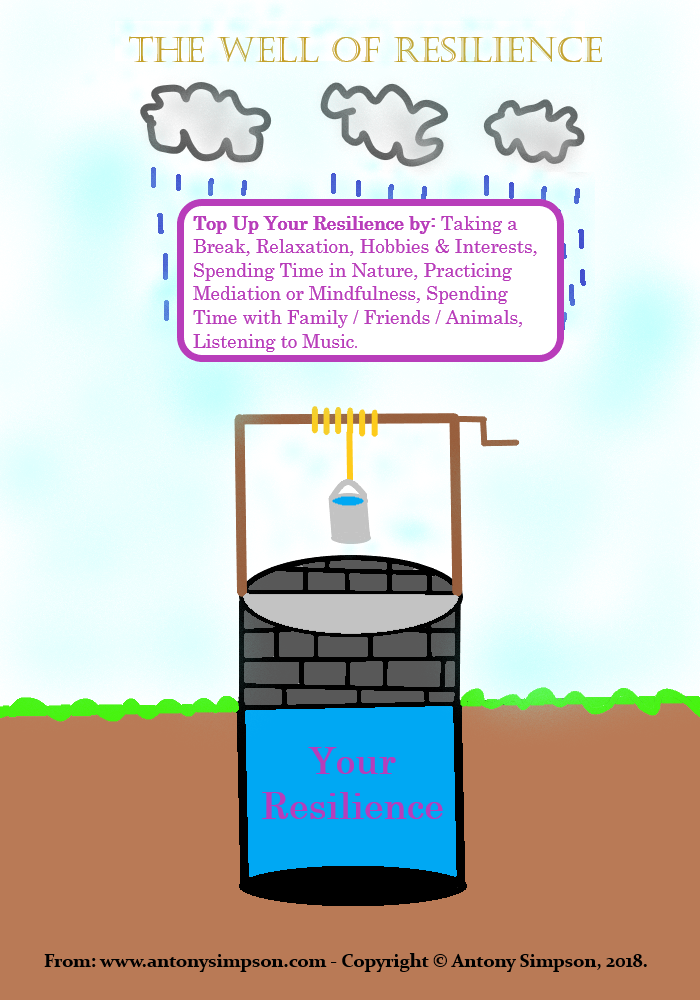
Resilience or emotional resilience is our ability to deal with adverse events in life that cause pressure or stress. I like to think of resilience as being like water in a well:
We only have so much resilience within us, like there is only so much water in a well. Adverse events cause us to use our resilience water by the bucket loads. But there is good news.
We can make it rain to add more resilience water to the well or just top it up a little at any time. We can do this by: Taking a Break, Relaxation, undertaking Hobbies & Interests, Spending Time in Nature, Practicing Meditation or Mindfulness, Spending Time with Family / Friends / Animals and Listening to Music.
How do you top up your well of resilience? Leave a comment below and let me know.
I’ve worked with teenagers, or adolescents or using the term I prefer young people for most of my career.
I’m often asked the same questions about young people, such as: Why do they take risks? Why can’t they always think about the potential consequences of their actions? Why can’t they see the perspectives of others? Why are they so concerned about what their peers think of them?
This great TED Talk video explains more about young people’s brain and its development:
Although this video is enlightening, it shows that neuroscience is in its infancy. Our understanding of probably the most the most important organ in the body is extremely limited.
I wish the speaker had gone into further details about young people’s behaviour, so that the questions above were more fully answered for those that have them.
Blog soon,
Antony
Support
I recognise that people visiting this page/post might want to know where they can get support. If you require support around your mental health, addiction or physical health, see this Support page here.
This is the eleventh and final blog post in a series titled Wonderful Websites. The first focused on general health and can be read here. The second focused on mental health and mental illness and can be read here.
The third post focused on shopping and can be read here. The fourth focused on money and can be read here. The fifth focused on gigs, shows and theatres and can be read here. The sixth focused on paganism and can be read here. The seventh focused on gay culture and society and can be read here. The eighth focused on TV, Online Streaming & Films and can be read here. The ninth focused on music & radio and can be read here. The tenth focused on technology and can be read here.
Here’s Wonderful Websites for autism and Asperger’s syndrome:
1. The National Autistic Society – A great online resource. It covers autism and Asperger’s syndrome for all ages and people in all circumstances.
2. NHS Choices – Autism Spectrum Disorder a great website for understanding the basics of autism and Asperger’s syndrome. It includes sections on: overview, symptoms, causes, diagnosis, treatment and adults with autism.
3. Scope: Autism – A fantastic website for all things disability. Their website has sections for people whom are disabled, a section for families and a section for professionals. They also have a telephone helpline.
4. Child Autism UK – A useful website if you have a child who has or you suspect has autism.
6. Asperger-Syndrome.me.uk – This website has some great content, but you can’t copy/paste the information as the information is saved as images rather than text. This means it’s usefulness for research purposes is limited.
Are there any websites around autism or Asperger’s syndrome that you think are useful that aren’t on the list? If so leave a comment below and let me know.
I’m a type 1 diabetic who has always struggled to have good control of my blood sugars.
I’ve been using a traditional glucose meter (a TEE2). Every diabetic will have a glucose meter. The meter tells the tester what their blood sugar is at the time that the reading is taken.
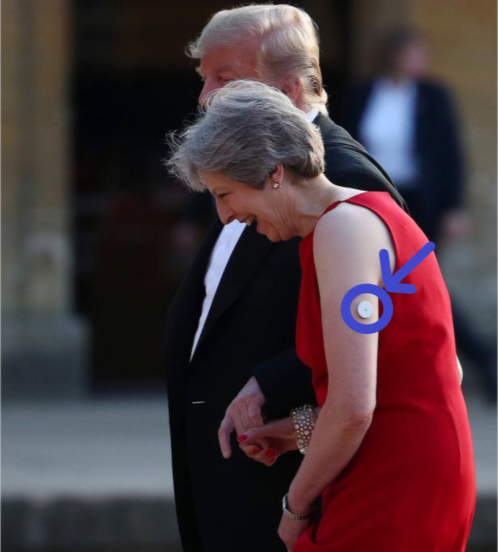
Nothing had really changed in the management or treatment of my diabetes for the last decade. That was until just over a week ago. It started when I saw this photo in the media:
I saw this photo of Theresa May (the current Prime Minister) who is Type 1 diabetic. I wondered what it was on her arm. (I’ve added on the circle and arrow on to the photo.)
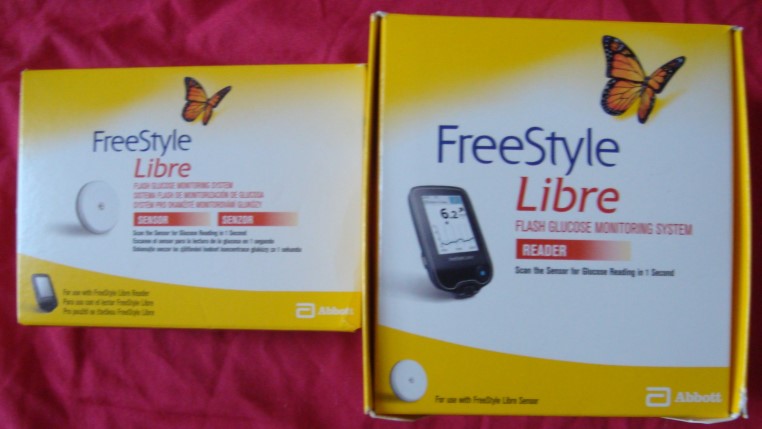
A sensor that has a needle that goes into the interstitial fluid is placed on the back of an arm. The sensor on the skin is about the size of a two pound coin. The sensor takes a reading every minute and stores readings at 15 minute intervals. The sensor can store 8 hours of data. A sensor lasts 14 days.
A Reader downloads data from the sensor, including the most current blood sugar reading by placing the reader near the sensor (using Fear Field Communication (NFC)). You don’t even need a Reader if you have a phone with NFC. You can download an App available for both Android and Apple smartphones that allows you to use your phone as a reader. I haven’t got a phone with NFC, so would need a reader.
So I did some research. I read the entire FreeStyle Libre website including watching tutorial videos and FAQs. Then I read some posts on the Diabetes UK Forums. I watched every video about the FreeStyle Libre on YouTube.
I discovered that in November of last year (2017) the FreeStyle Libre became available on the NHS. However from reading the forums it seemed that availability depended on local criteria.
I decided I needed to trial the FreeStyle Libre as part of a new health plan to improve my health and prevent illness where possible.
I managed to buy two sensors at my local Boots Pharmacy. A sensor cost more than £50 each. This was because I thought I’d probably have to self-fund due to the cost to the NHS.But I couldn’t buy a Reader anywhere. I rang my local Diabetes Specialists Centre. Their criteria for starting me on the FreeStlye Libre is: 1. is type one diabetic and 2. testing blood sugar 6-10 times a day. I met the criteria so they sorted me out with a Reader.
The Diabetic Specialist Nurse at my local Diabetes Centre was amazing. She sorted me a Reader. I saw the Diabetic Consultant in January and have been awaiting an appointment with a Dietitian. She said she’d chase this.
The Diabetic Specialist Nurse and I also arranged an appointment together in a few weeks time. This is so I can give her an update on my use of the FreeStyle Libre and so that she could write to my GP about putting the sensors on prescription. She informed me that if there was no improvement in my blood sugar control after 6 months, that my GP may choose to stop prescribing the sensors.
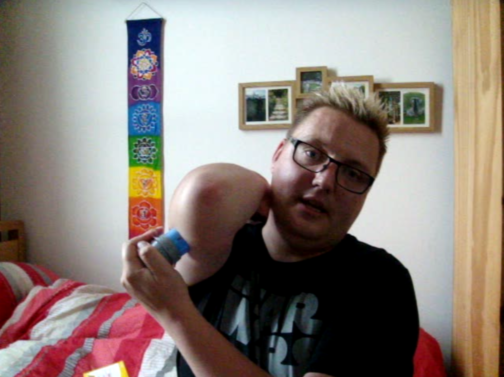
Excited I put on the sensor:
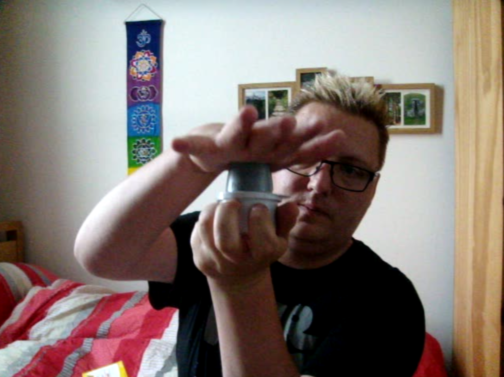
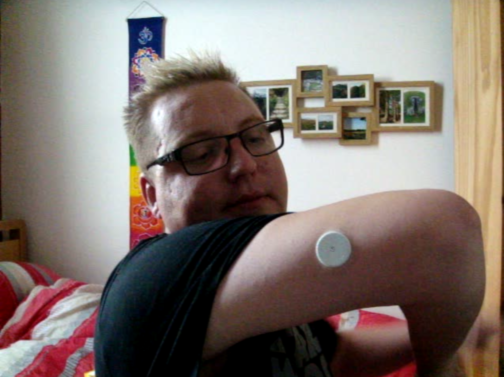
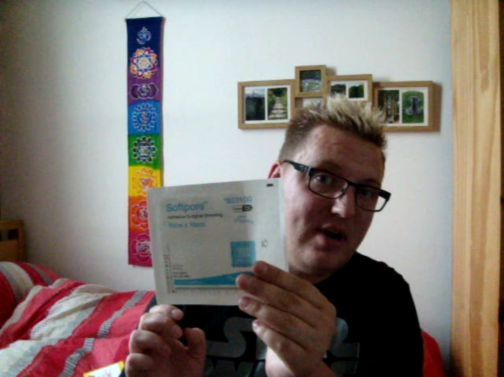
The sensor should be placed on the back of the arm. Start by cleaning with a pre-injection swab (provided with the sensor).The sensor is assembled by pulling off the lid of the white tub, then matching up the gray lines and pressing down. Really easy and simple.Place to your skin and press down. It’s painless and makes a clicking sound.There it is. Sensor on.I’ve chosen to put a 10cmx10cm dressing on my sensor to better protect it.All set up. Quick, easy and simple. I’ll let you know how I go on.
I’ve been wearing the sensor and using the reader for a few days now. So here’s the pros and cons I’ve discovered so far:
Pros
Cons
The sensor isn’t noticed by others being on the back of my arm (covered even by short sleeves).
I don’t feel the sensor in my arm at all. No discomfort or pain. The reader is pocked sized
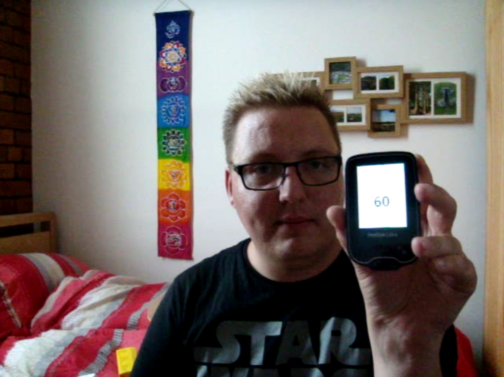
It’s quick and easy. A quick swipe and you have your current blood sugar along with a line graph showing your blood sugar throughout the day (and night) from readings the sensor has taken.
It’s more discrete swiping the reader near your arm, rather than getting out your glucose meter and pricking your finger.
I can check my blood sugar as often as I want, without worrying about running out of testing strips.
The reader has a whole host of useful features including: reading alarm reminders, logbook, daily graph, average glucose, daily patterns, time in target glucose range (which you set when you setup the reader), sensor usage, add notes to go with readings (including units of rapid-acting insulin, units of long-acting insulin, food – carbs, medicine and exercise).
It tells you how many days you have before you need to change the senor on the home screen.
The daily graph along with arrows showing whether your blood sugar is increasing (and how quickly), stable or decreasing (and how quickly) are enabling me to make better bolus insulin adjustments. The food notes will enable me to better match the number of rapid insulin units I need to administer based on the number carbs I’ve eaten.
The reader is helping me to identify trends in my blood sugars and helping me prevent my blood sugar from rising too high. FreeStyle have software for both Windows on Mac that uses the data to create reports that you can share with Health Professionals.
If you have a phone with NFC you can use an App on your phone rather than using the reader. The Apps appear to have all the same features as the Reader.
The reader comes with with a USB wire (for connecting to computers) and has a plug to charge it from mains. According to the manufacturer, a full charge lasts about a week with average use.
The sensor takes the reading from interstitial fluid rather than blood. This means that the reading is 10-15 mins behind. This is not an issue if your blood sugar is stable, but could be an issue if it’s dropping.
The reader feels a little flimsy and doesn’t come with any cover or pouch to protect it from damage and general wear and tear.
The DVLA don’t currently allow readings from this monitor to count as a before driving test. Therefore a traditional glucose meter and finger pricking is still required prior to driving.
The sensors are expensive, costing over £50 each. This is a Con whether you are paying for them privately or whether the NHS is being charged for them (as we pay for the NHS through our taxes).
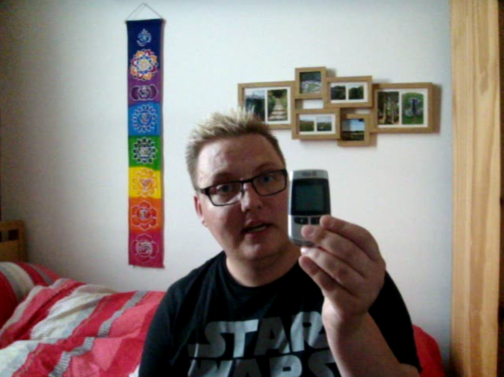
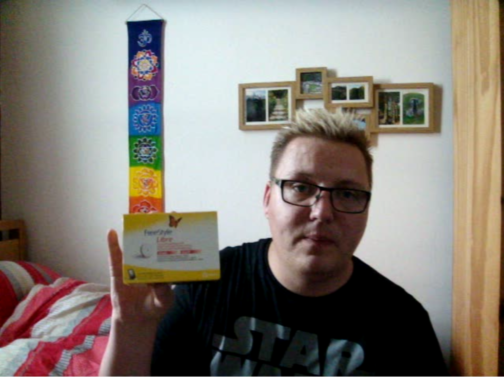
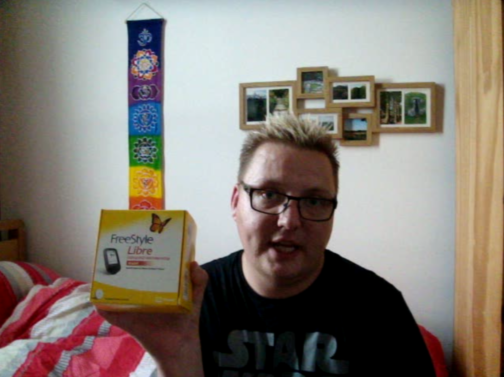
I was going to do this blog posts as a vlog (video blog). But I couldn’t get my head around the video editing software, so opted for the written method instead. That’s why the photos of me look like image captures from a video, because they are.
The FreeStyle Libre Glucose Monitoring System is just one part of my new health plan. I also want to become SmokeFree for good and lose weight through a better diet and regular exercise.
Write soon,
Antony
Support
I recognise that people visiting this page/post might want to know where they can get support. If you require support around your mental health, addiction or physical health, see this Support page here.