Thinking

Proud of Tom Daley

Reading Time: 2 minutes

I know it’s old news now; but Tom Daley recently revealed that he is in a relationship with a man. He made this disclosure on this YouTube video:

Click here to display content from YouTube.
Learn more in YouTube’s privacy policy (opens in a new tab).

My initial reaction was pride. All out gay or bisexual men have had to have these difficult conversations at some point, so I definitely empathised. These conversations are hard enough, but for Tom it must have been even more difficult given his position.

Tom is an Athlete in the Sporting Profession; and how many out gay professional Athlete’s or sports people do you know? Gareth Thomas the retired Rugby Player comes to mind, but he only came out as gay after he retired.

Then there’s Robbie Rogers a US Football Player, who used to play in the UK but no longer does. It is unbelievable that of the estimated 4,500 professional Football Players in the UK, he is the only gay or bisexual one. Statistics apparently show that 1 in 10 men are gay or bisexual, so it is likely that there are many professional footballers as well as other Athlete’s and sports people that haven’t come out.

The reason Athlete’s and sports people don’t come out is the stigma still attached with being gay in the sport industry. Professional sports people worry about losing fans, sponsors and ultimately their jobs. Tom will have been aware of all this and is very brave for risking all.

I’ve read many journalistic reactions and opinion pieces on his disclosure. I’ve also read many supportive messages to him, along with some quite blatantly homophobic ones.

I wasn’t just proud that Tom had come out as being in a relationship with a man, but that he had put himself in a position of emotional vulnerability in search for acceptance. Acceptance is an innate human desire and in order to gain acceptance you have to let people know you.

I have pondered if Tom deliberately avoided using the words gay or bisexual, or even if these words needed to be said. I’m sure that Tom coming out will be a great role model to any gay teens struggling with their sexuality – what it means for them and their life.

If I were to give a message to Tom it would be this:

Thank you for sharing who you are. I wish you every happiness, you deserve it. Keep the people in your life that accept, love and care for you. The people that don’t this feel this way – don’t worry or waste your time thinking about them. Just keep working, living and loving who you are.

Published by: The Gay UK on Friday 17th January 2014.

Other Content

If you liked this post, you might like:

Take care,

Antony

More Content From Antony

Here are the books that Antony has published:
Share on Social Media:
The Web, Thinking, , , , , , , , , , , , , , , , , , , , , , , , , , , , , , , , , , ,

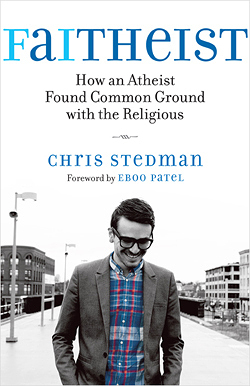
Book Review: Faitheist by Chris Stedman

Reading Time: 3 minutes

Chris Stedman is an atheist with a humanistic ethical code. Stedman, through his interfaith work, encourages the religious and nonreligious to come together and share their stories to humanise and understand one another for the greater good. He is the Assistant Humanist Chaplain at Harvard University and writes on his blog NonProphet Status, for the Huffington Post as well as on various other media platforms.

In Faitheist, Chris Stedman shares the story of his life (so far). The full title of the book is longwinded (Faitheist: How an Atheist Found Common Ground with the Religious) and the introduction is off-putting. The introduction is full of terminology that is unfamiliar, unless you’re an Atheist Activist or an Interfaith Worker/Volunteer. This terminology and the elongated words are both unnecessary.

But get past the introduction and Stedman’s story is fascinating. Told in his warm and engaging writers voice his story is educational, enlightening, completely honest and emotionally resonant.

Stedman starts with his childhood; describing it as ‘not particularly religious.’ He discusses his search for a place to belong and a community to be a part of. Towards the end of his childhood he joins a church and becomes a Christian.

Stedman moves into his adolescence and tells us of his developing homosexuality. He describes a difficult time in his life, one where his sexuality and his extreme Christian beliefs are at odds. He discusses his self-hate, guilt and his loss of faith in God. He reveals how his mum discovered that he was gay and how she supported him. Lost, Stedman sets out on journey to find himself.

Stedman tells of his early adulthood; describing his journey to find himself and what he wants to do with his life. He tells that through Voluntary & Community Work he served others (a recurring theme throughout his entire life), he realised that the religious and nonreligious need to work together (interfaith working). He explains that he realised this has to start with understanding one another’s perspective.

Stedman writes about his set and strong convictions towards the end of this book, clearly promoting humanism. However he has a history of changing some of his views, based on his life experiences. So this left the question as to whether some of his views may change over time. Not his core values, those have always remained a constant, but some of his views on complex ‘grey’ areas in life.

As Stedman shares his story he describes his patchwork of tattoos and their meaning to him and his life. Stedman demonstrates his wonderful ability to reflect on his own experiences and learn from them. He reveals his unique passion, vibrant personality and how so alive he is. A gorgeous man with a beautiful, caring soul.

Stedman concludes his book, not surprisingly, advocating the bringing together of the religious and the nonreligious (atheists). He suggests that they should share their life stories with one another. This he states will lead to a better understanding of one another, so that they can work better together. He encourages the reader to open a dialogue with people from all walks of life, to listen to their stories and share yours.

Stedman could have included some glossy photo pages to match his autobiographical style of story sharing, which would have been great for visual learners.

Faitheist by Chris Stedman is a thought-provoking read and will appeal to anyone who is interested in the study of religious or atheism, the effect of religion on homosexuality, humanism, philosophy, ideology, interfaith work and/or bringing communities together.

Faitheist: How an Atheist Found Common Ground with the Religious by Chris Stedman is available to buy on Amazon. If you liked this post, you might like: All Books & Literature Content.

Review soon,

Antony

Share on Social Media:
Books & Authors, Gay, Reviews, Thinking, , , , , , , , , , , , , , , , , , , , , , , , , , , , , , , , , , , , , ,

Changes to The Pink List (2013)

Reading Time: 2 minutes
Pink List 2013 Logo

The Independent on Sunday has been producing their annual Pink List since 2000. The Pink List is a list of influential gay, lesbian, bisexual and trans gay people in the UK. Each year The Independent assembles a panel of Judges, opens up for nominations from the public and then decides who to award the 100 places to and in which order.

This year’s Pink List 2013 has been published and with some interesting changes. No longer is it enough to be gay and a well known public figure whose a role model to gay youth. This year people on the list have to have contributed or made a difference in some way.

The Independent on Sunday have created two separate lists in addition to the main pink list; one for National Treasures and one for Politicians. On the National Treasures list is the likes of Russell T Davies, Paul O’Grady, Sir Elton John, Stephen Fry, Sir Ian McKellen and John Barrowman. On the Politicians list is various Westminster Peeps.

I am disappointed by the creation of these separate lists for National Treasures and Politicians. I think it is enough to be gay and a role model, so I’d have kept the one Pink List. I’d have just put people who have contributed more in the last year higher up on the list.

I would have extended the list to accommodate the increasing number gay people coming out. It shows that we are out there in numbers and contributing to society. For easy reading, I would have split the list into parts: 1-10, 11-30, 31-50, 51-100 and 101+.

The Pink List has always missed out people that are not in the media spotlight. I think the Pink List could be massively improved by including these people who are contributing a great deal to their local communities and society as a whole. These ‘ordinary’ LGBT people are doing amazing things. Such as those Workers/Volunteers for The Albert Kennedy Trust & George House Trust, Students who’ve set up LGBT Societies in Universities and Employees that set up or run LGBT forums within their employers organisations.

The Pink List should include out LGBT parents. Its very difficult to be an out LGBT parent. Many LGBT parents worry about the impact of their sexuality/gender identity on their children, in terms of some schools institutional homophobia and bullying by other children. I discovered this through two interviews with LGBT parents for a feature article for The Gay UK. The first interview was with Paul and the other with Linda.

Finally, I think there should be a list of influential straight people who support gay rights. The gay marriage bill would have never been passed into law, if it wasn’t for the many straight people who voted in favour of the bill.

Other Content

If you liked this post, you might like:

Blog soon,

Antony

More Content From Antony

Here are the books that Antony has published:
Share on Social Media:
Gay, History, Thinking, , , , , , , , , , , , , , , , , , , , , , , , , , , , , , , ,

Thinking About Homelessness

Reading Time: 3 minutes

This time of year when it’s dark and cold makes me feel for people who are homeless. Who’d want to spend a single night sleeping outside in this weather?

No matter the cause of someone’s homelessness; it can be a vicious cycle. A person needs an address to get a bank account, so that state benefits can be paid to them. They often need to be in receipt of benefits to get support in accessing housing and so that housing agencies can contact them. Of course there are ways around this, but people who are homeless people often don’t know how the system works.

People who are homeless also tend to have complex issues (such as substance misuse, relationship breakdowns, bereavements, etc.) that they are trying to deal with at the same time.

So I recently made two donations to The Albert Kennedy Trust and Shelter. The donations were small, but something is better than nothing. Here is some information about the work the charities do and a link for donations:

The Albert Kennedy Trust supports lesbian, gay, bisexual and trans homeless young people in crisis. They have offices in London, Manchester and Newcastle.

Donate to The Albert Kennedy Trust

Shelter helps millions of people every year struggling with bad housing or homelessness – and they campaign to prevent it in the first place.

Donate to Shelter

A friend and I were talking recently about what we do when we see a person who is homeless on the street begging. I said that I don’t usually give money as I don’t carry it, but if I’ve got the time, I offer to buy them a hot drink.

My friend said that he collects McDonalds hot drink loyalty cards stickers and saves completed loyalty cards to give to the person who is homeless and on the street begging. I thought this was a great idea and will be doing it as well.

Anyone can become homelessness, it just needs a certain set of circumstances to happen a person. This means that it can happen to you, a member of your family or one of your friends. I once read somewhere that we are only ever two paydays away from being homeless. Considering this, perhaps it’s worth making a small sacrifice (like that cup of coffee from Starbucks/Costa you buy) and using the money to make a donation to one of the charities above? I’ll let you decide.

Throughout the year, I’ve also donated items of food to a FoodBank run by The Trussell Trust. The UK is one of the richest countries in the world, yet in the last few years the numbers of people who need to use FoodBanks has dramatically increased. This is worrying and is symptomatic of some of the poorest people being forced to make some very difficult choices.

I’d like to share a thought with you: It seems to me that the rich are getting richer and the poor are getting poorer. I don’t write this to be depressive, simply to express a thought that many people are thinking.

Here’s another thought: This is not the kind of society I want to live in. Food, water and housing are all basic things that everyone should have access to.

So the question becomes: How do we go about changing our society for the better? Any ideas or opinions, please comment below.

If you liked this post, you may like my All Societal Commentary Content page.

Take care,

Antony

Share on Social Media:
Thinking, , , , , , , , , , , , , , , , , , , , , , , , ,
Scroll to Top
×