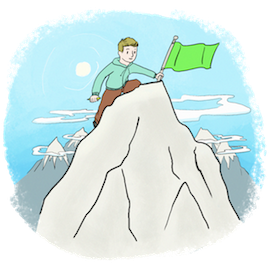
I’ve wanted to write this post for a long time. I’ve started it countless times, looking at adversity from many different angles. In the end, I decided that the best way to express what I want to say about adversity and overcoming adversity is through a little tale.
Growing up I had difficulties with reading and writing because of Dyslexia and Dyspraxia. At sixteen years old, I had a reading and comprehension age of fourteen. I remember when I was younger, having to read paragraphs two or three times to get the meaning of the words. The thought of reading a book at this age, was like the thought of climbing a mountain.
I couldn’t write my name until I was ten years old. I understood what we were taught in classes, but just couldn’t write it down on paper in an organised and structured way. I got very good at talking and verbal presentation to compensate.
Fast forward to now. I have overcome adversity in relation to reading and writing. I’m always reading at least ten books at any one time. I read nineteen books last year (see Book List 2015) and I read twenty-eight books the year before that (see Book List 2014). I regularly get sent books by publisher’s publicists to read and review. Thankfully I no longer need to re-read paragraphs two or three times to understand them. I write creatively on a regular basis. I’ve recently published a short story entitled Soulmates and write for The Gay UK.
In addition to the above: I have done well academically. I have been to university twice and about to go back to university to complete a further module. I have gained a HE Diploma in Children’s Nursing and a Honours Degree in Nursing, graded at a 2:1.
The reading, the writing and the university wouldn’t have been possible without overcoming adversity. But what’s really interesting is that I’ve learned some fundamental things that were required in order for me to overcome adversity. These included:
Grit or determination. Not giving up. Continuing to read and write, even when I felt like I was banging my head against a brick wall.
The support of others. My mum fought the education authorities to get the professional help I needed to learn to read and write. Teachers, Teaching Assistants and Volunteers all spent countless hours teaching me to read and understand what I was reading. My mum fought the health authorities to get the practical support from a brilliant and professional Occupational Therapist. And of course my mum helped and supported me in so many other ways: spending time reading with me, taking me to my Occupational Therapist appointments, just listening when I needed to vent my frustration, etc.
Practice. Repetition is the key to learning and the way of getting good at anything. Think of when you learned to ride a bike as a child.
Being driven by my love of literature. Even with my difficulties in reading and writing, I used to be captivated by the stories my mum would read to me at bedtime. By how words could ignite my imagination and make me feel very real emotions.
People having belief and faith that I could overcome my reading and writing difficulties. This includes both family and friends.
Believing in myself, or at least hoping that I could overcome these reading and writing difficulties.
I would imagine that these fundamental things are essential for anyone trying to overcome adversity. I wanted to share these thoughts, for anyone currently struggling with adversity. If you have overcome adversity, how did you do it? What did you need in order to overcome adversity? Leave a comment below.
See a Sunrise. Didn’t happen. The sun rises far to early for me. Visit a new place. A city or town that I’ve never been to. Does going to India in July count? See My India Adventure Part 1, Part 2, Part 3, Part 4, Part 5, Part 6, Part 7 & Part 8).
May
Celebrate my birthday. A night out to celebrate in style. Possibly in another city or town. Didn’t happen, instead I deliberately made no plans. Visit a Castle or a Pagan site. Didn’t happen due to poor health.
Visit Chester Zoo’s new Islands exhibit. This was something I really wanted to do this year, I just wasn’t well enough. In addition I had a marvellous massage.
September
Learn to Knit. Didn’t happen. Donate to charities. I made charitable donations in November. In addition I discovered the superb Writer Matt Haig, reading a reviewing: The Humans and Reasons to Stay Alive.
Take some time out to relax. I took what-I-call a Life Hiatus.
December
Watch Star Wars: The Force Awakens at the cinema. Didn’t happen.
Overall ill health has effected my ability to achieve my goals and have new experiences this year. In 2016, I hope for better health so that more of my goals can be achieved.
Recently, I had to take an unexpected what-I-call Life Hiatus. My mental health had gradually deteriorated to the point were I was having severe and erratic mood swings. Everyone’s mood fluctuates throughout the day, but not to the extremes I was experiencing.
People talk about good and bad days with depression. I was having good, bad, okay or mixed mood states lasting between 45 minutes to 4-6 hours. These mood swings were unpredictable with no pattern. They didn’t have triggers and were not related to a critical inner voice.
These mood swings were torturous. See My Mood Swing Table below for details of what these mood swings were like.
I felt desperate for the mood swings to end. To the point of having suicidal ideation and a clear plan of action.
I had thought that I was objective about my mental health. But because the mood swings had gradually got worse I hadn’t realised how unwell I was. I sought help because three people close to me said that I wasn’t well. Luckily I had these people around me and knew that could trust them, even if I couldn’t trust myself.
So I went to my local A&E. I was assessed by a Mental Health Nurse and together we decided that I needed admission. I stayed on the A&E Ward overnight, whilst I waited for an available bed on a mental health ward.
The next evening, I was transferred to a mental health ward. On arrival at the ward, my possessions were searched and Nursing Staff took my shoe laces, belt, hoodie (due to cord in hood), phone charger, lighters and medication. The ward layout was a square shaped main corridor with dormitories, individual rooms and many other rooms that where behind locked doors.
The first night was frightening. Everything about the place was frightening. The environment. The locked doors. The routine. The rules I hadn’t been told. The other patients. The staff. I even found my own mood swings frightening. At one point, I was physically shaking uncontrollably due to the fear and anxiety.
I was assessed by a Psychiatrist and commenced on 10 minute observations. It would be a few days before I was reviewed. At the time, I couldn’t understand why they appeared to be doing very little to help me and my state of mind. But afterwards, I realised that they had wanted to observe me and see my mood swings for themselves.
The Consultant Psychiatrist diagnosed me with a ‘Mood Disorder.’ Here is a definition of a ‘mood disorder:’
mood disorder – noun
a psychological disorder characterized by the elevation or lowering of a person’s mood, such as depression or bipolar disorder.
(From: Google, Last Accessed: Friday 27th November 2015.)
The Consultant Psychiatrist informed me that they were reluctant to give a more specific diagnosis on the first admission to a mental health ward. I told the Consultant Psychiatrist that I didn’t care what they called it, as long as they gave me some medication that worked. I explained that with some stability in mood, I could make further psychological and behavioural changes to help myself to get well and stay well.
I was started on Quetiapine, an antipsychotic and mood stabiliser medication. It was to help to take the edge off my mood swings and give me some stability of mood. I was also started on Mirtazapine, an antidepressant. This was to help to manage the depression/low moods.
Overall, I was an in-patient on the mental health ward for about 12 days. During this time, my Mum and good friend Steve were superb. They took over all my responsibilities and made sure that everything in the outside world was sorted, meaning that I didn’t have to worry about anything – apart from getting better.
I will never be able to thank Mum and Steve enough for what they have done for me, but I have repeatedly thanked them anyway. I will never be able to explain how much I appreciate them for everything that they have done for me, but I have tried to explain anyway.
I feel that I got to this crisis point because I waited so long to get referred to and assessed by Community Mental Health Services. It feels like Community Mental Health Services are designed to keep people out, rather than let people in to get the help and support that they need and in most cases are asking for. This is probably because of a lack of resources in mental health services. But this really doesn’t help and support people with mental health problems to get and stay well.
I have been discharged from the hospital and am and engaged with Community Mental Health Services. Recovery will be a slow and progressive one. I am taking the medication as prescribed, attending appointments with community services and setting myself daily goals that I am currently achieving.
Write soon,
Antony
My Mood Swing Table
Highs
Okays
Lows
Mixed Mood States
Physical Symptoms
High energy levels.
Very productive.
Difficulty in getting/staying asleep.
Head aches.
Speaking Quickly.
Hypersexualised.
Relatively symptom free. Considering the extreme High and Low physical symptoms.
Exhaustion – despite sleeping for many, many hours.
Back pain and stomach pain that doesn’t resolve with appropriate treatments.
Head aches.
Constipation.
Physical anxiety symptoms: raised pulse and blood pressure.
A mix of high, low and okay physical symptoms to varying degrees of severity.
Mental / Cognitive Symptoms
Racing thoughts – lots of ideas, but struggling to focus on one for long enough.
Difficulty in concentrating.
A rush of ideas for creative projects.
Saying whatever I think without considering the implications of what I’m saying.
Grandiose thinking – Thinking I can do anything to a level beyond the level of an expert.
Thinking that I understand things on a much deeper level than everyone else.
Short-term memory loss.
Insomnia and night terrors.
Slower mental and cognitive functioning, compared to when I was well.
Limited/no concentration span.
Short-term memory loss.
Critical inner voice.
Thoughts about what other people negatively think about me.
Insomnia and night terrors.
Concern about loosing my mind.
A mix of high, low and okay mental / cognitive symptoms to varying degrees of severity.
Concern about loosing my mind.
Concern about what mood would come next and its severity.
Emotional Symptoms
Excessively joyful with no reason for this state of mood.
Super confident. Loads of self-esteem.
Excessively excited again without reason.
Feeling like I can do anything.
Feeling frustrated or irritable without a reason.
Varying levels of anxiety, from worried to outright panic.
Void of any emotion.
Zombified. Feeling like what I imagine a zombie feels like.
Going through the motions.
Despair and hopelessness.
No confidence and rockbottom self-esteem.
Feeling frustrated or irritable without a reason.
Feeling like I am falling down a dark bottomless pit.
Feeling guilt, inadequacy and feeling like a failure.
Varying levels of anxiety, from worried to outright panic.
Desperation – wanting the mental and emotional anguish to end.
Feeling like my mind, body and soul are being devoured and destroyed.
A mix of high, low and okay emotional symptoms to varying degrees of severity.
Behavioural Examples
Being super productive.
Being overtly social.
Take on too many commitments, thinking that I can do everything.
Impulsive behaviours – including excessive shopping, even when I don’t have the money.
Unfinished tasks – sometimes being unable to focus for long enough on tasks to complete them.
Able to function, but only just.
Loss of interest in leisure activities.
Unable to watch TV, read or do other leisure activities.
Overeating or forcing myself to eat despite having no appetite.
Poor personal hygiene.
No motivation.
Reckless spending of money – mostly through online shopping.
Social anxiety – isolating myself and avoiding social situations.
A mix of high, low and okay behaviours to varying degrees of severity.
Support
I recognise that people visiting this page/post might want to know where they can get support. If you require support around your mental health, addiction or physical health, see this Support page here.