Edit: 20/05/19, 08:45 – I had to change the video as the user had removed the original. There was a Vevo video, uploaded to Madonna’s official YouTube channel however it appeared to have been altered to make her performance sound better than it was during the original broadcast. So I went for this video that is more reflective of the original performance.
Madonna has had criticism since, with many calling it a disastrous and possibly career ending performance. People have described her voice as flat or off key, her outfit and the Christian heavy iconography controversial and unappealing.
I must admit that cringed watching it. But I realised something from it: We’re all human. Even Madonna.
We’ve all had times when things have gone disastrously wrong for us. I don’t know much about Madonna to be honest, but I once did see an interview where she described herself as a perfectionist. So I imagine that Madonna is currently in a mental state of self-denial, or one of rumination with her critical inner voice in over drive.
So here’s some mental health advice to Madonna, from my book Mental Health Wisdom:
Rumination
Rumination is thinking the same thoughts or replaying memories again, again and again in your mind. Nothing good ever comes from it. It’s like having a song that you hate on full ear-bleeding volume and stuck on repeat. Rumination makes you feel like you are losing your mind.
When it comes to replaying memories, they are usually memories that are emotionally traumatic. Our memory of events is never accurate and always has a negative bias. What you need to remember if you find yourself ruminating is that the event has happened. It’s in the past. It’s gone. You can’t change what’s happened, no matter how many times you replay the video. It’s time to accept what’s happened, how it made you feel, so that you can let it go and move on.
Rumination is a waste of time, energy and effort. Rumination and the Critical Inner Voice go together. The critical inner voice is that voice inside your head that says things like:
You’re not good enough.
You don’t know what you’re doing.
Just who do you think you are?
You’re worthless.
You screw everything up. You are a screw up.
Nobody cares about you.
The critical inner voice is abusive and says things that we wouldn’t dream of saying to our worst enemy. It never says anything useful, nice, good or kind. It tends to get louder and louder if we allow it to. Managing the critical inner voice starts with the choice not to put up with the things it says to you.
I manage my critical inner voice in two main ways. First by imagining a volume control knob. I imagine it being turned down and hear the voice go quieter and quieter until it is silent. Second, I repeat positive affirmations that I know are true. I say things to myself like:
I am good at my job. I have a lot of specialist knowledge and thirteen years of clinical experience.
I offer a lot to people around me, including humour, compassion and kindness.
People value my opinion. I know this because I am often asked for it by others.
I am doing the best that I can and learn every day.
Having difficulty coming up with positive affirmations about yourself that are true? Ask people who are close to you: What is positive about me? What do you like about me? Others often see things that we don’t spot in ourselves.
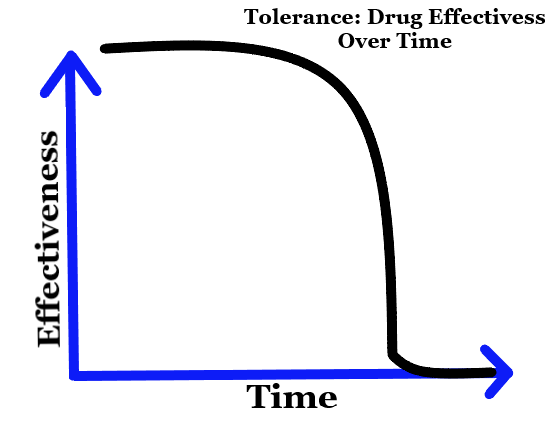
If you take medication for anything, including mental illness, over a long period of time your brain and body develops a tolerance. This means that the medication becomes less effective.
How long a tolerance takes to develop depends on the individual. You may get a tolerance quickly (weeks or months of use) or slowly (years or decades of use). The process of developing a tolerance is so gradual that you might not notice straight away. In fact it might take you quite sometime to understand that the symptoms of illness are returning and that you need to have your medication reviewed. Here is a line graph that shows drug effectiveness over time:
When your brain and body develop a tolerance you have two options:
Increase the dose of your medication.
Change your medication.
Any increases in dose or changes to your medication should be done under medical supervision. Some medications have withdrawal effects, which you may experience if you suddenly stop or decrease the dose too rapidly. The withdrawal symptoms range from relatively mild to extremely severe.
I am on a mood stabiliser medication. Developing a tolerance to this medication is beyond terrible. It’s awful, frustrating and occasionally overwhelming. At times it feels like I am being tortured.
I visited my GP some months ago and explained how I was feeling in mood. My GP referred me to the Community Mental Health Team. I waited 4 weeks for a twenty minute telephone assessment.
I was passed onto a Pharmacist Prescriber, another 4 week wait. She appeared to be concerned about hypomanic symptoms that I’m experiencing including:
High levels of anxiety.
Increased energy.
Difficulties in falling or staying asleep.
Increased productivity.
Obsessional thinking.
Being very irritable and frustrated.
Switching between tasks without finishing any of them.
Increase in desire to have sex.
Feeling on edge and being unable to relax.
Writing a lot.
Fidgeting.
A couple of severe mixed mood states per week.
Although many of these symptoms may seem positive at first glance, when your mind takes them to extremes they become destructive and are damaging to your physical and mental health.
The Pharmacist Prescriber doubled the doses of my medication. This proved ineffective. She discussed my case with she with a Consultant Psychiatrist whom wants to see me. Another 5 week wait.
All this time waiting and struggling. All this time of lacking a quality of life. I can’t even sleep off the severe mixed mood states.
I totally understand how underfunded the NHS is and in particular how under resourced mental health services are. So far I’ve waited 13 weeks (3 months and 1 week).
The wait feels eternal and I am beginning to feel that nothing will ever change. I know rationally that neither these last two emotionally driven thoughts are correct. Yet it can be difficult to disregard how you feel.
What’s the number of people likely to like or love you? What’s the number of people likely to be indifferent towards you? What’s the number of people likely to dislike you?
This fascinating psychological theory from Professor Steve Peters, called One in Five answers the above questions:
I’m unsure what research and evidence this theory is based on. But being aware of this theory can help you to:
Recognise the people that like or love you. I name these fans. Despite being fans of you, good relationships with these people will still need to be developed and maintained.
Recognise that the majority of people will be indifferent towards you, but that you can influence these people by what you say and/or do. Try to be as self-aware as possible. Understand and empathise where these people are coming from and understand their wants, needs, desires and motivations.
Accept that not everyone will like you. No matter what you say and/or do.
I hope you find this psychological theory useful, I certainly did when thinking about my desire to please people.