money

Is the UK Heading for an Economic Disaster? It SEEMS like it is.

Reading Time: 2 minutes

What I write in this post is my personal opinion. I am not an Economist or similar profession. I am simply a UK citizen who has been trying to keep myself informed around the cost of living and who is seeing people around me struggling. Struggling with rising costs and stagnant wages.

The UK seems like it is heading for an economic disaster, one in which masses of people won’t be able to afford to pay all of their bills and fully meet all of their expenses. With every individual bill/expense likely to rise in 2027 by between 3%-20%, I just don’t know how people are going to afford it. Here are some expected increases, click on table image for full size:
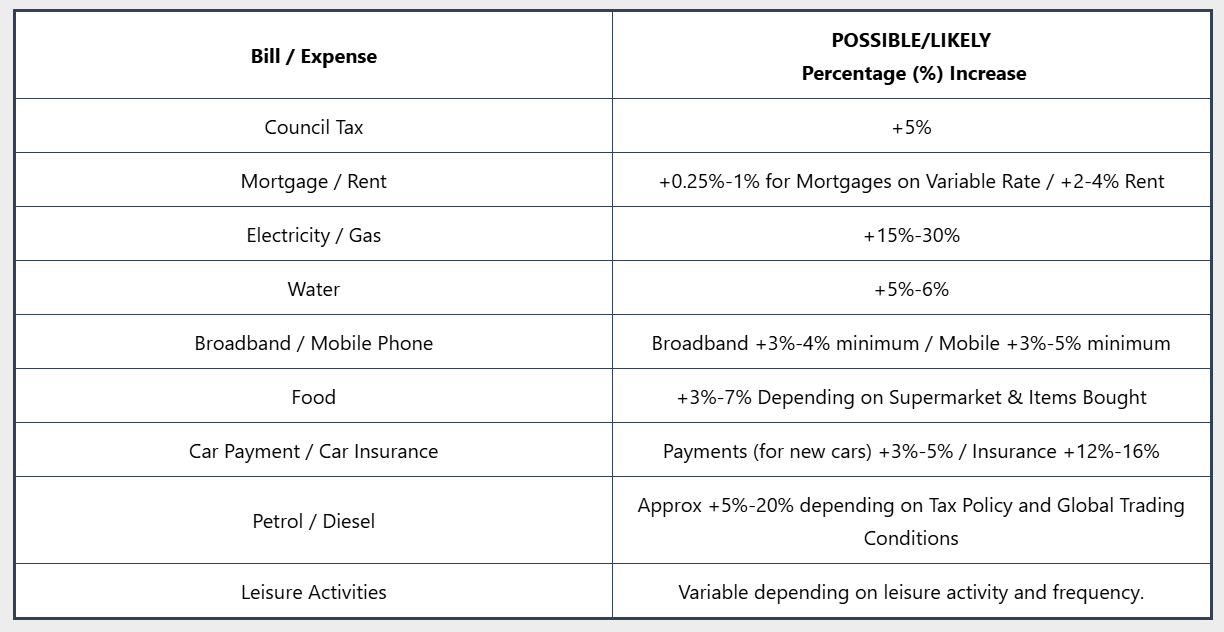
Note: The table image above doesn’t include every bill/expense a person/people could have. It is just to represent the costs that most adults in the UK have.

Very few people are likely to get a significant pay rise in 2027. Even if some people do get a significant pay rise, it would need to be massive to meet all of these increased bills/expenses costs. I’m seeing people struggling with rising living costs now, but in 2027, it seems much worse is to come.

The UK Government recently released its budget (link to the BBC with details), that felt to me like it was: too little, too late. It seems like The Labour Party at best have no ideas and at worst don’t care about helping their citizens.

I would like to take this opportunity to point out that all the corporations and companies that are increasing these bills/expenses are in the vast majority, making profits, some of them in the billions of pounds/per year. They don’t need to be increasing costs and certainly not by the percentages they are. It is greed. Greed will only make the rich much richer and the poor much poorer.

When Will The Economic Disaster Happen? What Will Happen?

I think it is likely to happen in April of 2027, when the new tax year starts. Honestly, I’m not exactly sure what will happen when hundreds of thousands or perhaps even millions of people can’t afford to make payments on all of their bills/expenses in full. It is likely that the Government will have to step in with emergency measures to prevent complete economic collapse.

Write soon,

Antony

mental-health-wisdom-banner
Share on Social Media:
Money / Finances, Political, Thinking, , , , , , , , , , , , , ,

Can Money Buy Happiness? – a section from my next book titled FINDING YOUR HAPPINESS

Reading Time: 4 minutes

I am currently writing a book on the topic of happiness, titled FINDING YOUR HAPPINESS, which is due for release later this year (2026). Writing a non-fiction book requires me to do a lot of research and explore my thoughts, opinions and feelings about what the research suggests. This is something I love about writing.

A question that has caused me to do a lot of thinking and feeling recently is the question: Can money buy happiness? I didn’t know the answer to this question, so I looked into the research. In this blog post, I share with you the section I’ve written for FINDING YOUR HAPPINESS, free of charge, because I’ve found it fascinating.

Your Money

The question that I often get asked is:

Can money buy happiness?

Research suggests that having more money does increase the likelihood of a person being happier, up until a certain annual income.

Once a person reaches around £75,000 (around $100,000 USD) per year, money no longer has any impact on how happy the person is, when compared with other people that have the same income.

I would like to acknowledge here that this is a very high level of income and that most people don’t have an income this high. At this point, I am answering the question above based on available research.

This amount of money stated above is correct for the year 2026. This annual income amount is likely to increase year on year, as the cost of living is ever increasing.

According to research, the reasons why more money increases the likelihood that a person will be happier include:

  • Basic needs are met: Enough food, clean water, decent housing, appropriate clothing, access to healthcare and access to education. This significantly reduces a person’s level of stress and can provide a person with a greater sense of security.
  • Increased choice and autonomy. The person has more options and freedom of choice in their life.
  • The person has money for comfort, pleasure, leisure and fun. This includes money for travelling and new experiences.
  • The person can use money to give them more free time. For example, they could hire a cleaner, cook, pay for childcare, all freeing them up from the time they would have spent undertaking these activities.

Some people who reach this high level of income or exceed and still seek to increase their income. Why do they do this?

One reason could be that they have a strong belief that more money = more happiness. This belief likely comes from their past experiences. Earlier in their career, increases in income probably did contribute to making them feel happier.

Although the research does suggest that more money increases the likelihood of being happier, it also points out that having any amount of money doesn’t guarantee happiness.

You could earn the amount stated above (or more) and still be miserable. You could equally earn a lot less and yet be incredibly happy.

My view is that no amount of money can buy happiness. Happiness is a feeling. A feeling we get through a wide variety of experiences. Yes some of these experiences require money, but others do not.

The best way to keep informed of the release of FINDING YOUR HAPPINESS is to sign up to my newsletter here. You’ll receive just 1 email per month covering: details of my new books/articles as I release them, notification of my latest blog posts and the very occasional special offer. This is not a spammy sales newsletter, but an opportunity to stay up to date.

Write soon,

Antony

My published non-fiction books include:

Share on Social Media:
Books & Authors, Creativity, Happiness & Joy, Money / Finances, Thinking, , , , , , , ,

Witchcraft For Charity

Reading Time: < 1 minute

I don’t just use my Witchcraft for personal gain. I occasionally use it to help others. Here is one such case, were I’ve made magic bags to sell for someone who is raising money for charity:

These magic bags are around the themes of happiness and money and have made using the correct magical properties.

Blog soon,

Antony

Share on Social Media:
Paganism, , , , ,

A Money Bowl

Reading Time: 2 minutes

Money bowls bring wealth to you and your home. They originate in Chinese culture and Feng Shui. The practice of money bowls has recently become popular among Witches, Pagans, Spiritualists and other groups in the UK.

Here is my money bowl:

Good items to put in a Money Bowl include:

  • A green candle – The colour green being associated with money. (Interesting sidenote: in China the colour red is associated with wealth.)
  • Rice – Due to its historic Chinese association with wealth.
  • Cinnamon – Either sticks, ground Cinnamon or essential oil. Cinnamon is associated with money and abundance.
  • Crystals – I’ve used a Citrine point. But you can also use green stones like Adventurine and Malachite. Loadstones are great for attraction (as they are naturally magnetic), if you have them.
  • Bay Leaves – Associated with prosperity.
  • Symbols of money or wealth – Including coins and notes of the currency.
  • Chilli Flakes or Ginger – To give it a magical boost.

Making a money bowl is fun. But it’s important to not make it and then forget about it. Money bowls work by constantly feeding it your energy on a daily basis. So each day try to spend some time with it. Add items, talk to it, meditate with it, do whatever feels right.

It is inadvisable to take items out of your money bowl, as symbolically it is like subtracting wealth.

Every now and then you’ll need to refresh your money bowl to keep it being effective at drawing in the wealth.

You may enjoy my page: All Paganism, Witchcraft & Magic Content.

Write soon,

Antony

Share on Social Media:
Paganism, , , , , , , , , , , , ,
Scroll to Top
×