Reading Time: 3minutesVictoria Wood Funny Image (from: ‘An Audience with Victoria Wood,’ December 1998)
It is with great sadness that I write this blog post. Today Victoria Wood died, after a short battle with cancer at the age of just sixty two.
Victoria was an exceptionally funny Comedian, Actress and Writer. I feel that we have lost a great source of laughter in the world.
Victoria came from humble beginnings, being born and raised in Rochdale, Lancashire, in the North West of England. Victoria moved down to London to pursue her dream of becoming an Entertainer. In an interview with Victoria she once said that she always knew that she wanted to be a performer.
Victoria had much success and recognition in her career working in the mediums of stand-up comedy, sketches scene comedy, musical comedy and script writing. She has worked on TV, radio and theatre shows.
Through Victoria’s TV work she touched the hearts and resonated with millions of people across the country. This was likely because of her very down to earth and human approach to the audience. In Victoria’s shows she was always ahead of the times. All of her previous work is as relevant today as the day she wrote/performed it.
When Victoria first started out in mainstream comedy, all Comedians were male. It is said by some that Victoria led the way for other female Comedians – the likes of French & Saunders.
In Victoria’s personal life, she married young and has had two children. My thoughts are with her family. Victoria also disclosed and has talked openly about having depression.
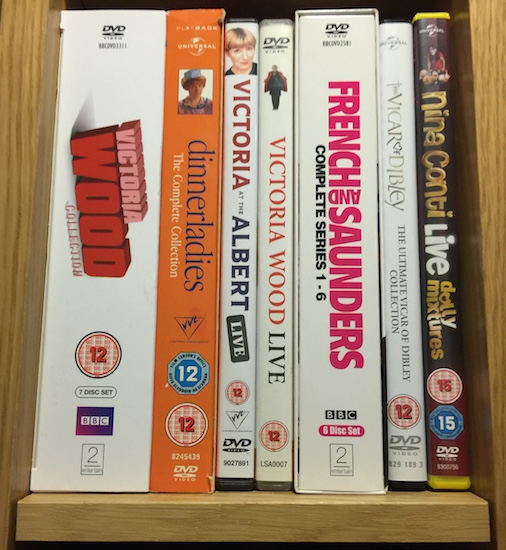
My Victoria Wood DVD Collection, along with other DVDs by female comedians.
or me Victoria was and is a constant source of laughter. Proper laugh-out-loud laughter.
Left is an image of my Victoria Wood DVDs. Some of them I have watched so often that I could repeat them to you word by word. Yet they still make me laugh. Victoria was a clever comedian that found the fun and humour in the often otherwise ordinary. I wish she had toured in the last few years, so I could have seen her live.
Victoria Wood is also a source of connection to my good friend Sye. We have often watched Victoria Wood DVDs together and laughed. The laughter helping to cement our friendship through our shared love of Victoria’s comedy and the shared experiences of watching together.
I heard the news of her death on the radio whilst driving home from work. My initial thought was one of disbelief.
I had to check several newspaper websites when I got home from work. Then I sat down in shock. Victoria has often worked with the same people throughout her career, many of whom were older than her. Yet she has died before them. Just goes to show, you never know how much time you have on this planet.
My third feeling and the one that’s stayed is a feeling of sadness. Think of how much unfinished ideas and creative works she wasn’t able to complete. Think of the new jokes and tales of laughter she was planning on sharing. Very sad.
This is the third and final part in a blog post series, where I’ll be sharing some of what I’ve learned about creative writing over the last few years. The first blog post in the series was Creative Writing: Beginning and the second blog post in the series was Creative Writing: Middle.
1. Carry a Notebook for Ideas
Ideas often come at the strangest of times and in the strangest of places. I’ve had ideas come to me in the bath and had to jump out, dripping wet, to write them down. So be prepared. Carry a notebook with you everywhere that you go. Keep one on your bedside table. Any ideas you get, good, bad or neither, just write them down. It might be a plot, or a character, or a location. The idea might not be fully formed. It doesn’t matter. Just write it down.
2. NEVER Delete Anything
Never delete anything that you write. Save everything. One day, you might want to go back to it. Even if you don’t continue where you left off, but instead start the creative work again with a completely different angle. You’re going to need the original beginnings.
3. Editing Checklist
Most writers spend more time editing than they do writing. It is advisable to click Save As… and save another version of your work with every edit, so that if you want to go back you can. Here’s my editing checklist:
First Read Aloud. Any sentences that you struggle to read or make sense of usually need further work. Check for appropriate use of capitalisation, commas, semicolons, full stops and speech marks. Check for typos. Grammar and Spelling Check. Cut Overwriting & Repetitions. Re-write sentences that don’t make sense or are unclear. Second Read Aloud. Any sentences that you struggle to read or make sense of usually need further work. Consistency Checks: Tense, Perspective, Description, Characters and Plot. Consider plot and pacing. Are there any plot holes? Is the pacing of scenes, chapters or even the whole work to slow, to fast or about right? Third Read Aloud. Any sentences that you struggle to read or make sense of usually need further work. Put the work away for a few weeks, then go back to it and start the editing checklist again. A break from a creative project gives you distance and allows you to spot mistakes or problems that you didn’t see in the original writing or editing stages because you were to close to the work.
Reader feedback is great. But you have to be open to any constructive criticism about your creative work. If you ask friends or family to read your work, ensure that you have a relationship with them that allows complete honesty. Ensure that this honesty doesn’t damage your relationship. I read a good friend’s creative work on a regular basis, as he does mine, and we are completely honest in our feedback. We can do this because we both know that the feedback we give and receive is given with kindness, and is aimed at helping one another to create the best work that we can.
You should always appreciate and appraise reader feedback from any source. Appreciate that someone has taken the time to read your work and give feedback. People who give feedback are often working on their own creative projects. They have taken time out of their creative work to give you feedback on yours.
You don’t need to agree on all the points that they raise, or change everything that they suggest needs changing. You are the creator of your own work, so use your own judgement. But consider the feedback, especially if you are getting the same feedback from several different sources.
Some Writers come together in local Writers groups to get feedback on their creative work. These days there are probably some Writers groups online. Some Writers find these groups useful, others don’t. The best way to see if this works for you is to give it a try.
5. Publishing Options
You can send your work to agents and publishers. To the larger presses or smaller independent ones. You can self-publish on Amazon and even get your self-published printed on demand (POD). I don’t have loads of knowledge about publishing or the experience to advise. All I would say is people with little or no experience manage to get their work published all the time.
6. Promoting Your Work
Some great ways to promote your work include:
Get a good book cover designed. Book covers are the first thing people see about your work. A good book cover design can make the difference between people buying your creative work or not.
If you’re writing the blurb on the back cover, make sure it is written in a way that sells your creative work.
Use social media. Facebook, Twitter, goodreads and Instagram as a minimum.
Approach appropriate bloggers, vbloggers and ask them to read & review your creative work.
Send copies of your work to appropriate News Paper Entertainment Columnist, Magazine Writers, other Authors, etc. requesting they read & review your work.
Attend literacy events and be involved with the literacy community (both locally and online).
Do interviews with anyone that is willing to interview you.
Try and be in the Media: TV, Radio, News Papers & Magazines. Even if it isn’t directly about your creative work, you’d be surprised how many people will see, hear or read what you say/write and go on to seek out your creative works.
Do readings.
Contact local libraries, book stores, etc and arrange signings and/or readings.
Encourage people to write Amazon Reviews.
Have a book Giveaway – people love the opportunity to win something.
Hire a Marketing Company, there are many out there that specialise in the PR and marketing of books.
Reading Time: 3minutesWelcome to my yearly review. 2013 has been a great year; both for me and my creative writing. There’s so much to tell you about my writing that I’ve given My Awesome Year in Words it’s own post on my Writer Website. Here I shall focus on my personal life.
In February I went to a friend’s 50th birthday party and one of my nephew’s 18th birthday party. I undertook my February Photo Challenge.
March came along and I was on TV – Live To The Nation! Although an exciting, uncomfortable and anxiety ridden experience, it was also one of great learning. Educating me in the world of the media. And unbeknown to me at the time, it wasn’t going to be my last excursion into the media world this year. Oh and I got an iPhone 5.
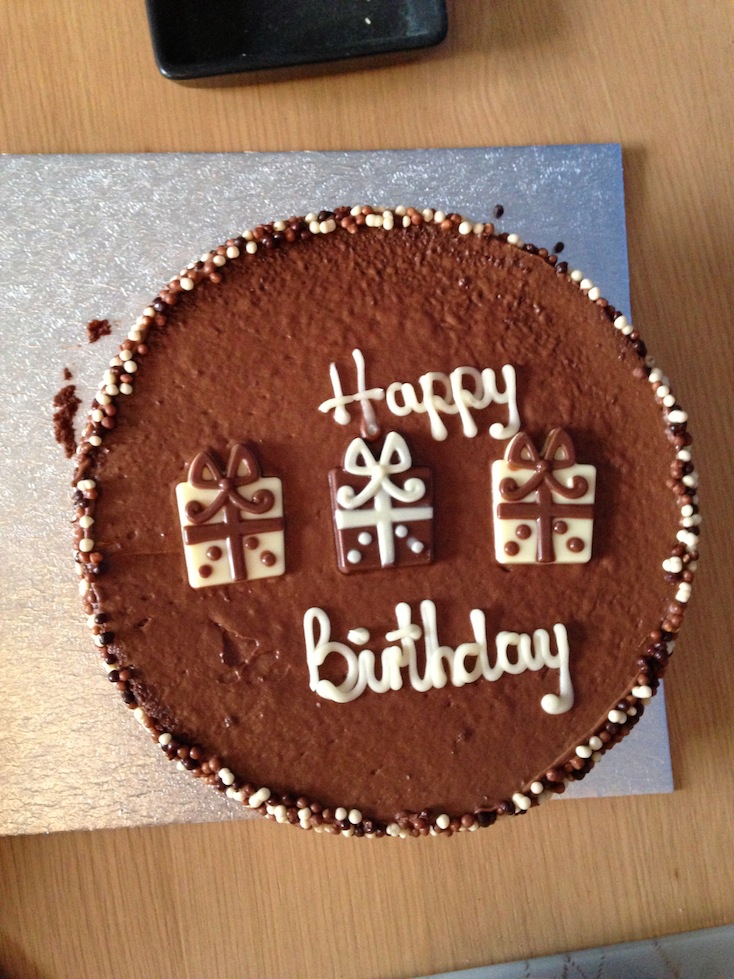
My Birthday Presents – Happy Birthday Cake
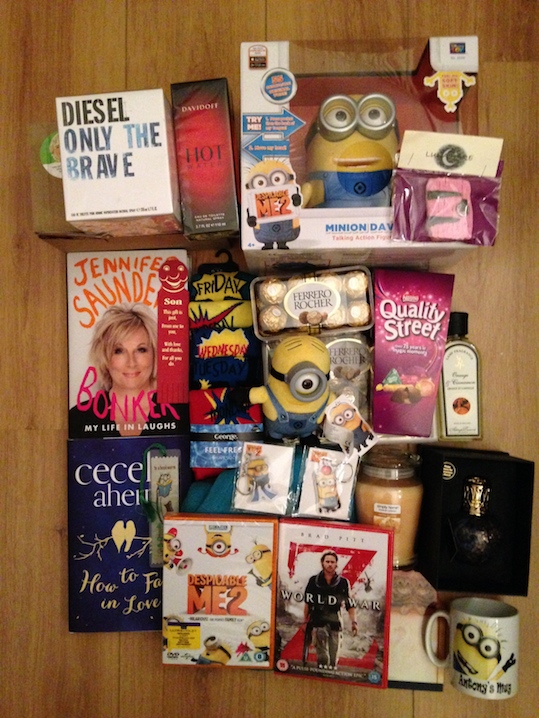
I did so much in May. I had a great Bank Holiday Weekend. I celebrated my twenty seventh birthday by seeing friends and family; they got me some fab Birthday Presents. I got an extra special birthday present off the wonderful Writer Mel Bossa. I had a Cumbria Adventure. I enjoyed this Get Lucky Cover, as well as the original song by Daft Punk.
In October Steve and I went watching Wicked at Manchester Palace Theatre. I had a bug, got offered a job which I initially accepted and then later declined. My contract at work got made permanent. I got interviewed on BBC Radio 5 Live.
Reading Time: 3minutesI’m sat here writing this post on an old, dodgy and excruciatingly slow old Windows 7 laptop. Why? Because my iMac (see iMac Part 1 & iMac Part 2) has shown me: a black unresponsive screen, several not-booting-up grey screens and the infamous blue screen of death.
I won’t bore you with the tedious details of how this occurred; but when the Recovery software wouldn’t work I knew I needed a genius appointment.
Steve & I booked an appointment with an Apple Genius in our local Apple Store and went along. The genius did some testing and discovered that the hard drive had failed. I’ve never been so thankful to be in the European Union (EU).
I’ve had my iMac about a year and a half. EU law means Apple have a two year warranty rather than their standard one year warranty (without Apple Protection). The genius arranged for the repair, told us they’d pay the cost and that it would take about a week.
For the next week I have no access to photos, music, TV, films (both downloaded and DVD’s) and a limited ability to browse the internet. These are things I can easily live without for a week. But there’s never a convenient time for a computer to break and the timing is particularly bad.
This week I have some important documents to write and need to reference some other documents in my Documents folder. This will create some hassle and difficulty.
Luckily, I learned the important lesson about backing up files some years ago. I use Time Machine which saves a backup volume to a separate hard drive and then copies new or changed files once an hour. I can’t use Time Machine’s backups or access the folders/files until I get my iMac back.
That’s where my manual backup on another separate drive comes in. I backup important files (Documents, Pictures, Music & Movies Folders) whenever I make significant changes to them. So at least I’ll be able to access the reference documents I need while the iMac is away for repair.
I bought an iMac because I heard loads of people say: “It just works.” I’ve told many of my family & friend’s how great the iMac is for that very reason. I was disappointed to learn that Apple use Seagate hard drives, which are notorious for problems. If you don’t believe me just do a Google search. With the price of the iMac you’d expect good quality. But after learning about the use of Seagate hard drives I’m starting to worry about what other low quality parts are in my iMac.
I’ve become a bit disillusioned with Apple not standing by the iMac for more than their standard one year warranty (outside the EU). Do Apple really expect customers to buy such an expensive device for it only to last a year? Probably not. But the fear of problems with such an costly device and a short warranty is most likely a deliberate act to sell it’s Apple Protection to customers.
When I bought the iMac I was an Apple enthusiast; but not so much so any more. I just want a reliable hardware with software that “just works.” If Apple can’t provide this, then perhaps I’d be better back on Windows? At least with Windows I know where I stand.
I’ll give you an update on the iMac when I get it back. In the meantime I’m using the free time enforced upon me to catch up on some reading.




 First Read Aloud. Any sentences that you struggle to read or make sense of usually need further work.