Fatigue is severe physical, mental & emotional exhaustion. Fatigue is unfortunately something people with Vasculitis, which includes me, experiences. Fatigue can be present whether or not a person’s vasculitis is in remission or an active flare up.
Vasculitis is also a progressive disease, meaning that meaning that it gets worse as time progressive, although progression can be slowed down with medical treatments.
Recently, I’ve been off work for 3 weeks due to sickness, caused by a Vasculitis flare up and the increased fatigue that it has caused. There have been days that I have slept for 18 hours. It has made me recognise how limited my energy, motivation and time is.
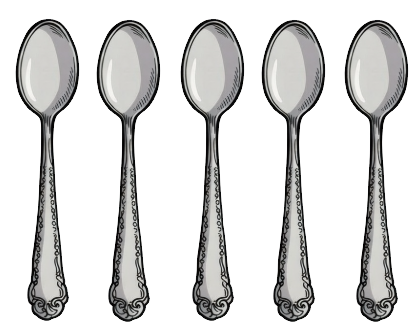
Your energy and motivation are limited resources. A good metaphor for explaining this concept is The ‘Spoons’ Theory by Christine Miserandino. Each spoon below is one unit of your daily energy.
Your energy and motivation are limited resources. A good metaphor for explaining this concept is The ‘Spoons’ Theory by Christine Miserandino. Each spoon below is one unit of your daily energy.
Each activity that you complete in a day costs you one or more spoons, depending on the effort, energy and motivation it requires. To explain this metaphor, let’s imagine that every activity takes one spoon. You wake up at the start of your day with 12 spoons. Here’s how you use your spoons:
You wake up.
You wash your face.
You make breakfast.
You eat your breakfast.
You get dressed.
You brush your teeth.
At this point you have already used half of your spoons and you’ve not even made it through the morning yet.
You get ready for work.
You travel to work.
You work.
You travel home.
You make tea.
You have a bath.
Now you have run out of spoons. You have two options: You can go to bed and rest, which will give you more spoons. Or you can decide to borrow spoons from tomorrow.
Due to the demands in life, you may opt to borrow spoons from tomorrow. But then you risk getting trapped in a cycle of constantly borrowing spoons from tomorrow.
As the days pass and you borrow more and more spoons, you’ll reach a point where there aren’t any left to borrow from tomorrow. You’ll be exhausted and burnt out.
The Spoon Theory has been adopted by people who are neurodiverse and people with chronic illnesses. But it can actually be applied to all. You. Me. Everyone we know.
I have had to accept my number of spoons is significantly less than other people. I went back to work this week, doing a shorter work week (4 days, rather than 5 days) and by Friday I felt exhausted. Working this number of hours, with the energy that it takes is unsustainable for me in the long term.
I have worked since being 15 years old. I was brought up that it is not just good for me to work, but also is how I contribute to others in society. However, there are other ways to contribute.
So right now, I’m thinking about what my plans for my future are and dealing with the emotions associated with the fact that working full time is completely unsustainable for me.
Blog soon,
Antony
Click the Image to be taken to Square to purchase the book.
I’ve always thought Dolly Parton was an incredible woman. A fantastic singer, song writer, business woman and philanthropist.
Dolly had a zest for life, always being warm, bubbly and fun.
I was saddened to learn of her death, but equally thankful for the fact she lived.
Dolly accepted LGBT people and spoke positively about the LGBT community, doing so before many other people with her sort of public platform.
But Dolly became an icon to me, when she famously said:
If I hadn’t been a woman, I’d have been a Drag Queen! – Dolly Parton
In this quote, Dolly wasn’t just saying she liked and appreciated LGBT people. Dolly was also saying, that if she’d a choice, she would have proudly been part of the community.
I knew Dolly was well-liked, but what I didn’t realise, is that for many people, Dolly was and is loved by them. Since the announcement of Dolly’s death, the number of visitors to my blog post Some Facts You May Not Know About Dolly Parton has exploded.
I once watched a TV interview with Dolly, where she told an interviewer a funny story. I’m going to share this story here, told by Dolly, in her own words.
The Time Dolly Lost A Dolly Parton Look Alike Contest
Once I dressed as a Dolly, an over exaggerated Dolly in LA. I was out there working and there’s this gay bar down on Santa Monica, close to my house and they where having a Dolly Parton look alike contest.
So me and a bunch of friends decided we’d go down there, because it would be fun, because we were all dressed up and me being Dolly.
So they had these big Drag Queens, I mean, they looked great too, prettier than I could ever dream of being, but anyway, when walked across the stage, if they applauded, you won the contest by the amount of applause, I guess you got free drinks or something.
So all these beautiful guys are walking across – these Dollys – all this tall – and here I come walking across the stage and I got the least applause of anybody.
So I’ve always said: “It’s terrible when you lose a Dolly Parton look alike contest.” – Dolly Parton
I feel privileged to have shared some of my time on this planet with this wonderful woman.
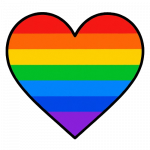
I remember the first time I saw the Rainbow Pride Flag (image left). I was a young gay man and it was at a local LGBT youth project I attended. I had recently come out to some close family and friends.
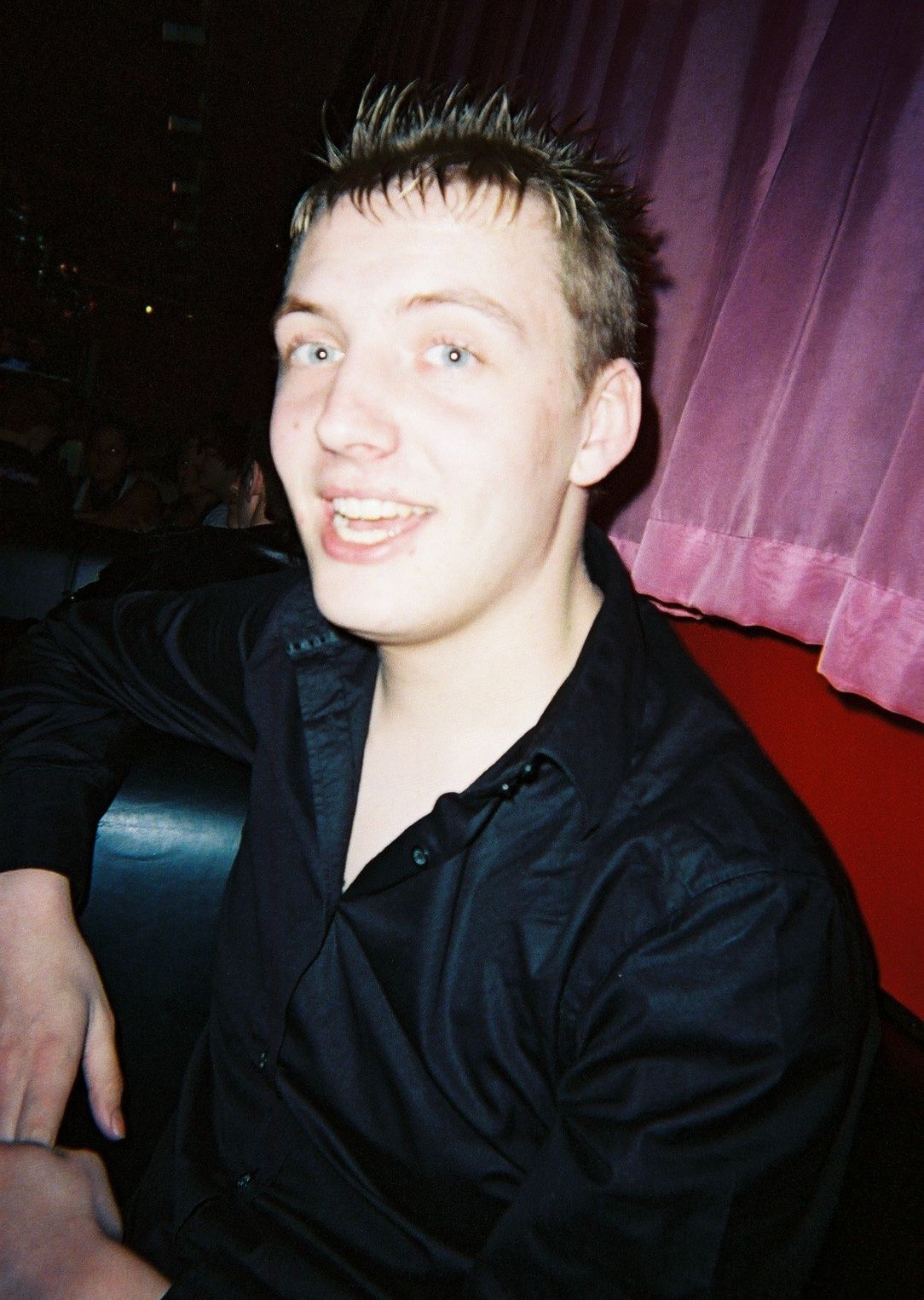
Me, aged 21 years old.
As I got a little older, I began to go to the gay pubs/clubs in my local city, meeting other Lesbian, Gay and Bisexual (LGB) people. The Rainbow Pride Flag was prominently displayed on both the outside and inside of every gay pub/club/business there. In these settings, I felt safe. I felt free to be my whole self, with no fears about how other people might react. I felt I was with my tribe. With people that were the same as me.
Ordinarily, in the outside world, I would monitor my voice and behaviour closely. I’d be hypervigilant for danger, always noticing the people around me, the environment and constantly scanning for the subtle signs that I might be in danger. Often, I considered multiple exit routes and what I might say to someone if they became verbally or physically abusive towards me. I’d also consider who, out of the strangers around, might help me, if I needed it.
My fear was very real. I’ve had experiences in the past where the risk of harm from strangers, just because of my sexuality, was very real. These experiences, along with hearing experiences from others, made me very cautious.I felt that hiding my sexuality, rather than it being noticeable, kept me safer. This fear for my safety even influenced what I chose to wear and how I styled my hair.
Being gay has always been part of who I am. But sadly, not all people like or accept gay people.
The Rainbow Pride Flag quickly became a symbol to me that represented: safety and that I was free to be my full true authentic self. I knew that I could breathe, relax and enjoy myself in any setting that had the flag on display. I never took that for granted. When I was leaving these settings, I knew was going back into a potentially hostile world.
I recently realised that I knew practically nothing about the Rainbow Pride Flag. I have displayed it, using its symbolism to hopefully make others feel safe and welcome. So I made the decision to do some research and learn more about the flag. In this post, I share with you what I learned:
1. Who designed The Rainbow Pride Flag?
The Rainbow Pride Flag was designed by Gilbert Baker, Lynn Segerblom, James McNamara and other gay rights activists in San Francisco, USA. Gilbert Baker was friends with and influenced by Harvey Milk, a very famous gay civil rights activist.
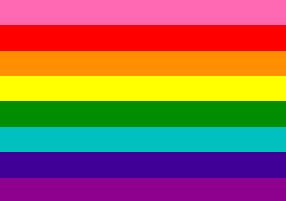
The Rainbow Pride Flag first appeared in 1978 at the San Francisco Gay Freedom Day Parade and was quickly adopted as a symbol for and by the LGBT community. The original flag had 8 colours, including hot pink, like below:
1978 Rainbow Pride Flag.
Some people have suggested that Baker and the other designers used the rainbow colours due Judy Garland. Judy Garland played Dorothy in The Wizard of Oz film and sung the song ‘Over The Rainbow.’ She later became somewhat of an icon in the gay community. Some in the LGB community would ask others: Are you a friend of Dorothy? This was a coded message, disclosing their sexuality and asking if they were also in the community.
However, Baker, in an interview in 1985 denied any association with Judy Garland, Dorothy or The Wizard of Oz. He reported that designers chose rainbow colours “because of its associations with the hippie movement of the Sixties.” Baker also noted that the use of this design dated all the way back to ancient Egypt.
The Rainbow Pride Flag was designed to be a symbol of the gay civil rights movement that was taking place in the USA at the time. The design has evolved over time, as has what the flag means to the LGBT community, allies and the general population. It is an extremely powerful symbol for the LGBT community.
It could be argued that the Rainbow Pride Flag has become much, much more than the original designers expected or could even have imagined.
2. What do the different colours on the flag symbolise?
Overall the flag was a symbol (and in some areas remains one) around equal civil rights and protections for LGBT people. The genius behind the deign of The Rainbow Pride Flag is that different individuals or community can attribute their own meaning to it. For example, as an individual to me it symbolises safety and being free to be my authentic self, as explained in my story above.
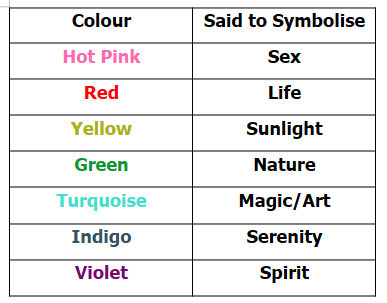
It is reported that each colour on the original 1978 Rainbow Pride flag symbolised something specific. The colours on the flag and are what they are reported to symbolise is well reported on the internet. The colours on the original 1978 flag are said to symbolise:
During my research, I could find no credible reference to confirm or deny that the designers had specific symbols in mind for the specific colours that make up the flag.
It could be that they did, equally that they did not. It could be that these symbols were created or decided on at a later date, by the designers or practically anyone else and at some point, they just started getting reported as fact. We just don’t know for sure and likely never will.
3. How has the design of The Rainbow Pride Flag evolved over time?
The first design change of The Rainbow Pride Flag occurred towards the end of 1978. Harvey Milk was assassinated and this led to a massive increase in demand for the Rainbow Pride Flag.
The customers were likely LGBT people who wanted to support the gay civil rights movement, knowing that they already faced discrimination, harassment and sometimes physical assault. Harvey Milk’s murder likely made people think that this could happen to anyone of them and that they need to be politically active for rights and protections.
Some sales of the flag may have also come from allies, people who identify as hetrosexual (straight), but agreed that LGBT people should have the same rights and protections as everyone else.
In November 1978, due to the increased demand, the manufacturer was struggling to get hold of enough hot pink material to make the flags and complete orders. So Baker, tweaked the design, removing the hot pink colour.
Some time in 1979, Baker decided to remove Turquoise as he needed an even number of colours (6 rather than 7) as part of his pride parade plans to places two colours on each lampost repeatedly along the parade route.
Baker then adjusted the design of the Rainbow Pride Flag in 2017, making it a nine stripped flag. The turquoise stripe was back, along with a lavender stripe. Baker is said to have added the lavender stripe to symbolise diversity and reportedly did so due to the election of a certain orange President the year before.
There have also been a large number of organisations across the world that have adapted Baker’s designs, adding to or changing the design slightly. There are too many variations to list them all here and I would no doubt miss some out. So I have only included details of the original Rainbow Pride Flag’s evolution here.
4. A Powerful Symbol
Over time, The Rainbow Pride Flag has become an extremely powerful symbol for LGBT people in a number of places in the world. It has helped the community to be acknowledged, listened to and in many places respected. Although this hasn’t happened everywhere.
Today, many public institutions, private companies and charities recognise Pride Month in June and actively promote celebration of their customers/staff/others who are part of the LGBT community.
In some places attitudes towards LGBT people have improved and we have definitely gotten more legal rights/protections in many places. But there is still more work to be done. Both from a civil rights persepctive and to help others to understand some of the challenges and difficulties experienced by LGBT people.
an amount of money that you pay regularly to receive a product or service.
In recent years, the subscription business model has become popular for music, TV/online streaming shows, films, podcasts, games, software, computer files storage/back ups, AI use, reading of books and for adult content.
People can even sign up to subscriptions for particular physical products, or physical products by a particular brand. There are many companies offering monthly subscription boxes, which contain products around a particular theme or interest.
It feels as though there has been an explosion in companies using the subscription model; often without providing customers with any alternative way to permanently purchase their goods or services. Companies that have decided to move from a purchase business model, to a subscription business model, seem to have done so without any consultation with their customers.
The companies’ message seems clear: If you want to have and use our products/services, you must subscribe. You must pay every month/year.
The Benefits of the Subscription Model for Customers
The subscription model does have benefits for both customers and companies. For the customers, it’s convenient, instant access for digital content, no waiting for deliveries of physical items. Customers get the content that they actually want and streaming services save the customer’s limited hard drive space on their computers/other devices. Streaming can also save customer’s physical space at home, as no DVDs, CDs, players, etc are required.
In recent years, I have noticed laptops and PCs for sale with increasingly smaller hard drives. I have also noticed how difficult it is to get a laptop or a PC with a DVD/CD reader/writer. Making the process of watching a DVD or listening to a CD at home more inconvenient.
Could this be deliberate, to get people away from owning content and instead subscribing to access it?
The Benefits of the Subscription Model for Companies
Using the subscription model has a number of benefits for companies. The value of their product/services changes from a one time sale, to a recurring vale, which increases profits (dramatically in some cases). Subscriptions allow companies to better estimate their future income and in some cases can lead to a better allocation of financial resources for business growth, research and for development of current/future products/services.
When it comes to subscriptions, companies also benefit from vague legal contracts with customers. Companies can be vague, rather than specific about what they offer to their customers and change their offer at any time. Currently, in the UK, I am aware of no legislation aimed at protecting customers who are mis-sold subscriptions, or that provides customers who receive poor quality or even broken products/services with consumer rights or protections when customers have subscribed.
As more and more people are signing up to subscriptions, increasing numbers of customers are discovering problems with the business model. The most obvious is the companies expectation that you will pay forever. Some customers report feelings of resentment towards the companies and feel that they are being greedy.
Some customers can feel exploited, knowing that if you stop paying you loose your access to the products/services, your data and possibly settings/customisation. This is the subscription trap, where customers feel trapped by these companies.
Imagine if some customers have become reliant on these subscription services, then experience a sudden and unexpected change in financial circumstances (like loosing their job, pregnancy, illness or saving for a marriage/house/holiday). It could mean these subscriptions suddenly become unaffordable for these customers.
Companies can increase their prices at any time, or even change the subscription model all together, without customers having any say. A recent example of this was Netflix raising their prices in 2022 (not for the first time either), changing their pricing model and introducing advertising.
Many customers have also expressed dissatisfaction at the changes to and restriction of available products/services. There are numerous specific examples of this, but one that springs to mind is when the TV series Willow. It was wiped off the Disney+ platform, after it didn’t perform as well as expected. The series was removed from the platform, not renewed for a second series, without any comment from Disney+. See this reddit discussion thread for more details.
Another example is the removal of Star Trek: The Next Generation, Voyager & Deep Space 9 from Netflix with no explanation. The companies are able to do this due to vague legal contracts that don’t specifically specify what customers get access to and for how long under their subscription contracts.
All companies are collecting more data about their customers than ever before, keeping it forever and using it to make a detailed profile of each of their customers. This creates genuine concerns for customers around the misuse of the data they collect, the security of the data companies hold and some concerns around companies that may choose to share this data with partners, or others, without the knowledge, consent or permission of the customers.
I think a debate is long overdue around data ownership. I feel that any data that is collected about me, especially highly sensitive or specific identifiable data, should be owned by me and not these companies. That they should have to be very transparent with about what they are collecting and why, along with limits for how long they can keep historic data.
Alternatives to the Subscription Model for Customers
There are alternatives to the subscription model for customers. For music, TV/streaming shows, films and games, software, customers should demand production the of physical copies by the companies. Customers should buy physical copies of products whenever possible and maintain a way to use these physical copies.
In terms of online file storage customers could avoid this subscription by having a laptop or a PC with enough hard drive storage for their files and use an external hard drive to back up their files.
Currently, AI services providers are leaning heavily on the subscription model for tokens for AI use. They are trying to convince both corporate and personal customers, that they can only have access to use AI through their services. But this is not true.
In China they have developed an AI that can operate on a regular laptop or PC. It has all the functions of the cloud-based AI but without the expensive monthly subscription and doesn’t require vast data centres that will cause severe damage to the environment.
In the past decade, big tech companies have sold the masses the idea of the cloud. Being able to access your data any where and at any time. They even called it the cloud, which almost makes it sound like part of nature.
In reality your data is being stored in massive data centres, that require energy 24/7 and can have a significant impact on the environment. The real image of the cloud would be rows of rows of servers, computers always on, always consuming energy and requiring cooling with water due to the massive amount of heat that they generate.