The First Review of FINDING YOUR HAPPINESS

Reading Time: 2 minutes

Dear all,

It is my absolute delight to share the first review of my latest book, FINDING YOUR HAPPINESS, with you:
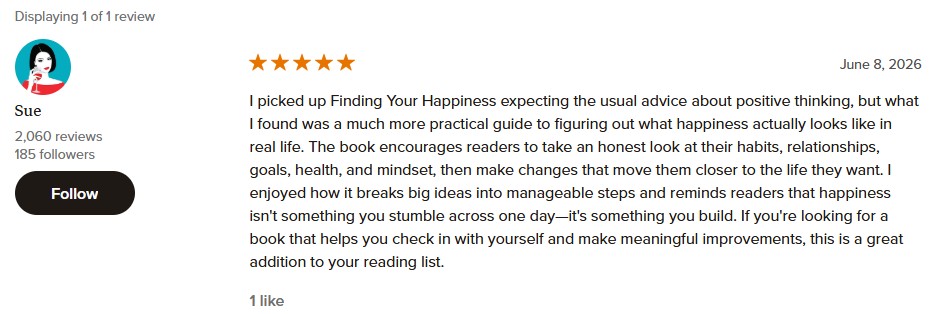
This review was posted on goodreads.

FINDING YOUR HAPPINESS is also gaining a number of 5 star ratings without reviews on various websites. Here is what the book is about:

FINDING YOUR HAPPINESS
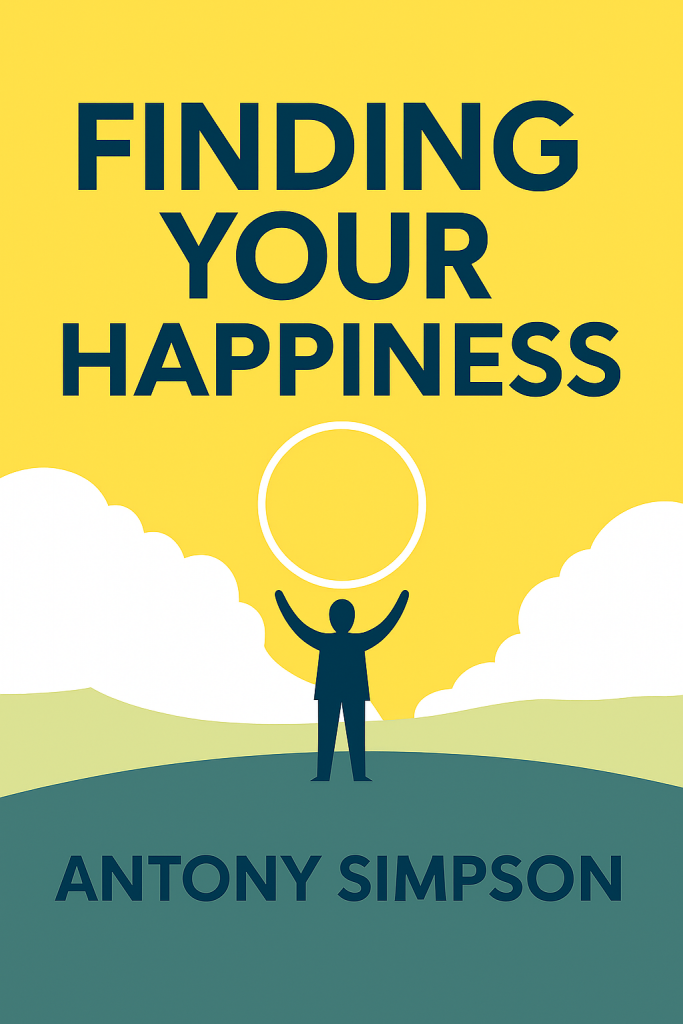
You deserve to be happy and to experience genuine wellbeing.

You deserve to feel positive and joyful.

But you weren’t taught what happiness truly is or how to create a happy life for yourself.

FINDING YOUR HAPPINESS is your practical, uplifting guide to building a life that feels good from the inside out. This book gives you the knowledge, skills and wisdom to live a happier and more fulfilling life.

Inside you will:

  • Discover the secret to happiness.
  • Learn to understand yourself on a deeper level.
  • Identify where you are in life right now and where you want to be.
  • Develop a plan for happiness.
  • Take meaningful actions towards a happy life.
  • Maintain your happiness, whatever is happening in your life.
  • Navigate adversity and challenges to your happiness successfully.

This book is an invitation to transform your life. To become happy. To step into your exciting future, one that’s filled with happiness and joy.

Happiness is lived in full colour, and this book embraces that spirit. Printed in full colour from cover to cover, it costs more to produce than the average book, and its price reflects that commitment to quality. This book takes approximately 5.5 hours to read from cover to cover.

You can see the content pages and read the first chapter for FREE here. Here is a video flick through of the book:

Click here to display content from YouTube.
Learn more in YouTube’s privacy policy.

If you liked this post, you might also like:

Write soon,

Antony

In the UK? Buy a signed, full colour, paperback copy by clicking the image below:
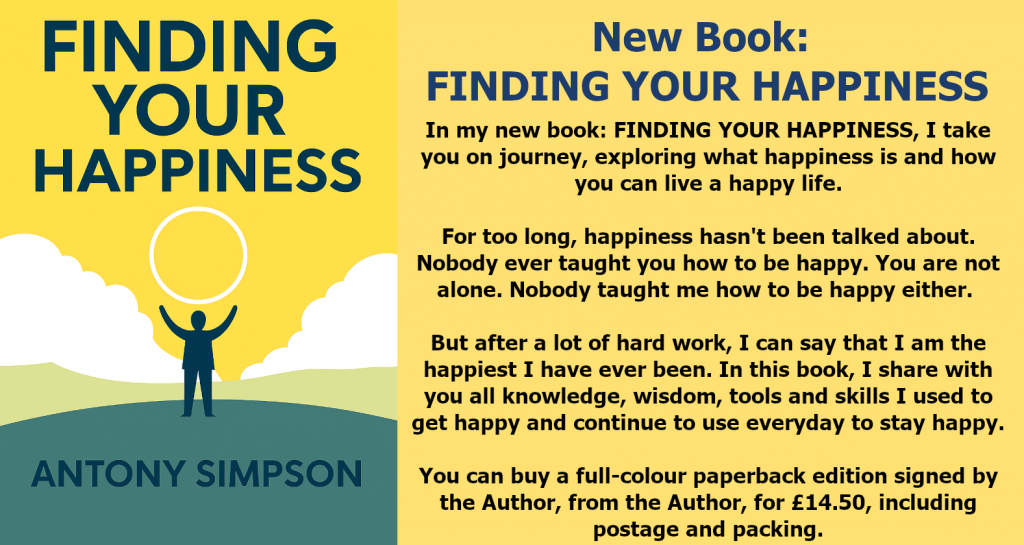
Click the Image to be taken to Square to purchase the book.
Share on Social Media:
Amazon, Books & Authors, Happiness & Joy, Reviews, , , , , , , ,

Parts of the ‘Self’ – A Short Extract From FINDING YOUR HAPPINESS

Reading Time: 3 minutes

Here is a small extract from my book FINDING YOUR HAPPINESS:

A core aspect to finding your happiness is to understand who you are, what drives you and most importantly: What will make you happy. These are unique to the individual, just like your fingerprints.

Parts of the ‘Self’

Everyone has different parts of the ‘Self’ that make up the whole of who they are. The different parts of your Self include:

★ The Physical Self – your body.
★ The Mental Self – your thoughts.
★ The Emotional Self – your emotions.
★ The Spiritual Self – your soul.

All these parts contribute to who you are and are interconnected.

All of these parts contribute to your behaviour – what you say and do.

Your spiritual self or soul is perhaps the most mysterious of all the parts. We know very little about souls. What is their purpose? How do they operate? The truth is that nobody can answer these questions with absolute certainty.

There are plenty of theories about souls. Just look at the many religious and spiritual systems in the world today. I personally believe that any work we do to understand our spiritual self, helps us to more deeply understand the universe and how everything is interconnected.

The interaction between these different parts of the Self, the influence they have on one another and our behaviour is very complex and constantly changing.

But a couple of example scenarios here will help you to understand that the different parts of your Self can and do influence one another:

Example Scenario 1: Anxiety

A really good example of the interaction between the different parts of the Self in action, is the state of anxiety. Anxiety starts through a trigger. A trigger is an event or experience that causes something to happen.

Imagine you have been triggered. In your mind anxious thoughts start to form. Then you start to feel the emotion of fear. Your physical self responds to these thoughts and emotions. Your heart beats faster, you become more alert and your appetite decreases.

In the scenario above, your thoughts influenced your emotional state. Then your physical body responded to both your thoughts and your emotional state.

It is important to know that just because you’re currently focused on one part of your Self, it doesn’t mean that the other parts are inactive.

Let’s look at another example scenario to illustrate my point:

Example Scenario 2: Exercise

Imagine you have gone for a run. Your physical self is firing on all cylinders – your heart beats fast, your lungs inhale oxygen rapidly and your muscles propel you forwards. But as you run, the other parts of your Self are not inactive.

In your mind, you may be thinking about events earlier in your day. You may think about something that triggers your emotions. These thoughts or emotions may cause you to run faster, run slower or stop running altogether.

To summarise, all parts of your Self (Physical, Mental, Emotional & Spiritual) interact with one another. They can influence one another. This in turn can influence your behaviour – what you say, do and omit to do.

In terms of happiness, it is really important to consider each part of your Self. Happiness can only be achieved when all parts of you are working in tandem with one another. All parts of your Self must be in a state of unity.

You can read more in my book FINDING YOUR HAPPINESS, which is available to buy on Amazon here.

Blog soon,

Antony

Learn more about lifetime Fanatic membership.
Share on Social Media:
Amazon, Books & Authors, Happiness & Joy, Health, Life, , , , ,

The 7 Love Languages Theory by Dr Gary Chapman

Reading Time: 3 minutes

Dr Gary Chapman is an American Minister who came up with The 7 Love Languages Theory.

Dr Chapman theorised that we all have 1 or 2 ways in which we show our love to others and that we prefer others to show their love for us in these same ways.

Dr Chapman called these expressions of love ‘languages’ and suggested that there are 7 of these love languages:

    The 7 Love Languages

    1. Words of Affirmation.
    2. Quality Time.
    3. Receiving Gifts.
    4. Acts of Service.
    5. Physical Touch.
    6. Shared Experiences.
    7. Emotional Security.

    It should be noted here that Dr Chapman originally suggested only the first 5 love languages, adding the 6th & 7th love languages later.

    Dr Chapman theorised that when couples have difficulties in their relationship it is because they are expressing their love for one another in their own preferred love language, rather than the language that their partner prefers. Let’s look at these love languages in more detail:

    1. Words of Affirmation

    People who prefer the words of affirmation love language want their partner to compliment them, praise them and say positive things about them and their relationship to them regularly. They value words and what is said or written over actions.

    2. Quality Time

    People who prefer this love language want to complete activities and share experiences with their partner often. If they perceive that a partner is giving too much of their attention and time to others or to working, their partner may feel neglected or unloved.

    3. Receiving Gifts

    People who prefer the receiving gifts love language, like presents, but that doesn’t mean that they are materialistic. Often these people don’t care about the cost of the gifts. It’s more about their partner thinking of them, appreciating them and providing evidence through a small gift.

    4. Acts of Service

    Acts of Service always reminds me of the saying: Actions speak louder than words. People who prefer this love language will complete selfless acts of service to demonstrate their love for a partner and want their partner to do the same for them.

    5. Physical Touch

    People who prefer this love language require regular physical contact with their partner to express their love and in return feel loved. Physical touch is not about intimacy or sex, but instead any sort of physical contact with their partner. Such as: holding hands, hugs, resting their hand of their partner’s leg and kissing.

    6. Shared Experiences

    For people who have shared experiences as their preferred love language, they must engage in regular activities, experiences and adventures that are fully shared with their partner in order to express their love and to feel loved by their partner. People who prefer this love language will always be planning their next shared experience with their partner.

    7. Emotional Security

    For people who prefer the emotional security love language, they show and feel loved if they and their partner feel safe, can fully trust one another and are given reassurance when required. For these people, how they feel is extremely important and they value honesty and kindness greatly.

    Conclusion

    Dr Chapman’s love languages theory is worth knowing about. It could be used to navigate some difficulties in some relationships. It could even be used to strengthen some relationships. But Dr Chapman’s theory doesn’t consider external factors that could cause difficulties in a relationship. Two things are clear: Both people and relationships are complex and multifaceted.

    Blog soon,

    Antony

    I write about love, in all its forms, and how it contributes to people’s happiness in my book FINDING YOUR HAPPINESS:

    Share on Social Media:
    Love & Relationships, , , , , , , , ,

    A Request for Reviews

    Reading Time: < 1 minute

    Dear all,

    I have a small request. Please can you leave a review for any of my books that you’ve read on Amazon and goodreads? A review should be honest and can be just a few words long. It really helps others readers to discover my books.

    Here are the relevant links:

    Thank you in advance,

    Antony

    More Content From Antony

    Here are the books that Antony has published, click any cover to learn more:

    Share on Social Media:
    Amazon, Books & Authors, Reviews, , , , , ,
    Scroll to Top
    ×