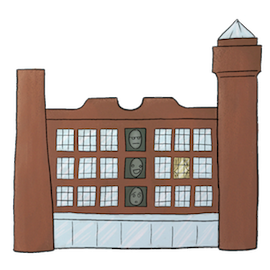
Reading Time: 2minutesMy Apartment is in a former Cotton Mill. Image Illustrated by Sye Watts.
A house is a building usually with four walls, a roof, windows and doors that people live in. Whereas a home can be any sort of dwelling and is infinitely more. A home is:
A destination that you always look forward to arriving at.
A sense of belonging.
A place where kin come together to socialise, share meals, drink and be merry.
A place filled with laughter.
A place where birthdays, Christmas and other events are celebrated.
A place of mental and emotional comfort.
A place of physical comfort.
A place of good memories.
A place of love, affection and sex.
A place that can be quiet or noisy.
A place that may have children, pets and plants that need caring for.
A place of growth.
A place of life and death.
A place filled with sentimental items: photos, ornaments and artwork.
A place of safety.
A place where you can be yourself without fear of judgement.
A place where you can feel exactly as you do without having to explain.
A place you feel yourself immediately relax on entering.
A place of mediation and reflection.
A place where you can dance unobserved.
Somewhere that there’s always a cup of tea on offer.
A place where good meals are made and devoured.
A place filled with sentimental items: photos, ornaments and artwork.
A place where personal hygiene takes place.
A place where pyjamas are worn.
A place where books are read and your imagination is ignited & stimulated.
A place where TV and films are watched.
A place where music is listened to and enjoyed.
A place of privacy.
A place where some practice their faith, religion or magic.
A place where more than one language may be spoken, sometimes in the same conversation.
A place that is part of a vibrant and diverse community.
I am so fortunate. Seven years ago I bought my own apartment (see The Move) and it quickly became my own home. But what makes me feel really fortunate, is that I have several other places that feel like home. Places where friends and self-proclaimed-adoptive-families live.
I recently discovered The Independent: Save The Elephants Appeal. Elephant’s are being hunted to extinction by poachers after their ivory tusks to sell. It seems that the ivory trade is booming, with up to a hundred elephants killed everyday. These wonderful animals are likely to be hunted to extinction in our life time, unless something radical is done.
Elephant’s are incredible animals and I want to share some interesting facts about them you may not know:
Elephants are Altruistic
Generally elephants are altruistic animals, meaning that they will go out of their way not to harm other animals and people. There have been cases of elephants staying with injured humans until they are rescued.
This doesn’t apply if elephants are under attack. When under attack they will do what is necessary to survive and protect their herd. But most of the time they are big softies.
An Elephant Never Forgets
Yes, the saying is true. Elephants had superb memories. This was demonstrated by a test on a herd in Africa. The elephants recognised two distinct tribal colours. One tribe had been aggressive towards the elephants and as such when the elephant saw people dressed in this colour they became frightened and defensive.
The other tribe had been kind towards the elephants. When the elephants saw people dressed in this tribe’s colour they were more relaxed as well as more open to contact with the people.
Female Elephants are the Boss
Elephant herds (families) always have a matriarchal head. This is usually a grandmother or great grandmother elephant who is in charge and the whole herd benefits from her long life experience.
Elephants are Family Focused
Elephant herds usually consist of a grandmother, mother, her sisters, daughters and their calfs (babies). Adolescent male elephants break off from their own herd and create bachelor all-male herds, which have a very loose structure. Adult males join female herds when there are females that are in heat. Once the adult male has mated, he will usually go back to their bachelor all-male herd.
Elephant herds vary in size from three up to twenty five. Herd sizes depend on the availability of food and water, natural predators and inter-social relationships within the herd.
Elephants are very social animals that have strong family bonds. Female herds will share responsibilities, so you may have one mother elephant looking after up to thirty of the herd’s calfs. While she does this, the other herd members will do other tasks such as finding food and water, watching out for predators, etc.
Calfs Have Temper Tantrum
Calfs can be naughty and have terrible temper tantrums like children on that TV programme super nanny. When they do, they will throw themselves on to the ground and flail about in the mud until they have exhausted themselves.
Elephants Protect The Most Vulnerable
When a herd is attacked by a natural predator – usually a lion, the stronger elephants create a circle around the most vulnerable members of the herd to protect them. The most vulnerable are the calfs and the elderly. Elephants will remain in this protective circle for as long as it takes and most of the time the lion will give up, walking away without a meal.
Elephants Grieve
When a member of their herd die the other elephants grieve. When elephants have been murdered, other herd members have even been known to undertake revenge attacks on the perpetrators of the murder.
Some Elephants are Gay
Some male elephants have been known to touch other males with their trunks (elephants see touch as essential for creating and maintaining a deep bond), kiss other males (inserting their trunk into the other elephant’s mouth) and even male on male sex (mounting). Relationships between two male elephants (usually one older and one younger) have been known to last for years.
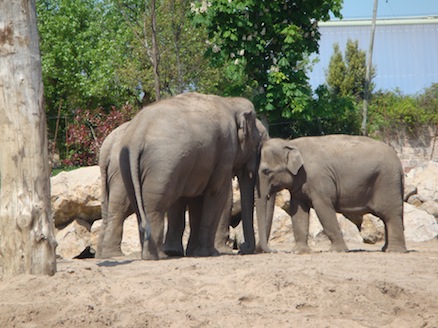
Chester Zoo: Safe Elephants
Elephant Herds Do Breakup
Elephant herds breakup for a number of reasons such as particular elephants not getting on socially, limited availability of food and water in the area that they live or the death of a matriarch.
I’ve only ever seen these amazing animals in the likes of Chester Zoo. But these animals should be in their natural habitats.
The best way to protect elephants is to have Rangers out in their habitats and to create safe wildlife sanctuaries. The Independent: Save The Elephants Appeal aims to raise much needed funds for Rangers and to help create safe wildlife sanctuaries.