Before 1799, Archaeologists, Historians and Linguists all had a problem.
Their problem was that they couldn’t work out how to translate and understand the many pictograms or hieroglyphics that had been drawn by the Ancient Egyptians.
More and more tombs, artifacts and stone slabs were being discovered all the time in Egypt, all covered with these mysterious and unfathomable symbols.
More and more tombs, artifacts and stone slabs were being discovered all the time in Egypt, all covered with these mysterious and unfathomable symbols. Just imagine how frustrating it must have been, to have all this information recorded about and recoded by the Ancient Egyptian people, but not to be able to make sense of it.
This apparently reads: Can you read this? Made using a generator on LINGOJAM.
The story starts with Napoleon (a French General, who would at one point become the Emperor of France) deciding to invade Egypt in 1798. Napoleon did this to threaten the British Empire’s control of India. Likely due to the conflict and poor record keeping by the French army, details about the Rosetta Stone’s discovery are vague.
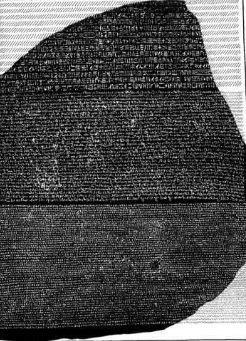
Historians seem to think that on 15th July 1799, French soldiers discovered the Rosetta Stone accidently whilst digging foundations for a fort. Historians suggest that when Pierre-François Bouchard, the Officer in Charge of the unit, he immediately understood the significance of what they had found.
What Did Pierre-François See and Understand About The Rosetta Stone?
The Rosetta Stone is a written/drawn decree, the same decree, repeated in three different languages. The first language was Egyptian hieroglyphics, suitable for groups of people in ancient times that could read that. The suggestion from Historians is that these people were either priests, wealthy or both. But we don’t know this for sure.
The second language was cursive Egyptian, which was thought to be ‘the language for every day people.’ The language that the majority of the people could read.
But it was the third language that Pierre-François spotted and made this stone slab special. The third language was Ancient Greek, which some scholars could still read.
This meant that well-educated people could possibly compare the passages using Ancient Greek passage like a the right key to a locked door. That they could decipher both the hieroglyphic and cursive Egyptian languages using the Ancient Greek passage.
At an earlier point in history, Alexander The Great (a Greek King) conquered Egypt with an army. Historians suggest that a group of people who could only read Ancient Greek existed in Egypt because of this past. That for whatever reasons these ancient Greeks opted to stay in Egypt, or perhaps, were instructed to stay, rather than going back home to Greece.
What Happened Next?
Jean-François Champollion, a French Egyptologist, was the first to successfully translate the meaning of different hieroglyphics in 1821. However, according to a number of different sources online, he had faced fierce competition from his former mentor Thomas Young, a British Scientist (I’m using the word Scientist here to describe a broad range of activities).
After this other people developed further understanding, but their works are all based on the foundations of Jean-François Champollion’s work. As the days have turned into months, and the months into years other stone slabs have been discovered with other decrees on them. A total of 29 Rosetta Stones have been found at the time this blog post was published.
Where is the Original Rosetta Stone Now?
At the time this post was published the original Rosetta Stone, the key to translating and understanding the ancient hieroglyphic language currently resides in The British Museum. How it ended up there…well that’s another story.
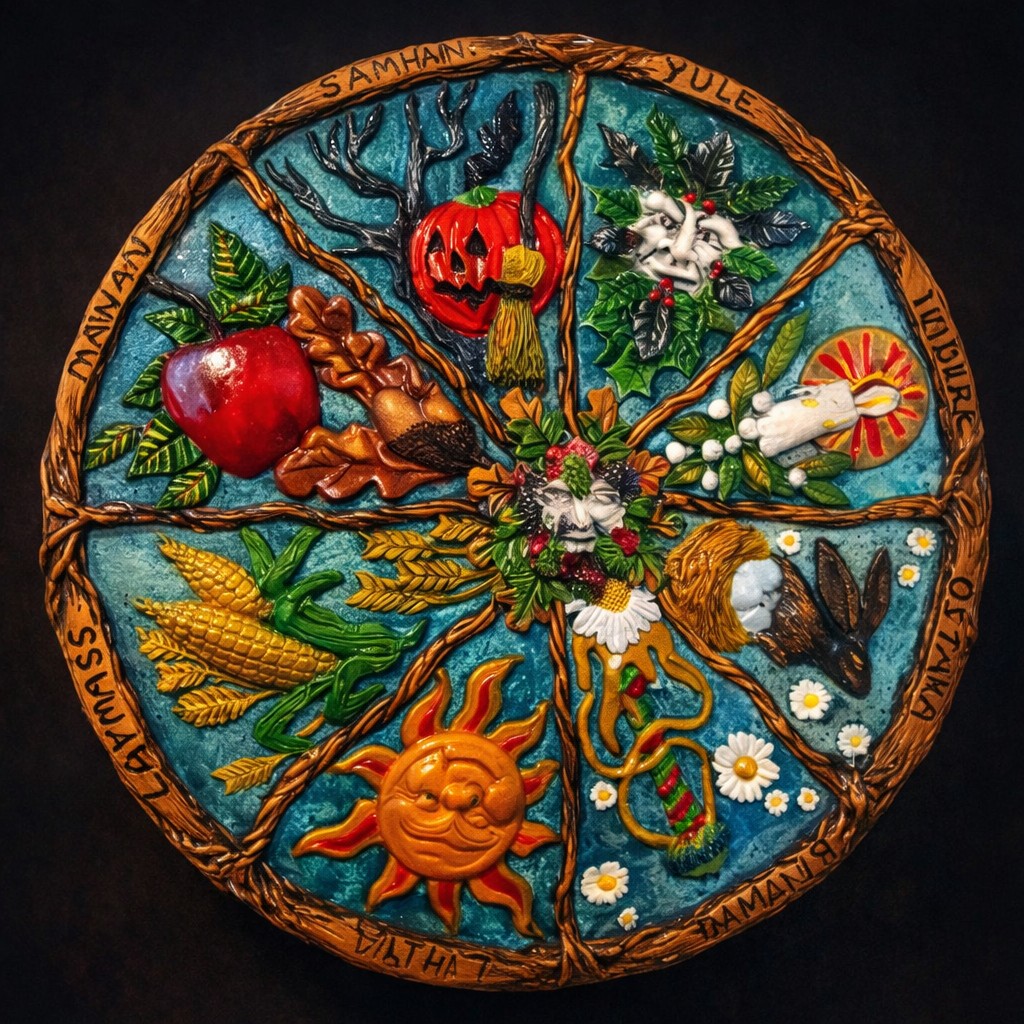
Image is of the Wheel of the Year Sculpture I have on my wall, that I bought in 2019.
Many belief that paganism and witchcraft have been practiced for thousands of years, all the way back to ancient humans hunting and gathering on the Savannah plains.
First, starting as an oral tradition, before moving into pictograms painted on the walls of caves, then finally into words (both verbal and written) as language evolved.
There is documented evidence of pictograms painted on the walls of caves, which have been carbon dated to approximately 12,000 years ago. Most show the hunt, with an animal in the centre of stick figured people, the people carrying spears. But in truth, we don’t know if these pictograms were merely wall decoration, or if they were painted in hope of a successful hunt, to document one or possibly as a form of spell to make a successful hunt more likely to happen.
Before we discuss the science (or lack it) for witchcraft, spells and magic, let us first define the terms. For this blog post, I’ll be using these definitions:
Definitions of Terms
Witchcraft – A fairly recent name given to a much older practices, where spells are used to direct magic through thought (intention) and emotion (strong desire or longing) to achieve a desired outcome or result.
Spells – Different methods to deliberately direct your intention and strong desire in the form of magic (energy) into the universe. A spell maybe a simple one step process, or a more multi-step complex process. It may require specific herbs, crystals or oils, or not. It may require tools/instruments or not. It may involve candles, sometimes of a specific colour, or not. It may require you to complete the steps on a specific day, date or time or not. It may require specific sun or moon phases or not. It may require a specific constellation alignment or not. It may have specific words that have to be said, sung, either once or repeatedly or not. The most important part of a spell, is that the person performing the spell has a clear intention and strong desire of the desired outcome or result.
Magic – A form of energy present through everything that was, is, will be or will never be in the universe.
Witchcraft Practitioner/Practitioner – For the purposes of this blog post, is defined as anyone practicing any form of witchcraft, inclusive of completing spells or using magic in any way.
Science – A systematic approach to understanding the universe, how it works and everything within it. The Scientific Method is thought to contain the following steps: 1. Observation 2. Development of a Theory 3. Experimentation 4. Analysis of Experimentation Results/Data 5. Consideration of Alternative Explanations or Influences on Results 6. Theory Fits – Suggest & Share 7. Theory Doesn’t Fit Evidence – Re-start Process
Witchcraft Versus Science
Witchcraft is definitely an observable phenomenon, as evidenced by the Census Data in 2021, from The Office for National Statistics, in England & Wales. 91,113 people identified their religion as pagan (I’ve grouped together here:Druids, Mysticism, New Age, Occult, Pagan, Wicca & Witchcraft), which raises to 155,858 people if you include people that described their religion as spiritual (I’ve grouped together here: all previous, plus Spiritual & Spiritualist).
In addition, there are large volume of books published about Witchcraft, you can see just some of these books listed on Amazon here.
The History of Witchcraft
In England, Witchcraft has a long history according to Philip Carr-Gomm & Richard Heygate, which they tell in their book: The Book of English Magic. I reviewed this excellent book here. It is available to buy on Amazon here. One of the great things about this book, is its extensive reference list. Most of what is written is referenced, making it a more reliable source to read or study.
I have also seen, but admit I’ve never read, books that detail the history of Witchcraft in many other parts of the world.
So the questions then become:
Is Witchcraft a scientifically proven method to achieve a desired outcome or result?
And if so, exactly how effective is it, compared with not practicing Witchcraft?
There is a theory to suggest that practicing Witchcraft may alter a person’s psychological and emotional state, which could impact on achieving a desired outcome or result. But there is no decent studies, published in scientific journals and that are peer reviewed. Most researchers tend to steer clear of Witchcraft due to fears for their academic reputation. They may also fear that researching this topic may result in fewer career opportunities in the future.
However, there are countless qualitative reports of people that have practiced Witchcraft (often on multiple occasions, over multiple years) to achieve a desired outcome or result with varying levels of success. Some say that success happens most of the time, others say success occurs some of the time, others state that success is less frequent – but that practicing Witchcraft has multiple other benefits.
Qualitative data is often seen in the scientific field as less reliable than quantitative data. However, where you to collect a wide range of these experiences from a wide range of people with randomised mixed different demographics, it would be difficult to theorise anything other than: Something is definitely going on. Especially if you compared experiences of people achieving a desired outcome or result with a control group (people who don’t practice Witchcraft).
Witchcraft is difficult to study because there is such variety and diversity of practices within the people that report using it. From a scientific stand point, this makes it incredibly difficult to study, as there are too many variables that could influence or impact the outcomes of practicing Witchcraft. To limit these variables, a scientific experiment could focus on a specific spell or type of spell.
Full Transparency
In the interest of full transparency, I have identified as a practicing Witch since 2004. I have written a book on Witchcraft practices, co-authored with Luna Hare, titled: SpellCast – Folk Magic for the 21st Century.
I have written this article as an genuine exploration of the question: Does Witchcraft, Spells & Magic Have A Scientific Explanation? This blog post is intended for others who may have pondered this same question and are my personal opinions only. Where possible, I have linked to any sources I have read or made reference to.
I would always strongly encourage anyone to do your own research, reading, experimentation and reach your own conclusions.
Spells Versus Science
A Spell is often completed by a Practitioner at a time of need or want of a specific outcome or result. Spell processes, ingredients used, tools used, time taken to complete, all vary on the individual Practitioner, depending upon how they work and the resources they have available. Some spells may come from existing sources (such as books or online) and completed as instructed, however, some Practitioners may amend or change the spell to suit them or their circumstances. Many Practitioners opt to create bespoke and personalised spells.
Add to this mix, the knowledge, past experience, skills and natural talents of the Practitioner or in some cases a group of Practitioners working together.
For example and totally andotally, I am better suited to instant magic, binding & banishings, spells around material gain, healing and protection. Whereas my good friend Luna Hare is better suited to blessings, cleansing spells, fertility, healing and happiness spells.
All of these variables make designing a suitable scientific experiment, with clear measurable objectives to demonstrate a spell’s success would be a practical impossiblilty. However, science has made some progress when it comes to measuring magic.
Missed Data!
Most Practitioners are very diligent when it comes to record keeping. What individual Practitioners record does vary, but generally most Practitioners keep a Book of Shadows which details:
Spell Name.
Ingredients used.
Tools used.
The process of the spell, including any words, movements, etc.
Traditionally, Practitioners have kept a hand written copy of their Book of Shadows. But as technology has evolved, so have some Practitioners’ record keeping practices.
Yet, to the best of my knowledge, no researchers have collected, analysed or intepreted this missing data.
It should be noted, that due to some historic persecution of Practitioners in some cultures, including in England & Wales, many choose to practice privately or secretly, with only those they are close to knowing that they practice Witchcraft.
However as the Census Data (2021) indicates, some Practitioners now feel safe to practice openly. But given that the number of Practitioners is unknown and has not been estimated, it is impossible to establish if any data gained would a representative sample for which conclusions could be scientifically drawn.
From a scientific point of view, some data is always better than none. Collecting some data about a observable phenomenon, usually leads to increased data collection over time, which would better inform possible theories and possibly lead to better understanding of what is happening when a Practitioner completes a spell.
Magic Versus Science
Scientific evidence is strongest if you consider magic as a form or forms of energy. So far, science has discovered:
The existence of lay lines and auras.
The existence of microorganisms and evidenced the impact they can have.
The exsistence of atoms and subatomic particles.
The theortical exisistance of dark matter and anti matter.
And no doubt much more that could be used to support an old idea:
That everything and everyone are interconnected in a web of energy. That learning how to be able to influence and change, anything and everything is possible. As above, so below.
Conclusion
At this time, scientific evidence to support Witchcraft practices including spells that send a Practitioner’s intention and strong desire for a specific income via magic is extremely limited. This is likely due to:
Researchers fears for their academic reputation and future career opportunities.
A scientific belief: If we can’t measure it, it doesn’t exist. A belief, I might add that has been proven wrong time and time again, with the advancement of science and technological developments.
The variety and diversity in spell work by Practitioners creating many different variables, along with the Practitioner’s own unique knowledge, experience, skills and talents.
A history of Practitioners being ostracised, harassed and in many cases persecuted just for the suspicion of practicing Witchcraft.
Lack of data collection, sharing, analysis and a data quality/improvement processes.
A belief that we know more abouteverything, than our ancestors did. That no knowledge, skills or wisdom could have been lost along the way.
Witchcraft has been practiced consistently for approximately 12,000 years. Indeed, before Doctors and the medical profession came along, when we lived in tribes, if you go ill or injured, you would go to see the elder of your tribe who may have done some practical healing (such as using plants and herbs), as well as some magic. Both were equally respected and equally valued.
I can’t imagine the human race continuing to practice Witchcraft for 12,000 years, if it didn’t work or do something, at least some of the time. Then there’s the countless experiences that Practitioners have had and documented their successes and failures with magic.
Each Practitioner has undertaken a unique and very personal journey, learning about witchcraft, spells and magic. Learning how to connect to magic, how send their thoughts (intention) and emotional energy (strong desire) to change outcomes in their favour.
When I first started exploring spells and magic, I approached each spell like an experiment. The first time I did a spell it worked. I wondered if it was the placebo effect. The second spell I did also gave me the outcome I desired. I considered whether it might just be a coincidence or luck. But after a while, I just accepted that it did work, without the need for an explanation as to how.
Of course, not all of the spells I have done have worked, or worked in exactly the way I wanted. Usually when this happens, my intention wasn’t clear or I didn’t put enough emotional energy into the spell. Or later, it turns out that if I had got the outcome that I wanted when I performed the spell, it would have been harmful to me in some way.