Tag

NHS

Why I Wrote FINDING YOUR HAPPINESS

By Happiness & Joy, Books & Authors, Creativity, Friends & Family, Health, LifeNo Comments
Reading Time: 3 minutes

Dearest Reader,

I recently released my latest book FINDING YOUR HAPPINESS. I wanted to share with you why I wrote it. To do so, I need to tell you part of my story. So, here goes:

Nearly 2 years ago now, after two years of being physically and mentally ill, I was diagnosed with Vasculitis.

Vasculitis is an autoimmune disease, where your immune system wrongly mistakes small blood vessels for foreign cells and attacks them. The vasculitis diagnosis came with a reduced average life expectancy.

The average life expectancy for someone with Vasculitis is 20 years from the point of diagnosis. This meant I had just 20 years of life left. I was 38 years old at the time of diagnosis.

This shortened life expectancy caused me to ask myself: Are you happy? The answer was no.

I have Type 1 Diabetes and was slightly overweight. My blood sugars were always too high. I had high blood pressure and high cholesterol. I was on two different antidepressants and an antipsychotic medication. I didn’t have time, energy or motivation to exercise. I didn’t eat well or sleep well.

I was working in the National Health Service (NHS) as an Alcohol Specialist Nurse. I enjoyed my face to face work supporting people with addiction issues. But the ever increasing workload and other stressors made me unhappy at work.

My relationships with family or friends were good. Or at least, at the time, I thought so. I spent a lot of my time with family or friends trying to meet their expectations of me – to be entertaining and funny, to be there to support them in difficult times, to take care of them. This is what I thought a good relative or friend did.

I didn’t have a partner. I didn’t go out on dates. In truth, I’d given up on romantic love. I’d decided that I just wasn’t lucky in that department.

Despite being a Specialist Nurse on a decent salary, money was always tight. When I really thought about it: I was very unhappy. I felt like I was existing, rather than living.

I decided to use my own counselling skills developed in the 18+ years working with people with addiction issues to counsel myself. I decided to look at my entire life, every aspect of it, and ask myself: What would make you happier?Then I would make the necessary changes. It was a daunting task.

Sometimes, it is easier to be stuck in an unhappy and unfulfilling rut, rather than be brave and face the truth. Especially when facing and accepting where I was in my life. This involved acknowledging the unhappiness and beginning to make changes.

Change is always uncomfortable and sometimes even difficult. Our brains like patterns of behaviour, they are key to our survival as a species. But patterns of behaviour are not key to a healthier and happier life.

So I got counselling. In my eyes, the Counsellor had two roles. The first was to ensure I kept being honest with myself. The second was to ensure that I made the changes that needed to be made.

I explored every aspect of my life. I started making changes. After nearly two years of hard work, I can finally say that: I am the happiest I have ever been.

Transformation complete? No. True happiness is a constantly evolving and ever changing process. One that requires daily checking in with yourself, navigating through the challenges of life and continuous work to ensure you stay as healthy and happy as possible.

Take a moment to think about a time your past when you were truly happy. Imagine living every day with that same feeling of happiness. This is why I wrote FINDING YOUR HAPPINESS, because everyone deserves to live a happy life.

Take care,

Antony
Share on Social Media:

The ‘Hospital Boss’ Arrest in relation to Lucy Letby Leaves Many Unanswered Questions

By Health, ThinkingNo Comments
Reading Time: 2 minutes

It was reported in various news sources (see for example here on the BBC) that one of the hospital bosses in charge of the NHS Trust where Lucy Letby committed her crimes was arrested by the Police on suspicion of perverting the course of justice this week.

I have already given my thoughts on Lucy Letby’s case here: Lucy Letby: A Miscarriage of Justice?

The limited information about the ‘Hospital Boss’ have given me a lot of questions, including:

  1. Why wasn’t the individual named? Lucy Letby was named before being found guilty, so surely it can’t be about protecting the individual’s identity.
  2. Three other hospital bosses were arrested in June/June 2025 (see this previous BBC News report), but there has been no update. Why?
  3. Are any of these hospital bosses professionally registered, and if so, have they all informed their professional bodies (such as the General Medical Council, the Nursing & Midwifery Council, etc.) of the allegations made against them?
  4. Have any of these hospital bosses, who may have moved on to roles in other NHS Trusts/Other Employers, made their new employers aware of these allegations?
  5. What happened to the idea of having a regulating body for senior healthcare leaders who are not otherwise professionally regulated? This idea seems to have been completely forgotten about.
  6. Who are the Police using as professional advisors? They will require experts in the field to advise whether any evidence they discover is expected practice or not and if the evidence demonstrates corporate manslaughter or gross negligence. In Lucy Letby’s case the Police used a very questionable expert to help to convict Letby. I hope they don’t repeat this mistake.
  7. What does suspicion of perverting the course of justice mean in relation to this case?
  8. What support have the families been offered in relation to these on-going enquiries?
  9. Are the Police including only the cases that Lucy Letby was convicted on or looking at all cases of infant deaths on the neonatal unit? If so, what time period are they looking at? The reports indicate that the Police are investigating corporate manslaughter and gross negligence manslaughter, both of which could have been happening before the crimes of Lucy Letby. They could even still be continuing.
  10. What is the NHS Trust doing to ensure nothing like this ever happens again?
  11. What is the Care Quality Commission’s (CQC) role in all this? The CQC last inspected this NHS Trust in the end of 2023, rated most areas as Requires Improvement (in the areas of Safe, Effective, Responsive & Well-led). I want to be clear: This is not a criticism of the CQC. Just a question. An idea I have thought about is the CQC perhaps having legal set timeframe for returning to any healthcare organisation that has areas that Requires Improvement?
  12. Why hasn’t the Department for Health & Social Care released any statement about this or anything that is being done at the NHS Trust to improve? Surely, this would reassure local people.

I’m hoping that time will provide answers to at least some of these questions, if not all of them.

If you enjoyed this post, you may like my article: The History of the National Health Service in England (1858-2016).

Write soon,

Antony

mental-health-wisdom-banner
Share on Social Media:

The Story of Sir Alexander Fleming and his Accidental Discovery of Penicillin

By History, Health, InspirationNo Comments
Reading Time: 2 minutes
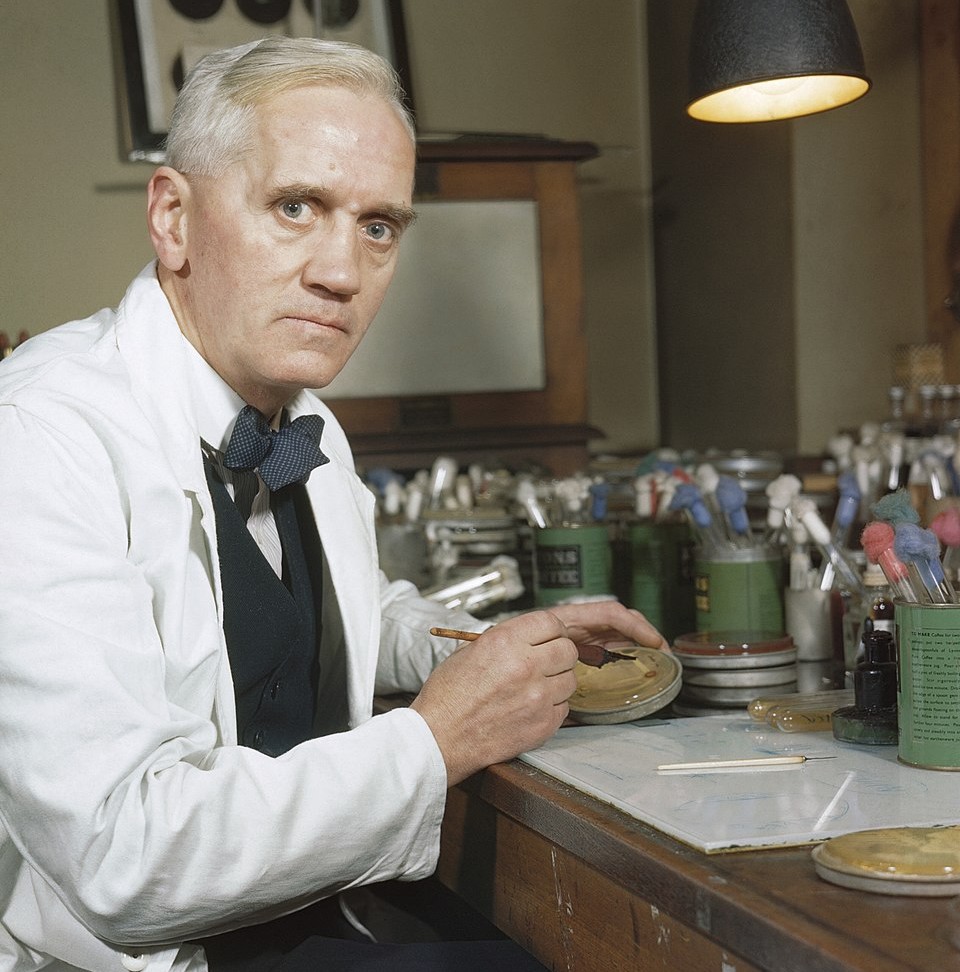
(Image From & Copyright © Wikipedia, 2026.)

Sir Alexander Fleming was a Doctor and Microbiologist who discovered the first antibiotic, Penicillin, by accident.

In 1928, Fleming was studying the bacterial organism Staphylococcus. Fleming accidentally left some petri dishes containing Staphylococcus uncovered in his lab before going away on holiday.

When Fleming returned to his lab, he discovered one of the petri dishes had developed mold. On examination, he discovered that all the Staphylococcus bacteria had been eliminated. Fleming discovered that this mold had produced a substance that had eliminated the bacteria. He identified the mold as Penicillium notatum, which is where he got the name Penicillin from.

The following year, Fleming reported his discovery in a talk to a Medical Research Club and wrote a paper which was published in the British Journal of Experimental Pathology. But it took nearly a decade for the scientific community to realise the implications and potential of Fleming’s discovery.

Fleming later reflected on his accidental discovery:

One sometimes finds what one is not looking for. When I woke up just after dawn on September 28, 1928, I certainly didn’t plan to revolutionise all medicine by discovering the world’s first antibiotic, or bacteria killer. But I suppose that was exactly what I did.
– Sir Alexander Fleming

Discovering Penicillin was not Fleming’s only achievement, but his most notable one. He was knighted in 1944 and shared the 1945 Nobel Prize in Physiology or Medicine. Knighted is when the reigning King or Queen bestows a knighthood, meaning that your title becomes Sir, rather than Mr or Dr.

Fleming was not exaggerating when he stated that he revolutionised all medicine. Antibiotics save many millions of lives across the world each year.

However, according to the NHS we are now seeing bacterial organisms that are resistant to some antibiotics. This means that some antibiotics no longer kill some harmful bacterial organisms. The NHS has been running a Keep Antibiotics Working campaign for a number of years, which has included this TV advert:

Click here to display content from YouTube.
Learn more in YouTube’s privacy policy.

Antibiotics don’t just save human lives. They can also be used to treat bacterial infections in animals too.

I find Fleming’s story incredible and inspiring. I hope you did too. If you enjoyed this post, you might like: The Story of Jonas Salk and The Polio Vaccine or Ida & Louise Cook: An Extraordinary & Inspirational Story.

Blog soon,

Antony

Share on Social Media:

Health & Future Plans Update: A Dramatic Reduction in HbA1c thanks to Medtronic Insulin Pump

By Books & Authors, Creativity, Gigs & Shows, Happiness & Joy, HealthNo Comments
Reading Time: 2 minutes

Health Update

There has been a dramatic reduction in my HbA1c thanks to my Medtronic Insulin Pump. I’ve gone from a HbA1c of 99 to 58. This means I’ve gone from being in the red to the green. It’s all thanks to the insulin pump’s SmartGuard, an algorithm that helps manage my blood sugars and insulin through use of a sensor and pump that work together via Bluetooth.

I’m feeling the benefits of a better controlled blood sugar – less tired, more energy, less susceptible to infections and next to no symptoms of a high blood sugar. There are benefits to my mental health as well, I don’t feel like I’m constantly failing to manage my diabetes anymore and like it is a constant battle every minute of the day.

The hole in the roof of my mouth is still there and still causing me problems with talking, eating and drinking. The surgeon wants an MRI and CT scans before proceeding, but there is a two to three month wait for these on the NHS. I often find myself apologising when I can’t be understood by others and it inevitably impacts on all areas of my life. But it will get fixed and that’s the main thing. This is temporary.

Future Plans Update

A friend and I are planning to go to some of Lancaster Literature Festival. This is in part to get ideas for Wigan Literature Festival. A festival I am hoping will be held later this year.

A friend and I are going to see Comedian Larry Dean in Salford.

Mum and I are going to meet some Alpacas and to watch The Rocky Horror Picture Show.

Finally, I get to go away to Wales with my unofficial adoptive family.

In October, my next book Z-Virus Monsters is released. You can pre-order a signed paperback copy here. Fanatic Members will get the ebook free on release.

I’ve also had another idea for either another article or book, depending on its length and have started the research for it.

I’ve got a lot to look forward too.

Write soon,

Antony

Share on Social Media:
×