A lot of employers are looking at the benefits of a 4 day work week for their employees. In the UK its even attracted the attention of The Labour Party, becoming part of their manifesto. The idea is that the employee works the same amount of hours, but over 4 days instead of 5 days.
I like this idea. It seems to be a win-win. The employee gains, but so do employers. Here are the benefits of a 4 day work week for the employee:
Increased happiness.
A better work/life balance.
More time with family and friends.
More time to take up hobbies, interests or even volunteering.
Better physical health – lower levels of stress, more and better quality sleep, improvement in concentration, memory and problem solving. Possible increased physical fitness due to more time for a better diet and exercise.
1Increased creativity.
Reduced risk of ‘burn out.’
A feeling of working to live, rather than living to work.
Save money due to less travel and lunch expenses.
Less time stuck in traffic on the commute to and from work. As employees will start earlier and finish later.
For Employers:
Increased productivity. Employees spend less time on non-work activities and really put their heads down to make the most of the hours they are in work.
Lower rates of sickness and a lessened length of sickness absence.
Employees that are more engaged.
Smarter ways of working developed.
Better outcomes from work undertaken.
More resilient individuals and teams that find it easier to deal with and adapt to change.
Employees give better customer service.
Improved communication and collaborative working.
Automation of some manual processes leading to increased efficiency.
Reduced estate costs – electricity only being used 4 days a week rather than 5 days.
More loyalty from staff – They’ll think twice about moving on if it means they’ll have to go back to a five day work week.
What do you think about a four day work week? Leave a comment below.
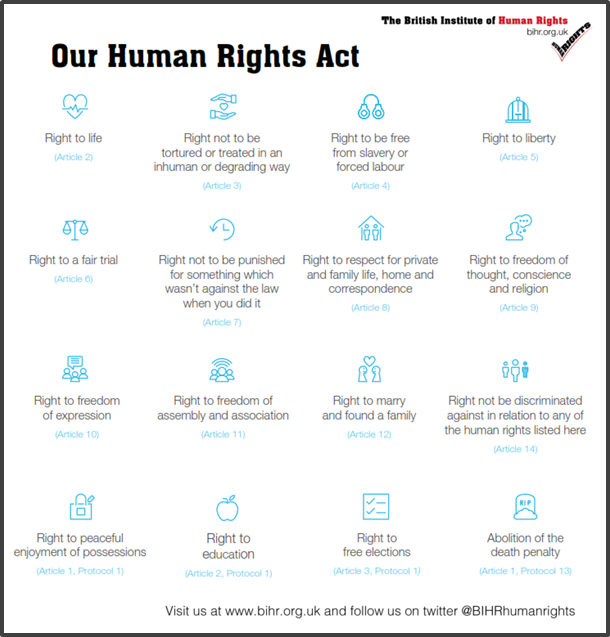
Article 3: Freedom from torture and inhuman or degrading treatment
Article 4: Freedom from slavery and forced labour
Article 5: Right to liberty and security
Article 6: Right to a fair trial
Article 7: No punishment without law
Article 8: Respect for your private and family life, home and correspondence
Article 9: Freedom of thought, belief and religion
Article 10: Freedom of expression
Article 11: Freedom of assembly and association
Article 12: Right to marry and start a family
Article 14: Protection from discrimination in respect of these rights and freedoms
Protocol 1, Article 1: Right to peaceful enjoyment of your property
Protocol 1, Article 2: Right to education
Protocol 1, Article 3: Right to participate in free elections
Protocol 13, Article 1: Abolition of the death penalty
Article 1 & 13 of the European Convention on Human Rights (ECHR) are not in The Human Rights Act (1998), as they are covered within the Act.
It is open to interpretation. For example, Article 12: The right to marry. Despite the Human Rights Act being dated 1998, Civil Partnerships for gay people only became legal in the UK in 2005. Gay Marriage only became legal in the UK in 2013. Prior to this the right to marry in the Human Rights Act (1998) was interpreted as only applying to straight people.
What it lacks?
With rights should come responsibilities. The Human Rights Act (1998) lacks listing responsibilities of the citizen, of local government and of national government. However you could argue that these responsibilities are covered by other UK laws.
The Human Rights Act does place a duty on Public Authorities to act within ways that are compatible with the Act, but again, this is open to interpretation.
Why?
The Human Rights Act (1998) exists to outline the rights and freedoms that every person in the UK should be entitled to.
When?
The Human Rights Act was passed through UK parliament in 1998, but came into force in October 2000.
How?
If a citizen feels their Human Rights have been denied, they can ask a court of law to look at their case. But this is a complex process and without good legal support can be difficult. This means that justice on Human Rights breeches are only challenged if people can afford good legal counsel, or are supported by certain charitable organisations that do work around Human Rights.
The Future of Human Rights?
The Government wants to replace The Human Rights Act (1998) with a British Bill of Rights. The concern is that this new bill of rights could weaken the rights laid out in The Human Rights Act and be even more open to interpretation than the current Act.
Other Content
If you enjoyed this post, you might like this other content:
The Manifesto is comprehensive (128 pages), well thoughtout and addresses all of the key issues in our society.
There’s so many great policies, ideas and promises in this Manifesto including:
Increase NHS funding by £30 billion over the next parliament.
Increase Social Care funding by £8 billion over the next parliament.
Give Local Authorities extra funding next year.
The creation of The National Care Service.
The creation of a National Education Service (NES) for England.
A £160 million annual investment cultural activities in schools.
Give mental health the same priority as physical health.
Recruit 10,000 more Police Officers.
Recruit 3,000 Fire Fighters.
Recruit 3,000 Prison Officers.
Spend at least 2% of GDP on defence.
Bring prisons & probation services back into public ownership.
Keep the NHS in public ownership.
£1 billion culture spending via a Cultural Capital Fund.
Reduce the voting age to 16 years old.
Stop NHS ‘Sustainability and Transformation Plans,’ which plan to close local A&E Departments and create Super Specialist Centres.
Increase capital funding in the NHS.
Free parking in NHS hospitals for patients, staff and visitors across England.
Reinstate bursaries for health-related degrees, including those for Nurses.
Increase funding for GPs and a halt to Pharmacy cuts.
More resources for NHS ambulance services.
An end to rationing of services and medicines across England.
Guaranteeing access to medical treatment within 18 weeks across England.
Guaranteeing 4 hour see and treat target in A&E Departments across England.
Investing in public health for children including increasing the numbers of Health Visitors and School Nurses. A £250 million Children’s Health Fund.
A strategy for the children of alcoholics.
Keep the BBC as a public broadcasting service and keep Channel 4 in public ownership.
Build over a million new homes, including at lease 100,000 social homes per year.
Create a Department for Housing.
End Right to Buy schemes for social housing, to keep the levels of social housing stable.
Back home owners who have leasehold and ground rent properties. To stop rip off management fees and ground rents.
Make 3 year tenancies the norm.
Set out a strategy to end rough sleeping within the next parliament. Part of this strategy will target the root causes of homelessness.
4 new Bank Holidays.
Raise the minimum wage to £10 by 2020.
Give all workers equal rights from day one.
Ban zero hour contracts.
Guarantee to ‘triple lock’ the state pension.
Keep Winter Fuel Allowance and bus passes for all pensioners.
Repeal the Trade Union Act and role out sectoral collective bargaining.
Promise trade union access to all workplaces.
Ensure schools are properly funded. Including putting an additional £150 million into schools.
Give £90 million per year for school-based counselling services.
Abolition of tuition fees, investment in college and higher education.
Give anybody the opportunity to upskill or retrain at any point in their life.
Renationalise the railway to deliver a better service and cheaper rail fares.
Electrification of rail throughout all of Britain.
Renationalise buses that are run for passengers and not for profit.
Renationalise the energy industry to give fairer energy prices.
Cap energy costs.
Renationalise water.
Renationalise the privatisation of Royal Mail.
A ban on fracking.
Public and local council services to deliver public services.
End the public sector pay cap.
End the pay cap on NHS Staff.
Trial PrEP (pre-exposure prophylaxis) treatment for those who have been exposed HIV.
Investment in NHS and Social Care Staff.
A promise to tackle tax avoidance and close tax loopholes.
Introduce an Excessive Pay Levy on companies with staff on very high pay.
Roll out a maximum pay ratio of 20:1.
A guarantee that 95% of taxpayers will have no increase in their tax contributions.
A guarantee that everyone will be protected from any increase in National Insurance contributions and VAT.
A target to eliminate the day-to-day spending deficit.
A National Transformation Fund and National Investment Bank that will invest £250 billion (over 10 years) into infrastructure.
Stop further cuts of youth services.
Tougher sentences for those convicted of committing animal cruelty.
Introduce a total ban on ivory trading, support the ban on wild animals in circuses, ban the sale of third-party puppies, cease the badger cull, maintain the bans on fox, deer and hare hunting.
Require companies to have plans in place to protect workers and pensioners when a company is taken over.
Make companies responsible not just to shareholders but to employees, customers, the environment and wider public.
Improve careers advice.
Stop closures of bank branches were there is a local need, putting customers first.
Ensure appropriate support for victims of crime.
Stop closures of libraries and Post Office branches.
Continue to keep museums and galleries free and funded.
Review of the Prevent programme.
Maintain security cooperation with other countries.
Ban unpaid internships.
Abolish employment tribunal fees.
Scrap punitive benefit sanctions and the bedroom tax.
Scrap cuts to the Bereavement Support Payment.
Increase Employment and Support Allowance (ESA) benefit by £30 per week.
Increase Carer’s Allowance benefit by £11 to the level of Jobseekers benefit.
End the parity of PIP (Personal Independence Payment) benefits between those with physical and mental health conditions.
End to pointless stress of reassessments for people with severe long-term conditions.
Guarantee the rights of EU Staff working in health and social care services.
Improve sexual health services, including those HIV specialist services.
Reinstate housing benefit for under 21 year olds.
Deliver of universal superfast broadband by 2022.
Free public wi-fi in city centres and on public transport.
Increased 4G and 5G coverage.
Halt the closures of Sure Start Centres.
A Child Poverty Strategy.
Extend 30 free hours of childcare to all two year olds.
Move towards making some childcare available for one year olds.
Extending maternity pay for 12 months.
Reduce class sizes to less than 30 for all five, six and seven year olds.
Free school meals for all primary school children.
Fully support veterans.
Actions to tackle loneliness.
A strategy for children with educational needs and disabilities (SEND).
Restore the Education Maintenance Allowance for 16 to 18 years olds from lower and middle income backgrounds.
Make free at the point of use further education courses, including English for Speakers of Other Languages.
Double the number of apprenticeships at NVQ Level 3 by 2022.
Prohibit courts from raising monies to provide services.
Introduction of no-fault divorce procedure.
Scrap quarterly reporting for businesses with a turnover of under £85,000.
Homeowners will be offered interest-free loans to improve their property.
Peace at the heart of foreign policy.
A vote for parliament on the Brexit deal.
Reinstate the Migration Impact Fund.
Fair immigration rules.
Building Human Rights and Social Justice into international trade policy.
Extend support for looked after children until they are aged 21 years old.
Fund child burial fees for bereaved parents.
Legislate to make terminal illness a protected characteristic under The Equality Act.
Changes to Fixed Odds Betting Terminals.
Building Crossrail 2 in London.
Creating safer roads and having a vision for 0 road deaths.
Give British Sign Language full recognition as a recognised language.
Creation of a Clean Air Act.
Renewal of Trident nuclear deterrent.
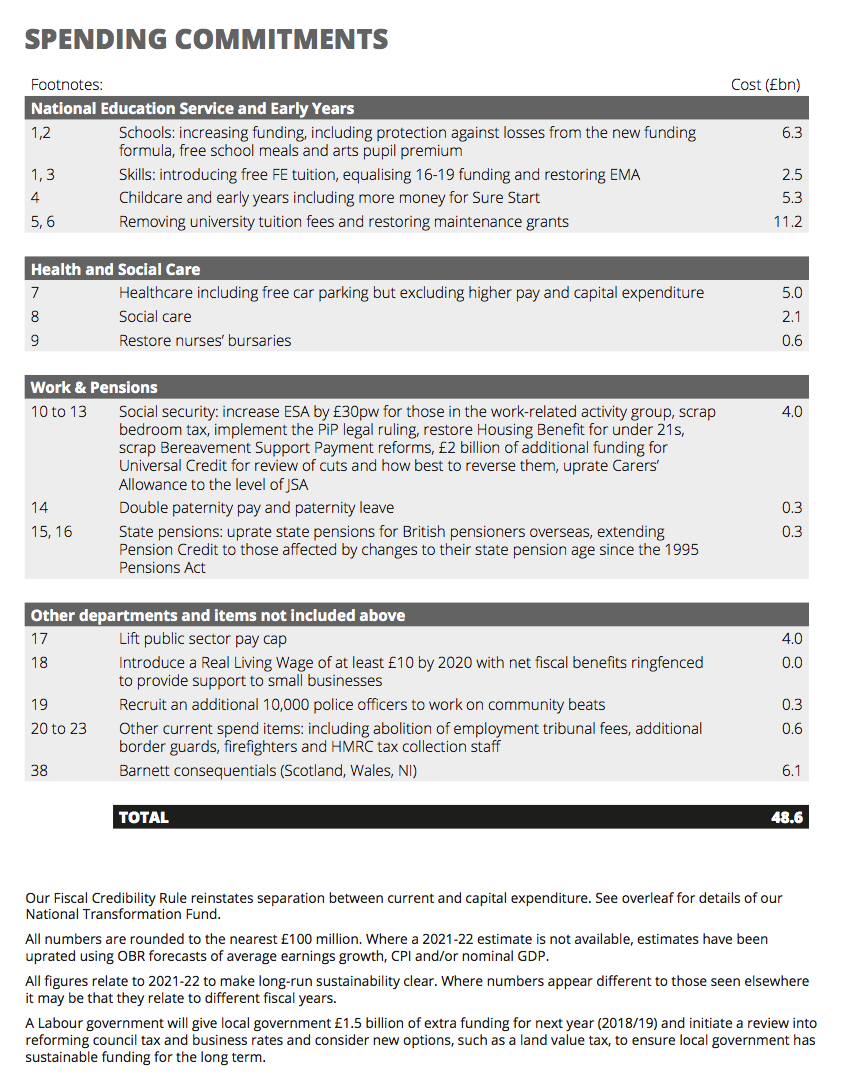
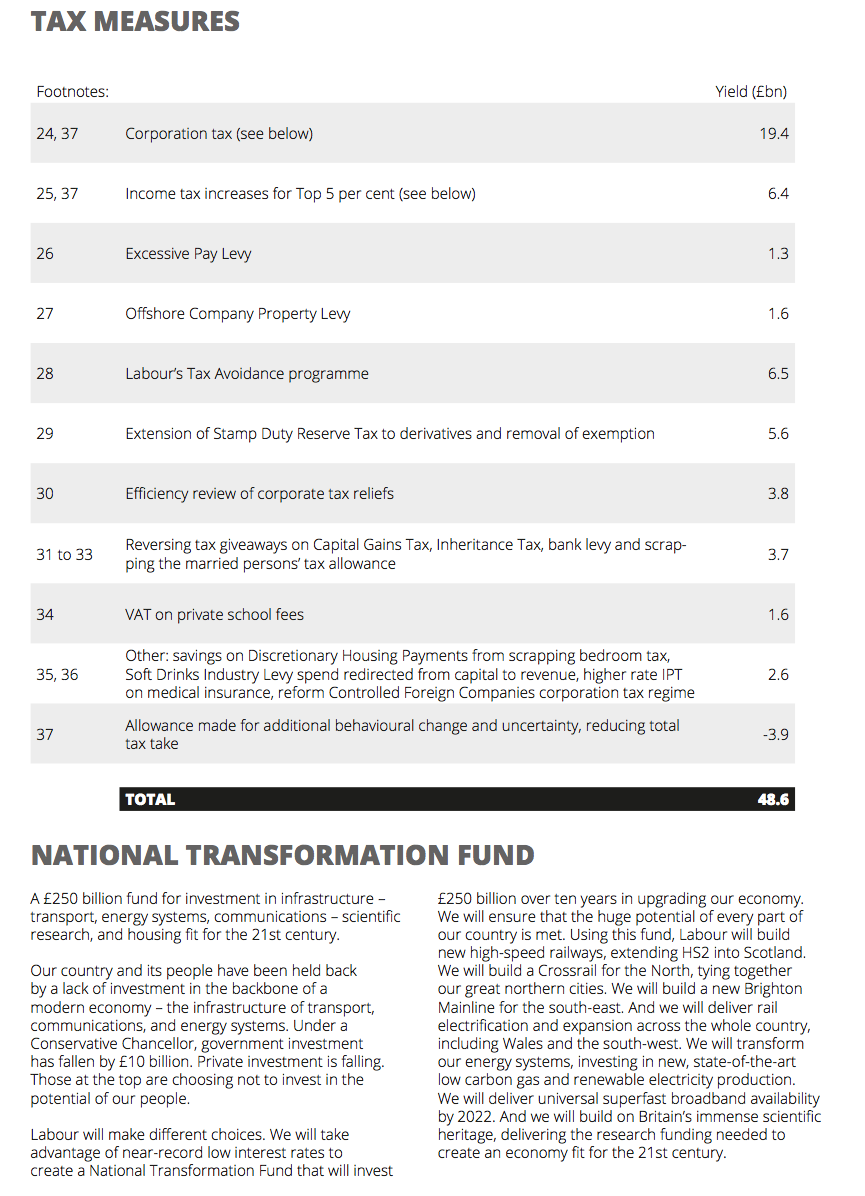
There has been some damaging and essentially untrue rhetoric that The Labour Party are fiscally irresponsible.
Labour have responded to this narrative by fully costing their spending commitments and how they will fund these commitments through tax measures. But don’t take my word for it, see the images below:
Labour’s Spending Commitments have been fully costed. Click on image for full size readable version.Labour’s Spending Commitments will be paid for by Tax Measures for the highest earning people and companies. Click on image for full size readable version.
With the general election, we have a chance to change our society. I want it to be changed for better.
The policies, ideas and promises in this Manifesto are exciting, inspiring and will change Britain for the better. The society set out in this Manifesto is a society I would be proud to be part of and to live in.
How do we get all of the listed above? How do we change society for the better? By going out and voting Labour on Thursday 8th June 2017.