Category

Gay

Book Review: Faitheist by Chris Stedman

By Books & Authors, Gay, Reviews, ThinkingNo Comments
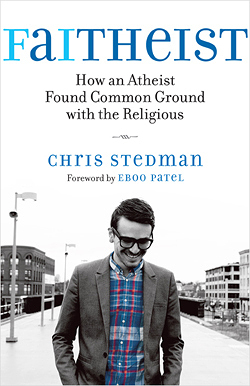
faitheist-chris-stedman-book-cover Chris Stedman is an atheist with a humanistic ethical code. Stedman, through his interfaith work, encourages the religious and nonreligious to come together and share their stories to humanise and understand one another for the greater good. He is the Assistant Humanist Chaplain at Harvard University and writes on his blog NonProphet Status, for the Huffington Post as well as on various other media platforms.

In Faitheist, Chirs Stedman shares the story of his life (so far). The full title of the book is longwinded (Faitheist: How an Atheist Found Common Ground with the Religious) and the introduction is off-putting. The introduction is full of terminology that is unfamiliar, unless you’re an Atheist Activist or an Interfaith Worker/Volunteer. This terminology and the elongated words are both unnecessary.

But get past the introduction and Stedman’s story is fascinating. Told in his warm and engaging writers voice his story is educational, enlightening, completely honest and emotionally resonant.

Stedman starts with his childhood; describing it as ‘not particularly religious.’ He discusses his search for a place to belong and a community to be a part of. Towards the end of his childhood he joins a church and becomes a Christian.

Stedman moves into his adolescence and tells us of his developing homosexuality. He describes a difficult time in his life, one where his sexuality and his extreme Christian beliefs are at odds. He discusses his self-hate, guilt and his loss of faith in God. He reveals how his mum discovered that he was gay and how she supported him. Lost, Stedman sets out on journey to find himself.

Stedman tells of his early adulthood; describing his journey to find himself and what he wants to do with his life. He tells that through Voluntary & Community Work he served others (a recurring theme throughout his entire life), he realised that the religious and nonreligious need to work together (interfaith working). He explains that he realised this has to start with understanding one another’s perspective.

Stedman writes about his set and strong convictions towards the end of this book, clearly promoting humanism. However he has a history of changing some of his views, based on his life experiences. So this left the question as to whether some of his views may change over time. Not his core values, those have always remained a constant, but some of his views on complex ‘grey’ areas in life.

As Stedman shares his story he describes his patchwork of tattoos and their meaning to him and his life. Stedman demonstrates his wonderful ability to reflect on his own experiences and learn from them. He reveals his unique passion, vibrant personality and how so alive he is. A gorgeous man with a beautiful, caring soul.

Stedman concludes his book, not surprisingly, advocating the bringing together of the religious and the nonreligious (atheists). He suggests that they should share their life stories with one another. This he states will lead to a better understanding of one another, so that they can work better together. He encourages the reader to open a dialogue with people from all walks of life, to listen to their stories and share yours.

Stedman could have included some glossy photo pages to match his autobiographical style of story sharing, which would have been great for visual learners.

Faitheist by Chris Stedman is a thought-provoking read and will appeal to anyone who is interested in the study of religious or atheism, the effect of religion on homosexuality, humanism, philosophy, ideology, interfaith work and/or bringing communities together.

Faitheist: How an Atheist Found Common Ground with the Religious by Chris Stedman is available to buy on Amazon.

Review soon,

Antony


I aim for posts on this blog to be informative, educational and entertaining. If you have found this post useful or enjoyable, please consider making a contribution by Paypal:


Share on Social Media:

Changes to The Pink List (2013)

By Gay, History, ThinkingNo Comments

Pink List 2013 Logo

The Independent on Sunday has been producing their annual Pink List since 2000. The Pink List is a list of influential gay, lesbian, bisexual and trans gay people in the UK. Each year The Independent assembles a panel of Judges, opens up for nominations from the public and then decides who to award the 100 places to and in which order.

This year’s Pink List 2013 has been published and with some interesting changes. No longer is it enough to be gay and a well known public figure whose a role model to gay youth. This year people on the list have to have contributed or made a difference in some way.

The Independent on Sunday have created two separate lists in addition to the main pink list; one for National Treasures and one for Politicians. On the National Treasures list is the likes of Russell T Davies, Paul O’Grady, Sir Elton John, Stephen Fry, Sir Ian McKellen and John Barrowman. On the Politicians list is various Westminster Peeps.

I am disappointed by the creation of these separate lists for National Treasures and Politicians. I think it is enough to be gay and a role model, so I’d have kept the one Pink List. I’d have just put people who have contributed more in the last year higher up on the list.

I would have extended the list to accomodate the increasing number gay people coming out. It shows that we are out there in numbers and contributing to society. For easy reading, I would have split the list into parts: 1-10, 11-30, 31-50, 51-100 and 101+.

The Pink List has always missed out people that are not in the media spotlight. I think the Pink List could be massively improved by including these people who are contributing a great deal to their local communities and society as a whole. These ‘ordinary’ LGBT people are doing amazing things. Such as those Workers/Volunteers for The Albert Kennedy Trust & George House Trust, Students who’ve set up LGBT Societies in Universities and Employees that set up or run LGBT forums within their employers organisations.

The Pink List should include out LGBT parents. Its very difficult to be an out LGBT parent. Many LGBT parents worry about the impact of their sexuality/gender identity on their children, in terms of some schools institutional homophobia and bullying by other children. I discovered this through two interviews with LGBT parents for a feature article for The Gay UK. The first interview was with Paul and the other with Linda.

Finally, I think there should be a list of influential straight people who support gay rights. The gay marriage bill would have never been passed into law, if it wasn’t for the many straight people who voted in favour of the bill.

Blog soon,

Antony

mental-health-wisdom-banner

Share on Social Media:

Import: Celebrities and Others Record Video Messages to Gay Teens to tell them: It Gets Better

By Gay, Inspiration, JournalismNo Comments

November is anti-bullying month. In 2010 there were a few high profile cases of gay teens committing suicide as a result of homophobic bullying both in school and in their communities in the USA. Dan Savage and his partner Terry Miller uploaded a video on YouTube titled ‘It Gets Better.’ The aim of this video, as you may have guessed, was to encourage gay teens to hang in there, as it does get better.

it-gets-better-logo

It Gets Better Logo

From this sprang the It Gets Better Project, an international campaign that aims to communicate the ‘it gets better’ message to gay teens to give them hope. The It Gets Better Project also aims to inspire and bring about change, so that there is less homophobia, more tolerance and more acceptance of gay teens.

Celebrities have voiced support for the It Gets Better Project with the likes of Zachary Quinto and Adam Lambert making their own ‘it gets better’ videos.

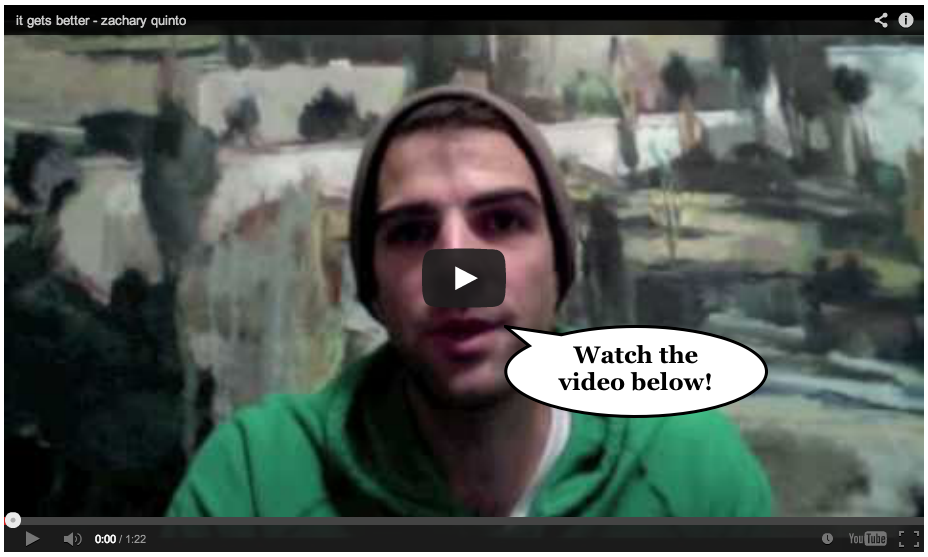
zachary-quinto-video-screen-shot

Zachary Quinto Video Screenshot

Zachary Quinto in his emotional video said: ‘The are countless other teens and young adults that are struggling to find a sense of identify and belonging in a chaotic and often unforgiving world…and to you I say it gets better.’

Click here to display content from YouTube.
Learn more in YouTube’s privacy policy.

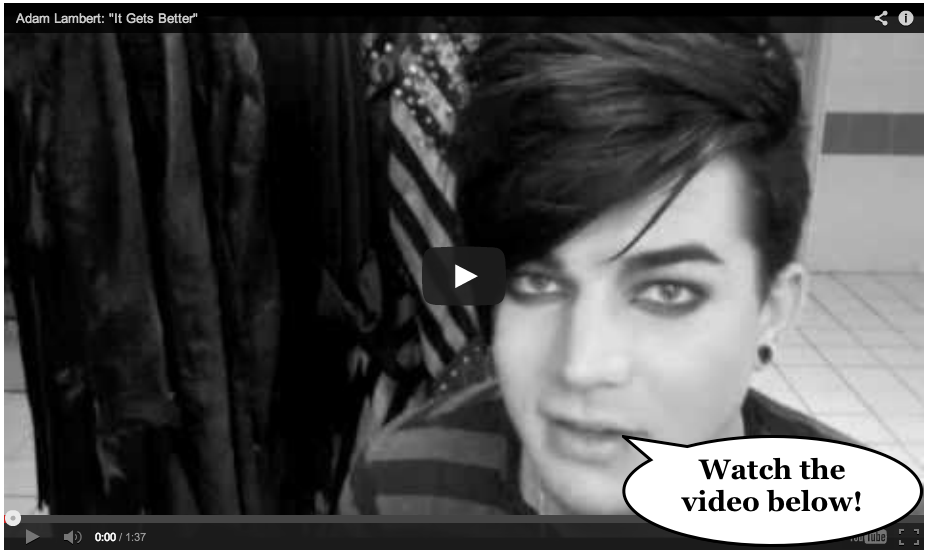
adam-lambert-video-screen-shot

Adam Lambert’s Video Screenshot

Adam Lambert in his upbeat video said: ‘You have to be strong…and you have to pay attention to the positive… and in doing so you will push through and you will rise up and you will live your life to the fullest. It gets better but its up to you.’

Click here to display content from YouTube.
Learn more in YouTube’s privacy policy.

President Obama, other American politicians and employees from the likes of Apple, Google, Microsoft and Dell have added their videos. Employees and students from Universities, Sports Clubs and other institutions have added supportive videos.

Thousands of people have used their webcams, video editing software and internet connections to uploaded their own individual videos aiming to give hope to gay teens.

The success of the ‘It Gets Better Project’ has been phenomenal. Seth Levy, Chairman of the Board of Directors for the project says that they’ve had success, but recognises that there’s still much more work to be done:

‘The It Gets Better Project works globally to share message of hope with LGBT youth and to make things better for them. The Project has already had great success through its international efforts in the Americas, Australia, Western Europe and the Carribbean. We are now beginning to work in more regions where, at times, the circumstances for LGBT youth are especially challenging and LGBT-focused resources are scarce. Moldova has historically been such a place. We are very excited to have partnered with our local affiliate, Egali, to help improve things for LGBT youth in Moldova. ‘

To learn more about the It Gets Better Project, visit their website: http://www.itgetsbetter.org/ .

Published by: The Gay UK on Friday 8th November 2013.


I aim for posts on this blog to be informative, educational and entertaining. If you have found this post useful or enjoyable, please consider making a contribution by Paypal:


Share on Social Media:

Import: FEATURE: Coming Out of the Broom Closest

By Books & Authors, Creativity, Gay, Journalism, PaganismNo Comments
Rivington - A Place of Bewitching Beauty I’ve come out of two closets in my life. First through the rainbow-coloured door – coming out as gay. Then out of the broom closet – coming out as pagan. Every time I’ve come out as pagan, I get asked the same sort of questions. Here are some of those questions and my responses:

What is it all about?
Paganism is a nature-based religion, so as a pagan I have a reverence for nature. Paganism has a dual aspect of divinity – meaning we have both a god and goddess.

This god and goddess duality symbolises balance that can be seen in all aspects of the world and universe. We cannot have life without death, happy times without sad times, etc.

Unlike most other religions we don’t have a bible or other book that tells us what to believe. What pagans believe is much more individual to them. But the two big focuses in paganism are nature and individual responsibility for our own actions and omissions.

Paganism has values that encourage equality, respect for all living beings and empathy for others, so generally pagans are very accepting of gay people. Acts of love, pleasure and beauty are important to pagans regardless of the sexuality or gender of those involved.

Do you worship the devil?
No…we actually don’t believe in a devil.

The Druid Circle Cumbria Do you have a Church?
Nature is our church. Some of us like to worship, celebrate and practice on our own; whereas others like to get together with other pagans.

Covens are closed groups of pagans usually consisting of a maximum of thirteen people. They have a High Priestess and a High Priest as leaders of their group, kind of like priests/vicars. Coven members will teach one another what they know, including the initiates (those new to paganism). Rituals, rites, magic, music and dance will all be taught within the closed coven circle.

Pagan moots are much more open. They are open to anyone and usually held at local cafes or pubs. Some moot organisers will arrange for talks on a range of pagan topics such as: herbs, crystals, healing, ghosts/other spirits, etc. Organisers usually ask for a donation or minimal charge to attend these fascinating talks.

Samhain-2012-4 Is magic like that on Charmed? Or like Willow on Buffy The Vampire Slayer does?
No…sorry. But it can be equally effective – it just works in a different way.

Imagine I cast a Spell for money. Money won’t magically appear. But I might see a job that I can apply for that’s better paid than the one I’m doing.

Just because I’ve cast the Spell, doesn’t mean the job is automatically mine! I still have to apply for the job, go to the interview and WOW the interviewers. I have to work hard to achieve my goals – like everyone else.

What’s the difference between a Pagan, a Wiccan and a Druid?
Paganism is a broad term to describe lots of different paths that have the same principle beliefs. Wicca, Druidism and others paths may have slightly different practices but share the same principle beliefs and are therefore are all encompassed under the term paganism.

Think of it in terms of Christianity. Christianity is the over-arching term, but within that you have the Church of England, the Roman Catholic Church and many others all with the same principle beliefs but with slightly different practices.

So you don’t celebrate Christmas?
We have our own holidays, many of which coincide with Christian holidays. But our big celebration is Samhain or Halloween, which to pagans is like Christmas and New Year rolled into one.

We are all individuals. Personally I celebrate Christmas with my family, because they do and because it’s a positive time for all. It’s the one time of year my family takes the time out to spend precious time together, to eat, drink and be merry – oh and of course there’s the presents!

Where can I learn more?
The best gay pagan book I’ve come across is Gay Witchcraft by Christopher Penczak. Christopher Penczak is a pagan gay man who wrote this for gay men. It even has a section on gay deities.

Other non-gay books I’ve learned a lot about paganism from are: The Real Witches’ Handbook by Kate West, Elements of Witchcraft by Ellen Dugan, Witchcraft: Theory and Practice by Le De Angeles and Everyday Magic by Dorothy Morrison. There’s also a myriad of information on the internet –just do a Google search.

Published by: The Gay UK on Tuesday 17th September 2013.


I aim for posts on this blog to be informative, educational and entertaining. If you have found this post useful or enjoyable, please consider making a contribution by Paypal:


Share on Social Media:
×