

Yesterday, the Nursing & Midwifery Council (NMC) announced their plans for education standards here.
The NMC is the regulator of Nurses, Midwives and Nurse Associates in the UK. Their announcement included:
- Strengthening expectations around anti-racism, bias awareness, cultural curiosity, safety and respect in practice learning placements, alongside strengthening partnership working to better support students requiring reasonable adjustments
- Ensuring nursing students undertake at least one community-based practice learning placement in a health or social care setting, reflecting the diverse needs of people and communities
- Allowing simulated practice learning to contribute towards practice learning hours for rare and hard to achieve proficiencies in pre-registration midwifery programmes, meeting the Standards for Student Supervision and Assessment.
From: NMC, last accessed: 20/11/26.
I was extremely disappointment with this announcement on their plans for education standards. The statement above read like corporate vague speak and I asked myself: Whatever happened to specific and clear NMC standards?
I also noted that there was no mention at all of:
- Safeguarding children and adults, including complex cases.
- How the human body works, including anatomy and physiology.
- What diseases/illnesses can affect the human body, how these diseases/illnesses are identified and treated – including safe use and the pharmacology of common medications.
- The birthing and dying processes.
- Clinical skills in assessment and observation.
- Models of nursing care.
- How to manage errors and other incidents.
- Caring for patients with learning disabilities, ADHD, addiction/dependency, mental health, dementia and other specific issues.
- Anything around working with families/partners/other people that may be part of a patient’s life.
- Clinical audit and research processes and skills.
- Activities aimed at developing clear and effective communication skills.
- The role of other members of the multi disciplinary team (MDT), the nurses’ role within this team and the vision for what true collaboration looks like.
- Activities aimed at developing critical thinking skills.
- Activities aimed at improving documentation skills.
- The influence of health & social care policies on both nursing practices and the NHS.
- The influence of politics on nursing practices and the NHS.
- Relevant legislation.
- The role of the Nurse in health promotion, health education and prevention of diseases/illnesses.
- The role of technology in healthcare, both now and in the future.
- The clinical experience and education/training required for Lecturers in universities who teach pre-registration/students training to become Nurses, Nurse Associates or Midwives.

Let me give you 2 examples from my clinical practice, which illustrate why I think the above are important:
Example 1 – The Practice Educator
A couple of years ago, whilst working in an NHS Hospital, I knew a Nurse who was a Practice Educator. The Practice Educator reported that they were training newly qualified Nurses (Nurses straight out of University) because they didn’t have the knowledge and skills required to go straight on the Wards to work. I found this absolutely shocking and asked what the newly qualified Nurses knowledge gaps were.
The Practice Educator reported that they had gaps in basic anatomy knowledge, such as how the heart operates.
Let me ask you, if you were having a heart attack: Would you want to be cared for by a Nurse who didn’t know how your heart was supposed to work?
Example 2 – The MRI Scan
I observed a patient ask a newly qualified Nurse what an MRI scan was (MRI stands for – Magnetic Resonance Imaging), as he was going for one later that day and wanted to know more about it.
The Nurse said she’d be back in a moment, went out of the bay, googled it and went back and told him what MRI stood for.
However when the patient asked follow up questions: What does that mean? What will happen during the scan? Why are they scanning me? What are they looking for? The newly qualified Nurse was obviously unable to answer.
On that particular Ward, the vast majority of patients would need and have an MRI scan. For this reason, I would have expected any Nurse on that ward to know what an MRI scan was and be able to answer basic questions about an MRI scan if asked by a patient.
Full Consultation Results – Not Shared AGAIN
The NMC regularly consults with their registered Nurses, Nurse Associates and Midwives online. I commend them for doing this. But they never release the full consultation results, which isn’t very transparent.
I know a number of Nurses that responded to the consultation around these education standards. None of them report writing about any of the topics raised in the NMC’s announcement.
This is making me, as a Registered Nurse, feel ignored by the NMC. It will also make much less likely to participate in future consultations. But perhaps, this is what the NMC wants?
Are You A Nurse, Nurse Associate, or Student?
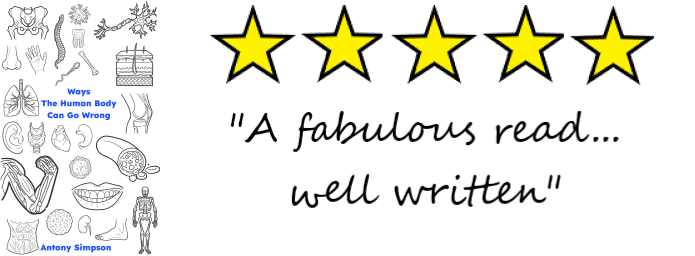
If you want to know more about the human body, including every system of the body, what can go wrong when the body malfunctions or fails, symptoms (including why these happen) and cures/treatments available, check out my book: Ways The Human Body Can Go Wrong.
You can read the 1st chapter for FREE here: Read FREE 1st Chapter Sample
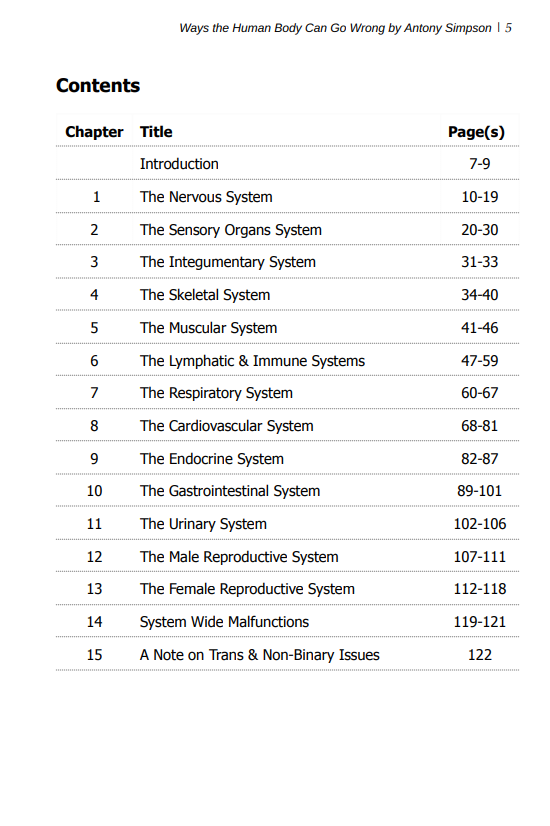
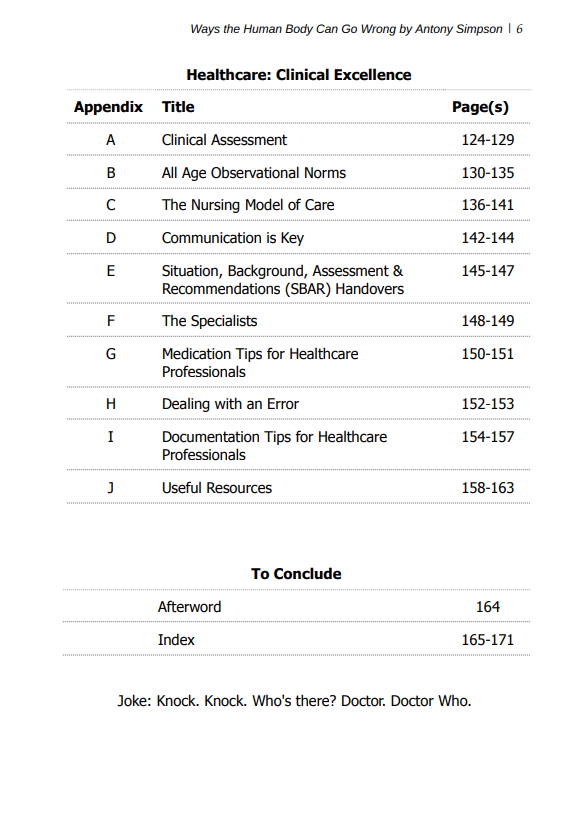
Below is also the complete contents pages, click for full size image:
About me
I have been a Registered Nurse for 19 years, with experience working in a range of settings including Accident & Emergency, a Hospital-wide Specialist Alcohol Service and Community Services. I am passionate about teaching how the body works, what can go wrong and how best to cure/treat these malfunctions/failures.
Write soon,
Antony
Other Content
If you liked this post, you might like:
- Ways The Human Body Can Go Wrong
- The Alcohol Therapy Workbook
- Mental Health Wisdom
- Article: The History of the NHS in England 1858-2016
- The Nurses’ Quiz
- All Nursing & Healthcare Content
