Category

Thinking

One in Five People

By Life, ThinkingNo Comments

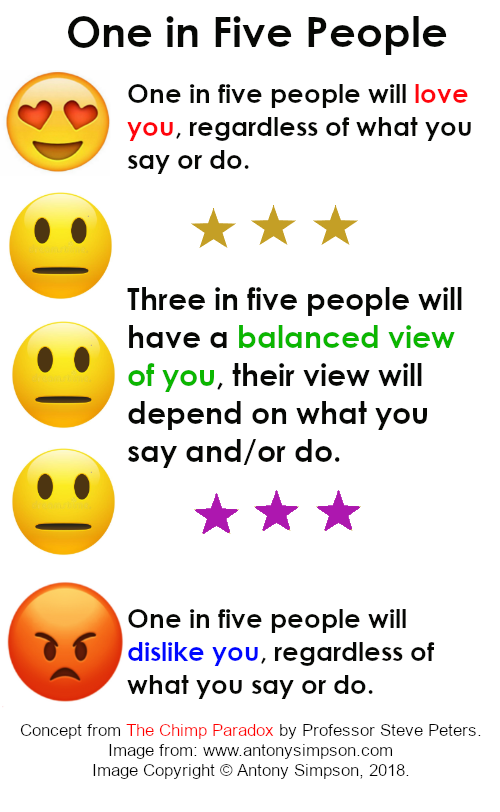
What’s the number of people likely to like or love you?
What’s the number of people likely to be indifferent towards you?
What’s the number of people likely to dislike you?

This fascinating psychological theory from Professor Steve Peters, called One in Five answers the above questions:

one-in-five-people

I’m unsure what research and evidence this theory is based on. But being aware of this theory can help you to:

  • Recognise the people that like or love you. I name these fans. Despite being fans of you, good relationships with these people will still need to be developed and maintained.
  • Recognise that the majority of people will be indifferent towards you, but that you can influence these people by what you say and/or do. Try to be as self-aware as possible. Understand and empathise where these people are coming from and understand their wants, needs, desires and motivations.
  • Accept that not everyone will like you. No matter what you say and/or do.

I hope you find this psychological theory useful, I certainly did when thinking about my desire to please people.

Write soon,

Antony

mental-health-wisdom-banner


I aim for posts on this blog to be informative, educational and entertaining. If you have found this post useful or enjoyable, please consider making a contribution by Paypal:


Share on Social Media:

Themes from Dr Who (Series 11)

By Happiness & Joy, Thinking, TV, Online Streaming & FilmsNo Comments
dr-who-2018-series-11-0

Image From & Copyright © BBC, 2018.

I’ve loved the most recent season of Dr Who. The lead role has been brilliantly played by Jodie Whittaker. There was some controversy about the role being played by a woman, to me I just thought: why is it even an issue?

There have been some fantastic themes through out the series. Here are the themes I’ve spotted in each episode:

Episode 1 – The Woman Who Fell to Earth

  • Diversity – It should be recognised and celebrated. Whether diversity comes from race, learning difficulty or sexuality (mentioned in episode 2). Shown in character representation, characters universal acceptance and appreciation different others.
  • We’re stronger working together as a team, than we are as separate individuals.
  • Only idiots carry knifes – A direct quote from the Doctor, probably in direct response to the rise in knife crime in the capitol London.

Episode 2 – The Ghost Monument

  • A Leader reassures, motivates and has the backs of their team. Shown in how Dr Who treats members of her team.
  • Brains Beat Bullets – A direct quote from the Doctor. Prior to this Doctor states: You’ve got to outthink the enemy. and after the direct quote above another: Guns make things worse.

Episode 3 – Rosa

  • Standing up for Equality – The story of Rosa Parks (see The Story of Rosa Parks) is all about equality and civil rights.
  • How dangerous and stupid white supremacy views are, including the dehumanising affect they have.
  • How racism affects the victims. Shown through character conversation behind the bin.
  • How a single person can change the world and the universe forever.

Episode 4 – Arachnids in the UK

  • Is he Ed Sheeran? – A direct quote from the Doctor. Even the Doctor knows who Ed Sheeran is, even if she doesn’t know what he looks like.
  • Irresponsible businesses and their leaders that care about the bottom line – profit – rather than doing the right thing are bad for all. Their employees, citizens living close to the businesses and the community as a whole.
  • Guns are bad.
  • Cruelty is never necessary.
  • Treat all living things with dignity and respect.
  • Togetherness is better than loneliness.
  • Grief takes time, lots of time.
  • Team TARDIS – Friendship that is built on mutual respect and coming together in a crisis, is too valuable to let go of and should be cherished.

Episode 5 – The Tsuranga Conundrum

  • The Doctor doesn’t mind admitting when she’s wrong.
  • The Doctor see’s all problems as puzzles to be solved.
  • The Doctor loves anti-matter drives, the concept and the actuality.
  • Dad’s don’t have to be perfect. But they should be there for their child and involved in their life.

mental-health-wisdom-banner

dr-who-2018-series-11-1

Image From & Copyright © BBC, 2018.

Episode 6 – Demons of the Punjab

  • A fixed event in time can’t be stopped.
  • Things are not always what they seem.
  • There’s nothing worse than when ordinary people lose their minds.
  • The Doctor believes in love in all its forms. The Doctor thinks love is a form of hope – Direct quote from The Doctor.

Episode 7 – Kerblam!

  • Always answer a call for help. Observed by The Doctor always answering calls for help.
  • The best managers, the really good ones, value their staff, and know instinctively if someone’s in trouble or if they need help. A direct quote from The Doctor.
  • You should be worthy of the job or position you hold.
  • The Doctor doesn’t like bullies, conspiracies or danger, said to Yaz by The Doctor.

Episode 8 – The Witchfinders

  • History has sometimes been hard to women.
  • We’re all the same. We want certainty, security. We want to believe that people are either evil or heroic, but that’s not how people are. A Direct Quote from The Doctor.
  • True knowledge has to be earned.
  • Start with the mysteries of the heart.

Episode 9 – It Takes You Away

  • The Doctor loves her sonic.
  • Some people will sacrifice almost anything to see and be with dead loved ones.
  • The living must let go of the dead and continue to live their life. They can still remember them, it’s just not good to live in the past.
  • Friends help friends face up to the truth, not hide from it. A direct quote from the Doctor.
  • The sheep revolution is just over 100 years away :).

Episode 10 – The Battle of Ranskoor Av Kolos

  • Doctor Who doesn’t like vengeful murder or the talk or the threatening of it.
  • The Doctor is fine destroying anything that can be rebuilt. Buildings and the like.
  • Following blind faith is wrong.
  • Rather than revenge, be the bigger man. It takes great strength to do this.

My Hopes for Series 12
More aliens and travel to other worlds. Essentially more Sci-Fi.

Write soon,

Antony

mental-health-wisdom-banner


I aim for posts on this blog to be informative, educational and entertaining. If you have found this post useful or enjoyable, please consider making a contribution by Paypal:


Share on Social Media:

World Mental Health Day – Young People & Mental Health

By Health, ThinkingNo Comments

Today is World Mental Health Day. This year the World Health Organization has decided that the theme is young people and mental health in a changing world. So here’s my post all about young people and mental health:
World-Mental-Health-Day-2018

What is a young person?
A young person is any person aged between thirteen and twenty one years old. They are in the adolescence stage of life:

Adolescence
The stage of adolescence or the teenage years starts around 12-13 years old and lasts until around 18-20 years old. The end of childhood and beginning of adolescence is marked by the start of puberty.

In adolescence your body and brain are going through massive changes. These changes mean that you need more sleep and may well be found sleeping in till midday or later.

In the body, high levels of hormones rage creating physical changes, increasing emotional intensity and a fierce need for independence. The emotional intensity explains why you are more likely to be rebellious in your thinking and actions as an adolescent.

If you’re a male physical changes include: body hair grows (public, underarm, facial & legs), voice breaks – becoming deeper, Adam’s apple becomes prominent, acne, penis growth, lowering of testis lower, growing taller and broader.

If you’re female physical changes include: growth of breasts, menstrual cycle, body hair grows (public, underarm & legs), acne, weight gain, change of body shape and growing taller.

In the brain, hormones make you more likely to act on impulse and take risks. This explains why you are more likely to try alcohol and/or drugs in adolescence.

Both the body and brain make you aware of those you feel sexually attracted to. You notice them. You want to get to know them and ultimately you want to have sex with them. You may start to have sexual and/or romantic relationships.

Your thinking is egocentric – you are only or mostly concerned about you. This egocentric thinking explains a lot of your thinking and behaviour including why you are so concerned about how you look.

Puberty takes around 4 years from the early signs to completion. As well as all the puberty changes, you have the pressures of high school including peer groups and exams.

From my blog post: The Cycle of Life, Last accessed 06/10/18.


Why focus on young people?
These statistics explain why:

  • 20% of adolescents may experience a mental health problem in any given year.
  • 50% of mental health problems are established by age 14 and 75% by age 24.
  • 10% of children and young people (aged 5-16 years) have a clinically diagnosable mental problem, yet 70% of children and adolescents who experience mental health problems have not had appropriate interventions at a sufficiently early age.

From: The Mental Health Foundation – Mental health statistics: children and young people, Last accessed: 06/10/18.


What can we do to support young people with mental health problems?
First teach them about resilience and how to increase resilience:

Resilience or emotional resilience is our ability to deal with adverse events in life that cause pressure or stress. I like to think of resilience as being like water in a well:
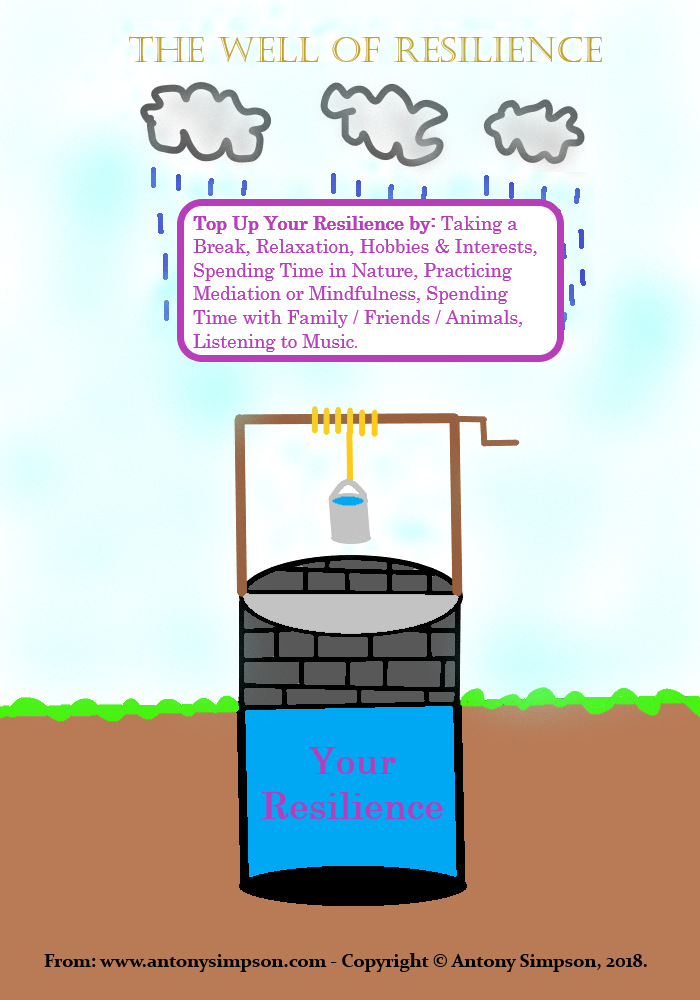
The-Well-of-Resilience-by-Antony-Simpson

We only have so much resilience within us, like there is only so much water in a well. Adverse events cause us to use our resilience water by the bucket loads. But there is good news.

We can make it rain to add more resilience water to the well or just top it up a little at any time. We can do this by: Taking a Break, Relaxation, undertaking Hobbies & Interests, Spending Time in Nature, Practicing Meditation or Mindfulness, Spending Time with Family / Friends / Animals and Listening to Music.

From my blog post: Mental Health Focus: The Well Of Resilience, Last accessed: 06/10/18.

Second support young people in a variety of ways including:

First educate yourself around mental illness.

Second: You must look after yourself. You can’t support anyone else if you are not well physically, mentally or emotionally.

On to the practical advice to support someone with mental illness:

  • Stay in contact with them. Ask them how they would like you to keep in contact. Some may may prefer phoning or seeing; whereas others may prefer messaging or texting.
  • Unconditional love and care. Let them know that you love them unconditionally and care for them deeply. Don’t have any expectation that they will reciprocate.
  • Listen to what they say and don’t assume anything.
  • Ensure that there are no distractions when you are with them or on the phone to them. Put your phone on silent and make sure any loud children are pets are out of the way (if you have them).
  • Offer practical support. Go shopping for them or with them, help them to clean, cook them a meal. Whatever it is that they need. They maybe resistant to the idea of practical help, so reassure them that you are happy to help and that you know they’d do it for you.
  • Remind them to take their medication or when appointments are due. People with mental illness tend to have poor short term memories.
  • Ask them about their appetite and diet. If they have an appetite but are struggling to make anything (due to lack of energy and/or motivation), find out what there favourite meal is and cook it for them.
  • Offer distracting activities. Distracting activities that you can both do together can give someone a break from their own critical inner of voice. The activities can be something as simple as a walk around the park. Make sure you are always led by the person with mental illness though. If they say that they are too unwell or tired to do the activity, don’t take it personally. And certainly don’t judge them or take offence.
  • Help them access support. This could include going with them to GP, counselling sessions or mental health service appointments. Offer to sit in appointments with them, but let them know that it’s okay if they want to be seen alone.
  • Be understanding. Someone with mental illness may cancel plans at the last minute. You may arrive at their house to find it messy and them unclean. Don’t take it personally, let them know that you understand and ask if there is anyway that you can help.
  • Be patient. Like any illness, mental illness takes the right treatment, the right support and time for them to start to feel better.
  • Limit questions and time spent with them, if you feel they are exhausted and need to rest. You’ll be able to spot if they need to rest by: pulling on their hair, forgetting what you’ve said to them, being very slow to respond, unable to think of words, dropping of their head, shuffling of feet and other body language people use when they look like they are about to drop off to sleep.
  • Be aware of your own body language and theirs. Try and display open body language and avoid mirroring.
  • Try not to give advice, as often it is unrealistic and unhelpful. For example never advise someone with depression to exercise more or have an healthier diet. This person has probably used all of their energy and motivation to get out of the bed. This single action has left them more exhausted than they have ever felt in their life. So advising them to exercise, eat an healthier diet or make big changes to their life will seem unachievable and may come across as if you are blaming them for their depression.
  • Sign-post them to useful resources.

From my blog post: Mental Health Focus: How to support someone with Mental Illness, Last accessed: 06/10/18.

I hope you found this blog post useful. Feel free to give feedback by leaving a comment below.

Write soon,

Antony
mental-health-wisdom-banner


I aim for posts on this blog to be informative, educational and entertaining. If you have found this post useful or enjoyable, please consider making a contribution by Paypal:


Share on Social Media:

Sometimes High, Sometimes Low

By Health, ThinkingNo Comments

It’s coming up to the three year anniversary of my life hiatus.

During my life hiatus, I was admitted to hospital due to mental illness and diagnosed with cyclothymic disorder (a form of bipolar).

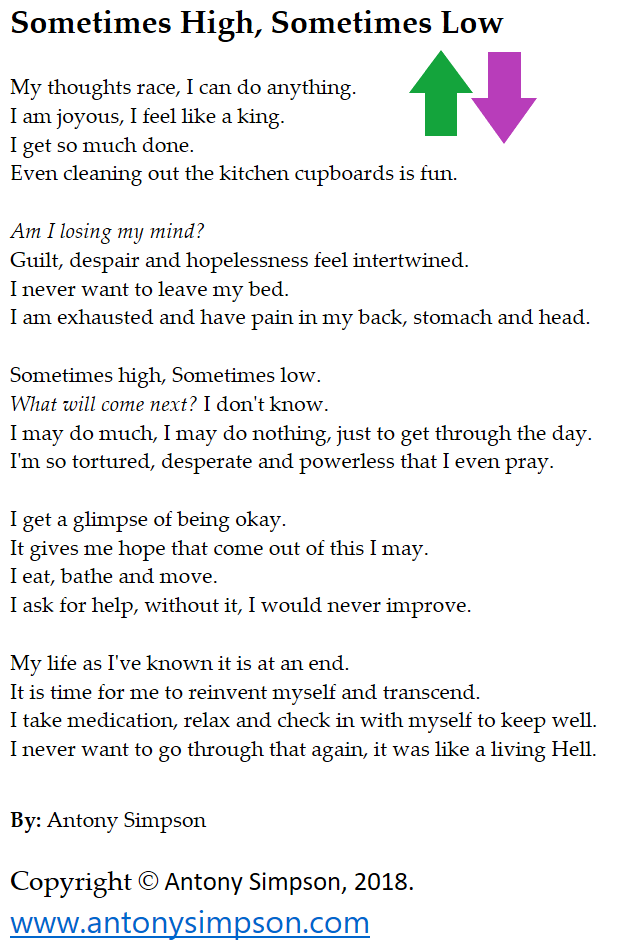
It’s taken three years, but I’ve finally written something to reflect on the experience. Here it is, called Sometimes High, Sometimes Low:

Click here to display content from docs.google.com.

Download (PDF, 194KB)

mental-health-wisdom-banner

In case the PDF viewer above doesn’t work for you, here is an image:

sometimes-high-sometimes-low-by-Antony-Simpson

Click for Full Size Image.

Blog soon,

Antony


I aim for posts on this blog to be informative, educational and entertaining. If you have found this post useful or enjoyable, please consider making a contribution by Paypal:


Share on Social Media:
×