Category

Thinking

The Secrets to Self-Awareness

By ThinkingNo Comments

The Secrets to:

self-awareness-image
Self-awareness.

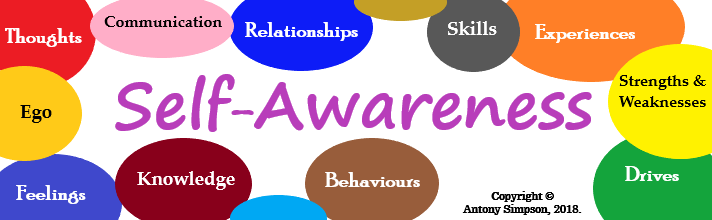
Self-awareness is about understanding more about you. It’s about being aware of your thoughts, feelings, ego, knowledge, skills, experiences, relationships, communication, strengths & weaknesses, drives and behaviours in a situation. Self-awareness isn’t something you do just once or occasionally. It should be an on-going day by day, hour by hour, moment by moment task.

There are numerous benefits to being more self-aware. A good example is that you can use self-awareness to change how you respond to different discussions and events to get better outcomes. It is just about you being aware of yourself and how you influence others. Nobody can be self-aware at all times, but you can make yourself more self-aware.

So how do you become more self-aware? Here’s my suggestions, based on research online and my own experiences:

1. Observation
Observe everything going on around you. Including yourself and how you interact with others.

2. Reflection
Reflect on just about everything. It could be a past experience, or reflecting on something you’ve learned or read. Consider:

  • Who? What? Why? How? When?
  • What were your thought?
  • What were your feelings?
  • What were your behaviours? How did others behave?
  • What outcome did you want? Did you get it? If not, what could you do differently?
  • What did you learn? How can you use this learning in the future?

People have lots of different ways of reflecting. Some good ideas include: meditation, keeping a daily journal and counselling sessions (using the counsellor as a sort of sounding board).

Two important things about reflection:
1. You’ve got to practice reflection to get good at it.
2. It has to become a regular behavioural habit.

3. Balanced Thinking
When observing or reflecting ensure that your thinking is balanced. When it comes to ourselves we are often too critical and only see the negatives. Be fair and kind to yourself. Recognise both the positives and negatives.

4. Develop Your Emotional Intelligence
Emotional intelligence is about being able to recognising how you are feeling and the emotions of others around you. A good way of developing emotional intelligence is to replay past situations in your mind and consider what emotions people in the situations (including yourself) were experiencing.

Emotional intelligence will enable you to have more control of your emotions, when/how you express them and being able to influence others on an emotional level.

It might also be worth learning more about body language as 80% of communication is non-verbal.

5. Honest Feedback
Honest feedback about yourself is important for self-awareness. Any feedback should come from a person that only wants to help you to improve yourself. If you suspect that feedback coming from a person is because of their own self-interest or because of another agenda, think carefully about its bias.

You can get feedback from family, friends, work colleagues, customers, practically anyone. Usually all you have to do is ask.

It’s good to know about the 5 to 1 ratio. The person giving you feedback should give you 5 authentic compliments to 1 piece of specific constructive criticism.

The person you ask for feedback may not of heard of the 5 to 1 ratio. So it might be worth discussing it with them prior to asking for feedback. It would also be good if you started using the 5 to 1 ratio when you give feedback to others.

6. List Your Strengths and Weaknesses
Make a list of your strengths and weaknesses. Celebrate your strengths and develop weaknesses.
mental-health-wisdom-banner

7. Encourage Open Questions
Encourage open questions that stimulate debate and discussion in all areas of your life. Debating and discussing opinions is a really good way to become more self-aware and develop awareness of others.

8. Know Your Story
The stories we tell ourselves, especially those about ourselves give insight to all things self-awareness. So know your story. Know how your past influences your now and how it could potentially impact on your future. Listen carefully to the narrative.

If there narrative is highly negative or too critical, you may want to sit down and rewrite your story on paper. Once you’ve done that start telling yourself and others your new story.

9. Life Goals
Write down your life goals. This exercise is brilliant for self-awareness, especially if you do the introspection as you develop your life goals.

10. Coaching
I’ve never had coaching. But there seems to be a widely held belief that good coaching encourages self-awareness. I can see how this would work. Like most things, the more you put into coaching in terms of self-awareness the more you’ll get out of it.

11. Our Own Version of the Truth
Two people can experience the same event, yet have completely different perspectives and views about it. We all have our own version of the truth. Remember this.

12. Psychometric tests
There are many psychometric tests available, each with its own Pros and Cons. Perhaps the most well-known is the Myers Briggs Type Indicator (MBTI) based on the work of Carl Jung, a psychoanalyst. You can take a MBTI test for free and view your results here.

Useful Online Resources
5 Ways to Become More Self-Aware – Harvard Business Review
Ways to Improve Your Self-Awareness – Cleverim
Know Thyself: How to Develop Self-Awareness – Psychology Today

Write soon,

Antony
mental-health-wisdom-banner


I aim for posts on this blog to be informative, educational and entertaining. If you have found this post useful or enjoyable, please consider making a contribution by Paypal:


Share on Social Media:

Mental Health Focus: The Well Of Resilience

By Health, Thinking2 Comments

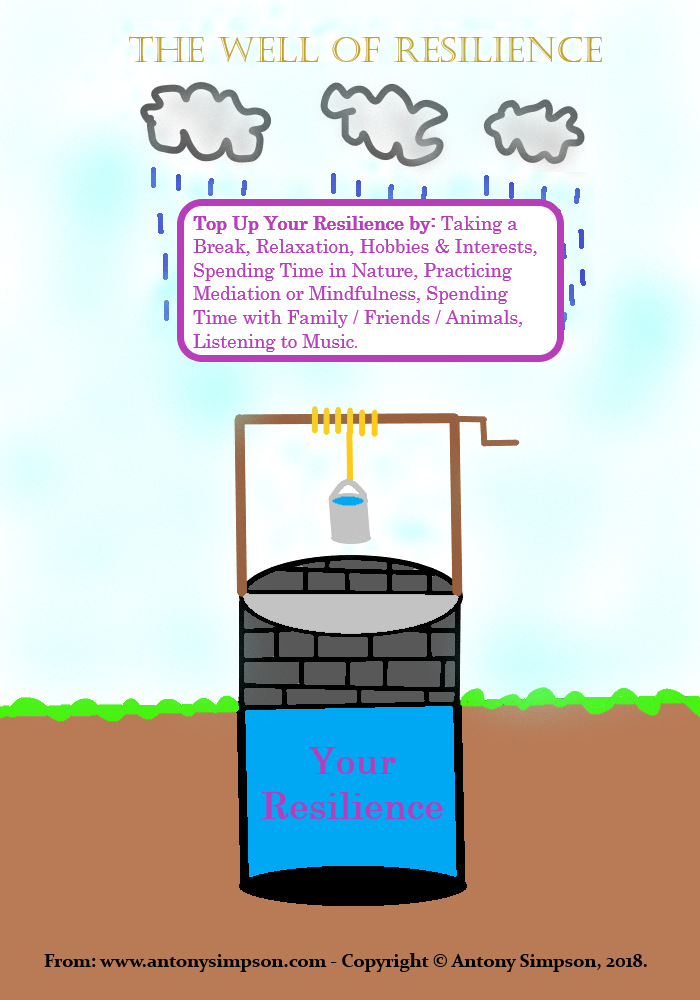
Resilience or emotional resilience is our ability to deal with adverse events in life that cause pressure or stress. I like to think of resilience as being like water in a well:

The-Well-of-Resilience-by-Antony-Simpson

We only have so much resilience within us, like there is only so much water in a well. Adverse events cause us to use our resilience water by the bucket loads. But there is good news.

We can make it rain to add more resilience water to the well or just top it up a little at any time. We can do this by: Taking a Break, Relaxation, undertaking Hobbies & Interests, Spending Time in Nature, Practicing Meditation or Mindfulness, Spending Time with Family / Friends / Animals and Listening to Music.

How do you top up your well of resilience? Leave a comment below and let me know.

This blog post is part of a series with a Mental Health Focus. Other posts you might like include: Wonderful Websites for Mental Health and Mental Illness, How to support someone with Mental Illness, 10 Easy Ways to Improve Your Mental Health, General statistics for Mental Health in the UK, A list of Famous People Who Have Experienced Mental Illness, Treatment and Recovery and A list of Common Conditions.

Take care,

Antony

mental-health-wisdom-banner


I aim for posts on this blog to be informative, educational and entertaining. If you have found this post useful or enjoyable, please consider making a contribution by Paypal:


Share on Social Media:

The Teenage Brain

By Education, Health, Life, ThinkingNo Comments

I’ve worked with teenagers, or adolescents or using the term I prefer young people for most of my career.

I’m often asked the same questions about young people, such as: Why do they take risks? Why can’t they always think about the potential consequences of their actions? Why can’t they see the perspectives of others? Why are they so concerned about what their peers think of them?

This great TED Talk video explains more about young people’s brain and its development:

Click here to display content from TED.
Learn more in TED’s privacy policy.


Although this video is enlightening, it shows that neuroscience is in its infancy. Our understanding of probably the most the most important organ in the body is extremely limited.

I wish the speaker had gone into further details about young people’s behaviour, so that the questions above were more fully answered for those that have them.

Blog soon,

Antony

mental-health-wisdom-banner


I aim for posts on this blog to be informative, educational and entertaining. If you have found this post useful or enjoyable, please consider making a contribution by Paypal:


Share on Social Media:

Autism & Asperger’s Syndrome Series – Wonderful Websites

By Life, The Web, ThinkingNo Comments
wonderful-websites-image This is the eleventh and final blog post in a series titled Wonderful Websites. The first focused on general health and can be read here. The second focused on mental health and mental illness and can be read here.

The third post focused on shopping and can be read here. The fourth focused on money and can be read here.

The fifth focused on gigs, shows and theatres and can be read here. The sixth focused on paganism and can be read here.

The seventh focused on gay culture and society and can be read here. The eighth focused on TV, Online Streaming & Films and can be read here.

The ninth focused on music & radio and can be read here. The tenth focused on technology and can be read here.

This is also the second in an Autism & Asperger’s Syndrome Series of blog posts. The first post was Autism & Asperger’s Syndrome Series – What they are, Signs/Symptoms, Diagnosis and Treatment Approaches.

Here’s Wonderful Websites for autism and Asperger’s syndrome:

1. The National Autistic Society – A great online resource. It covers autism and Asperger’s syndrome for all ages and people in all circumstances.

2. NHS Choices – Autism Spectrum Disorder a great website for understanding the basics of autism and Asperger’s syndrome. It includes sections on: overview, symptoms, causes, diagnosis, treatment and adults with autism.

3. Scope: Autism – A fantastic website for all things disability. Their website has sections for people whom are disabled, a section for families and a section for professionals. They also have a telephone helpline.

4. Child Autism UK – A useful website if you have a child who has or you suspect has autism.

5. Asperger’s Syndrome Foundation UK – The website is really basic, but does have some good information on.

6. Asperger-Syndrome.me.uk – This website has some great content, but you can’t copy/paste the information as the information is saved as images rather than text. This means it’s usefulness for research purposes is limited.

Are there any websites around autism or Asperger’s syndrome that you think are useful that aren’t on the list? If so leave a comment below and let me know.

Blog soon,

Antony

mental-health-wisdom-banner


I aim for posts on this blog to be informative, educational and entertaining. If you have found this post useful or enjoyable, please consider making a contribution by Paypal:


Share on Social Media:
×