
Two Change Theories – The Cycle of Change by Prochaska and DiClemente & The Three Stages of Change by Lewin
Everyone and everything changes. As the Greek Philosopher, Heraclitus of Ephesus once said:
Change is the only constant in life.
Understanding how change happens is key to changing any of your thought patterns, emotions or behaviours. It is also key to changing the thought patterns, emotions or behaviours of others.
Here I present two of my favourite change theories:
The Cycle of Change by Prochaska and DiClemente
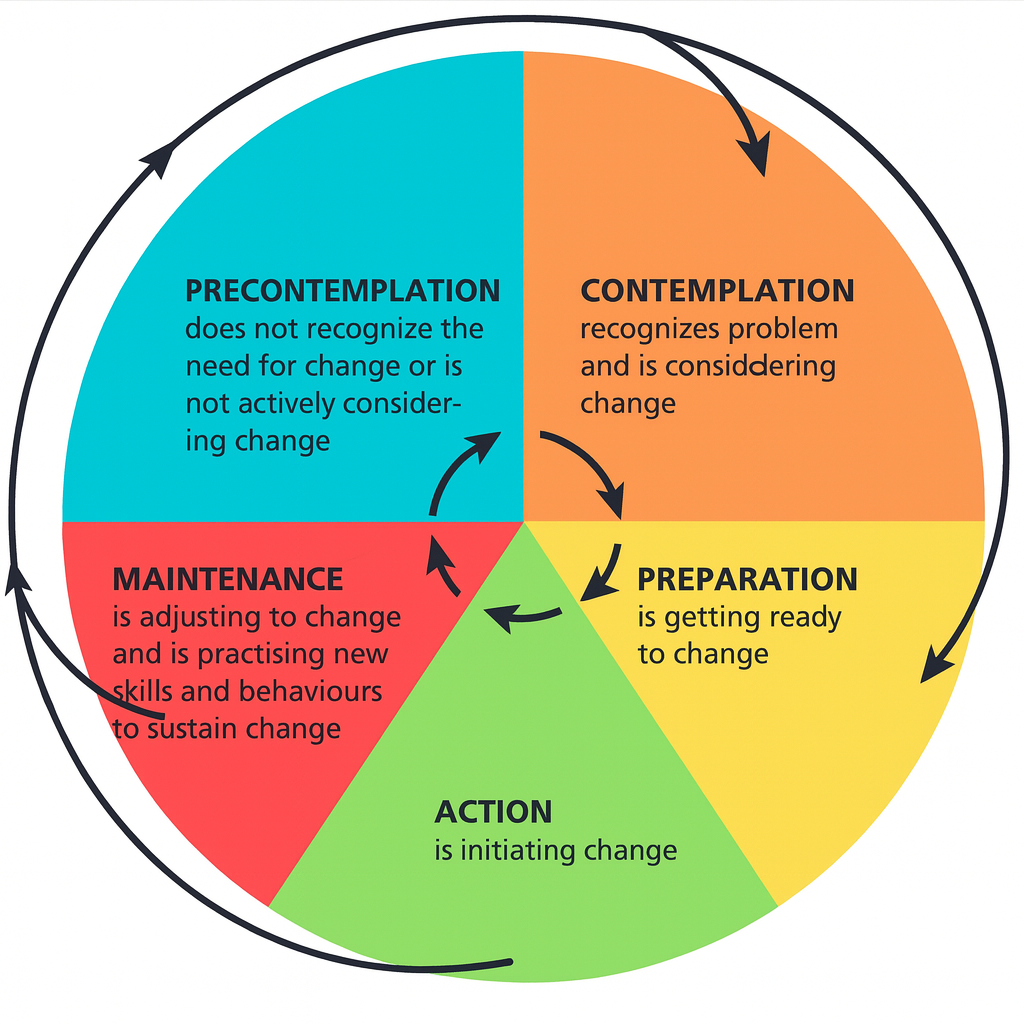
The Cycle of Change was developed by Prochaska and DiClemente in the 1980s looking at how smokers in America stopped smoking.
Prochaska and DiClemente identified that change happens in distinct stages and that these stages can be considered a cycle. They created a diagram to demonstrate this cycle, which I have recreated on the left.
Here is a more information about each stage:
1. Precontemplation
Precontemplation is the first stage in the Cycle of Change. If you are in this stage of change you don’t have any desire or thoughts around changing any of your thought or behavioural patterns.
2. Contemplation
In the contemplation stage you will be thinking about changing either a single thought or behavioural pattern or any number of them. You will be considering the good and bad aspects of the patterns. You will be thinking about how you could change the patterns and the impact you expect changes would have on you and others.
By the time you reach the end of the contemplation stage, you have made the decision to either change or not.
If you have decided to change, you progress to the next stage.
If you have decided not to change your behaviour then you go back to the precontemplative stage.
Some people can get stuck in the contemplation stage for a long time. Always try to be aware of which stage of change you are in and how long you have been there. This will prevent you from getting stuck in any stage of the change process for a prolonged period of time.
3. Preparation
The preparation stage is all about planning to make the change to your thought or behavioural patterns. You will begin to take some actions for the change you want, such as setting goals, making a plan, etc.
For example, say you wanted to change the amount of physical activity you undertake, by increasing it. In this stage you may:
- Join a gym.
- Join a local sports club.
- Plan a new routine which will give you more time for physical activity.
- Recruit a friend who will also take part in some or all of your physical activities.
4. Action
The action stage is where you stop the old patterns of thoughts or behaviours and start the new patterns. This stage of change is hard and initially takes a lot of conscious effort, energy and motivation.
However with repetition and the passage of time, the new patterns of thoughts or behaviours become easier, take less conscious effort, energy and motivation to complete.
5. Maintenance
In the maintenance stage, you maintain the new patterns of thoughts or behaviours by regular repetition. The aim is to make the new patterns become your new way of being and functioning.
Prochaska and DiClemente theorised that the maintenance stage takes 3-6 months to complete. After this time, what was once a change is the new normal for you.
Neuroscience suggests that it takes 3-6 months for neurons (brain cells) to reorganise and become fully established to support a new thought or behavioural pattern. This neuroscience idea is called Neuroplasticity. This means that neuroscience supports Prochaska and DiClemente’s theory that it takes 3-6 months for you to change thought or behavioural patterns.
Neuroscientists have discovered evidence to suggest that Neuroplasticity occurs throughout a person’s life. This means that no matter your stage of life or age, you can make changes to your thought or behavioural patterns at any time.
6. Lapse or Relapse
Prochaska and DiClemente described going back to old thoughts or behavioural patterns as an essential part of the process of how change happens.
They described a lapse as an event of going back to old thoughts or behavioural patterns for a short time, recognising that you have done this and still having a desire to change to the new patterns. In a lapse, you go back to the new thought or behavioural quickly.
Lapses are part of the process of change. A lapse can be a great learning opportunity for you. By reflecting on a lapse you can learn what triggered you to revert back to your old patterns and prevent it from happening again in the future. This can lead to your next attempt at change being more or completely successful.
Prochaska and DiClemente described a relapse as going back to the old thought or behavioural pattern in the longer term. The danger with a relapse is that you could lose your desire, energy or motivation for change and go back to the pre-contemplation stage of the cycle.
I give much more information, practical advice and tips for change in my book FINDING YOUR HAPPINESS:
The Three Stages of Change by Lewin
The Three Stages of Change by Lewin was developed in the 1940s. His theory consists of three distinct stages:
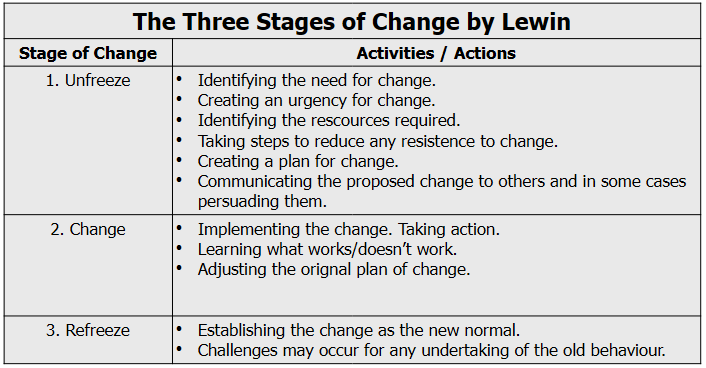
Both of these theories can help you change your thinking or behavioural patterns.
Write soon,
Antony