
Before 1799, Archaeologists, Historians and Linguists all had a problem.
Their problem was that they couldn’t work out how to translate and understand the many pictograms or hieroglyphics that had been drawn by the Ancient Egyptians.
More and more tombs, artifacts and stone slabs were being discovered all the time in Egypt, all covered with these mysterious and unfathomable symbols.
More and more tombs, artifacts and stone slabs were being discovered all the time in Egypt, all covered with these mysterious and unfathomable symbols. Just imagine how frustrating it must have been, to have all this information recorded about and recoded by the Ancient Egyptian people, but not to be able to make sense of it.

The story starts with Napoleon (a French General, who would at one point become the Emperor of France) deciding to invade Egypt in 1798. Napoleon did this to threaten the British Empire’s control of India. Likely due to the conflict and poor record keeping by the French army, details about the Rosetta Stone’s discovery are vague.
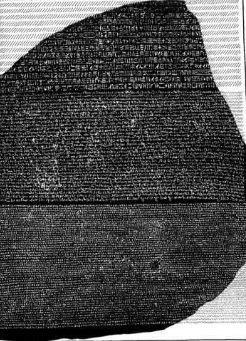
Historians seem to think that on 15th July 1799, French soldiers discovered the Rosetta Stone accidently whilst digging foundations for a fort. Historians suggest that when Pierre-François Bouchard, the Officer in Charge of the unit, he immediately understood the significance of what they had found.

What Did Pierre-François See and Understand About The Rosetta Stone?
The Rosetta Stone is a written/drawn decree, the same decree, repeated in three different languages. The first language was Egyptian hieroglyphics, suitable for groups of people in ancient times that could read that. The suggestion from Historians is that these people were either priests, wealthy or both. But we don’t know this for sure.
The second language was cursive Egyptian, which was thought to be ‘the language for every day people.’ The language that the majority of the people could read.
But it was the third language that Pierre-François spotted and made this stone slab special. The third language was Ancient Greek, which some scholars could still read.
This meant that well-educated people could possibly compare the passages using Ancient Greek passage like a the right key to a locked door. That they could decipher both the hieroglyphic and cursive Egyptian languages using the Ancient Greek passage.
At an earlier point in history, Alexander The Great (a Greek King) conquered Egypt with an army. Historians suggest that a group of people who could only read Ancient Greek existed in Egypt because of this past. That for whatever reasons these ancient Greeks opted to stay in Egypt, or perhaps, were instructed to stay, rather than going back home to Greece.

What Happened Next?
Jean-François Champollion, a French Egyptologist, was the first to successfully translate the meaning of different hieroglyphics in 1821. However, according to a number of different sources online, he had faced fierce competition from his former mentor Thomas Young, a British Scientist (I’m using the word Scientist here to describe a broad range of activities).
After this other people developed further understanding, but their works are all based on the foundations of Jean-François Champollion’s work. As the days have turned into months, and the months into years other stone slabs have been discovered with other decrees on them. A total of 29 Rosetta Stones have been found at the time this blog post was published.

Where is the Original Rosetta Stone Now?
At the time this post was published the original Rosetta Stone, the key to translating and understanding the ancient hieroglyphic language currently resides in The British Museum. How it ended up there…well that’s another story.
Blog soon,
Antony
