The Story of Sir Alexander Fleming and his Accidental Discovery of Penicillin
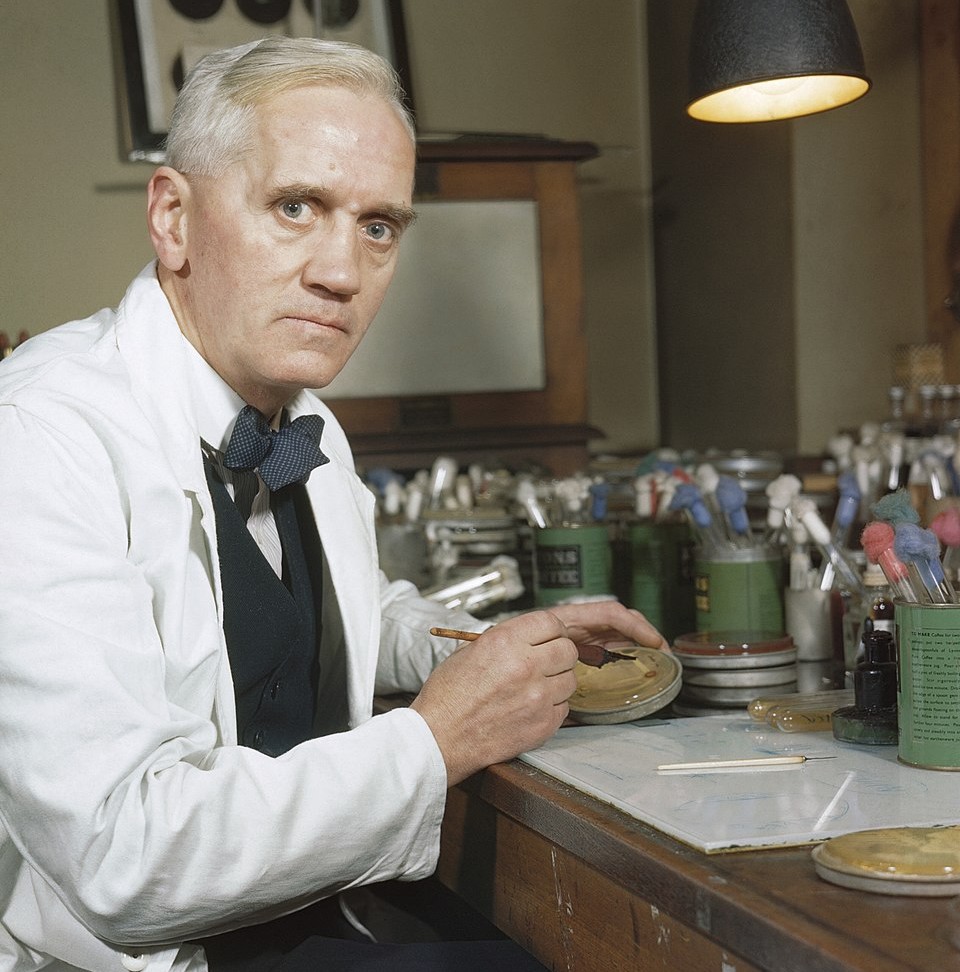
Sir Alexander Fleming was a Doctor and Microbiologist who discovered the first antibiotic, Penicillin, by accident.
In 1928, Fleming was studying the bacterial organism Staphylococcus. Fleming accidentally left some petri dishes containing Staphylococcus uncovered in his lab before going away on holiday.
When Fleming returned to his lab, he discovered one of the petri dishes had developed mold. On examination, he discovered that all the Staphylococcus bacteria had been eliminated. Fleming discovered that this mold had produced a substance that had eliminated the bacteria. He identified the mold as Penicillium notatum, which is where he got the name Penicillin from.
The following year, Fleming reported his discovery in a talk to a Medical Research Club and wrote a paper which was published in the British Journal of Experimental Pathology. But it took nearly a decade for the scientific community to realise the implications and potential of Fleming’s discovery.
Fleming later reflected on his accidental discovery:
One sometimes finds what one is not looking for. When I woke up just after dawn on September 28, 1928, I certainly didn’t plan to revolutionise all medicine by discovering the world’s first antibiotic, or bacteria killer. But I suppose that was exactly what I did.
– Sir Alexander Fleming
Discovering Penicillin was not Fleming’s only achievement, but his most notable one. He was knighted in 1944 and shared the 1945 Nobel Prize in Physiology or Medicine. Knighted is when the reigning King or Queen bestows a knighthood, meaning that your title becomes Sir, rather than Mr or Dr.
Fleming was not exaggerating when he stated that he revolutionised all medicine. Antibiotics save many millions of lives across the world each year.
However, according to the NHS we are now seeing bacterial organisms that are resistant to some antibiotics. This means that some antibiotics no longer kill some harmful bacterial organisms. The NHS has been running a Keep Antibiotics Working campaign for a number of years, which has included this TV advert:
Antibiotics don’t just save human lives. They can also be used to treat bacterial infections in animals too.
I find Fleming’s story incredible and inspiring. I hope you did too. If you enjoyed this post, you might like: The Story of Jonas Salk and The Polio Vaccine or Ida & Louise Cook: An Extraordinary & Inspirational Story.
Blog soon,
Antony