society

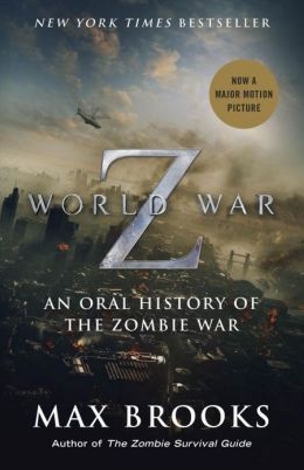
Book Review: World War Z – An Oral History of the Zombie War by Max Brooks
Reading Time: 2 minutes

I bought World War Z: An Oral History of the Zombie War after watching the World War Z film. I loved the film and was looking forward to the book. But it’s taken me over a year to read it.

World War Z: An Oral History of the Zombie War is written in an interview style, interviewing people from across the world, their memories unfolding what happened in the fictional zombie war. I had a huge problem with this style for two reasons.

Firstly, the reviews were set post World War Z. This meant that the reader knows from the outset that the characters being interviewed would survive, even if they be damaged physically or emotionally (which was usually apparent at the outset of the interview).

Secondly, there were so many different characters interviewed that I simply didn’t care for any of them. When the reader finds it difficult to connect with an ever-changing cast of characters it makes it difficult for you to care about their loss of family members, friends, colleagues, etc.

World War Z: An Oral History of the Zombie War is well researched. Brooks has considered the politics, culture, society and economic operations of each country his interviewer visits. He demonstrates his exceptional knowledge of traditional warfare. The plot starts with the initial actions countries would likely take to a Zombie War. When these initial reactions don’t work Brooks moves the plot on to more extreme actions.

Brooks explores the entire globe (and beyond) through the interviews showing how the human race overcome the threat of extinction by coming together and working together. Humanity working together differently and creatively. The ending of the book is satisfactory; filled with hope for humanity, but is a little over sentimental for the genre.

Some people will love World War Z: An Oral History of the Zombie War by Max Brooks; others will hate it. I neither loved or hated it. If anything it was mediocre and unexceptional.

We’ve all imagined what we’d do in a zombie apocalypse and for this reason alone I still want to read The Zombie Survival Guide by Max Brooks.

World War Z: An Oral History of the Zombie War by Max Brooks is available to buy on Amazon.

Review soon,

Antony

The Z-VIRUS Series
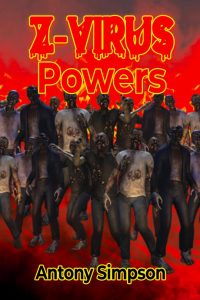
Z-VIRUS Powers

The Z-VIRUS mutates people’s DNA. The majority of infected people become zombies, but a minority seem immune but the virus causes them to develop powers.

At first these powers like invisibility, telepathy and telekinesis aided survival. But as the Z-VIRUS continues to mutate, the powers become more and more destructive.

Forced with no other choice, one group goes in search of a cure. But will they survive the roaming zombie hordes long enough to make an epic journey across the country to find the cure?

Join Alexis, Vis, Chan, Luke, Natalie, Grace, Chloe, Kyle, David and Goliath on this journey in Z-VIRUS Powers, the first instalment of this three part story.
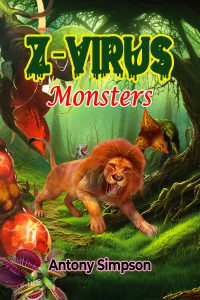
Z-VIRUS Monsters

The Z-VIRUS is mutating, now affecting plants and animals.

A group of people, most with supernatural powers, are in desperate hunt for a cure.

Their powers which once helped their survival, are now becoming destructive.

Can they survive for long enough to find the cure? And if so, what will happen when they take it?

Join Alexis, Goliath, Luke, Lucy, Kyle, Natalie, Erin, Sophie, Kevin, George, Zoha, Harry and Ryan on this epic, entertaining and thrilling adventure.
Share on Social Media:
Amazon, Books & Authors, Reviews, , , , , , , , , , , , , , , , , , , , , , , , , , , , , , , , ,

Changes to The Pink List (2013)

Reading Time: 2 minutesPink List 2013 Logo

The Independent on Sunday has been producing their annual Pink List since 2000. The Pink List is a list of influential gay, lesbian, bisexual and trans gay people in the UK. Each year The Independent assembles a panel of Judges, opens up for nominations from the public and then decides who to award the 100 places to and in which order.

This year’s Pink List 2013 has been published and with some interesting changes. No longer is it enough to be gay and a well known public figure whose a role model to gay youth. This year people on the list have to have contributed or made a difference in some way.

The Independent on Sunday have created two separate lists in addition to the main pink list; one for National Treasures and one for Politicians. On the National Treasures list is the likes of Russell T Davies, Paul O’Grady, Sir Elton John, Stephen Fry, Sir Ian McKellen and John Barrowman. On the Politicians list is various Westminster Peeps.

I am disappointed by the creation of these separate lists for National Treasures and Politicians. I think it is enough to be gay and a role model, so I’d have kept the one Pink List. I’d have just put people who have contributed more in the last year higher up on the list.

I would have extended the list to accomodate the increasing number gay people coming out. It shows that we are out there in numbers and contributing to society. For easy reading, I would have split the list into parts: 1-10, 11-30, 31-50, 51-100 and 101+.

The Pink List has always missed out people that are not in the media spotlight. I think the Pink List could be massively improved by including these people who are contributing a great deal to their local communities and society as a whole. These ‘ordinary’ LGBT people are doing amazing things. Such as those Workers/Volunteers for The Albert Kennedy Trust & George House Trust, Students who’ve set up LGBT Societies in Universities and Employees that set up or run LGBT forums within their employers organisations.

The Pink List should include out LGBT parents. Its very difficult to be an out LGBT parent. Many LGBT parents worry about the impact of their sexuality/gender identity on their children, in terms of some schools institutional homophobia and bullying by other children. I discovered this through two interviews with LGBT parents for a feature article for The Gay UK. The first interview was with Paul and the other with Linda.

Finally, I think there should be a list of influential straight people who support gay rights. The gay marriage bill would have never been passed into law, if it wasn’t for the many straight people who voted in favour of the bill.

Blog soon,

Antony

mental-health-wisdom-banner

Share on Social Media:
Gay, History, Thinking, , , , , , , , , , , , , , , , , , , , , , , , , , , , , , , ,

Thinking About Homelessness

Reading Time: 3 minutesThis time of year when it’s dark and cold makes me feel for people who are homeless. Who’d want to spend a single night sleeping outside in this weather?

No matter the cause of someone’s homelessness; it can be a vicious cycle. A person needs an address to get a bank account, so that state benefits can be paid to them. They often need to be in receipt of benefits to get support in accessing housing and so that housing agencies can contact them. Of course there are ways around this, but people who are homeless people often don’t know how the system works.

People who are homeless also tend to have complex issues (such as substance misuse, relationship breakdowns, bereavements, etc.) that they are trying to deal with at the same time.

So I recently made two donations to The Albert Kennedy Trust and Shelter. The donations were small, but something is better than nothing. Here is some information about the work the charities do and a link for donations:

Albert Kennedy Trust Logo The Albert Kennedy Trust supports lesbian, gay, bisexual and trans homeless young people in crisis. They have offices in London, Manchester and Newcastle.
Donate to The Albert Kennedy Trust
Shelter Logo Shelter helps millions of people every year struggling with bad housing or homelessness – and they campaign to prevent it in the first place.
Donate to Shelter

A friend and I were talking recently about what we do when we see a person who is homeless on the street begging. I said that I don’t usually give money as I don’t carry it, but if I’ve got the time, I offer to buy them a hot drink.

My friend said that he collects McDonalds hot drink loyalty cards stickers and saves completed loyalty cards to give to the person who is homeless and on the street begging. I thought this was a great idea and will be doing it as well.

Anyone can become homelessness, it just needs a certain set of circumstances to happen a person. This means that it can happen to you, a member of your family or one of your friends. I once read somewhere that we are only ever two paydays away from being homeless. Considering this, perhaps it’s worth making a small sacrifice (like that cup of coffee from Starbucks/Costa you buy) and using the money to make a donation to one of the charities above? I’ll let you decide.

Foodbank Image Throughout the year, I’ve also donated items of food to a FoodBank run by The Trussell Trust. The UK is one of the richest countries in the world, yet in the last few years the numbers of people who need to use FoodBanks has dramatically increased. This is worrying and is symptomatic of some of the poorest people being forced to make some very difficult choices.

I’d like to share a thought with you: It seems to me that the rich are getting richer and the poor are getting poorer. I don’t write this to be depressive, simply to express a thought that many people are thinking.

Here’s another thought: This is not the kind of society I want to live in. Food, water and housing are all basic things that everyone should have access to.

So the question becomes: How do we go about changing our society for the better?
Any ideas or opinions, please comment below.

Take care,

Antony

Share on Social Media:
Thinking, , , , , , , , , , , , , , , , , , , , , , , , ,
Scroll to Top
×