Thinking

Two Change Theories – The Cycle of Change by Prochaska and DiClemente & The Three Stages of Change by Lewin

Reading Time: 4 minutes

Everyone and everything changes. As the Greek Philosopher, Heraclitus of Ephesus once said:

Change is the only constant in life.

Understanding how change happens is key to changing any of your thought patterns, emotions or behaviours. It is also key to changing the thought patterns, emotions or behaviours of others.

Here I present two of my favourite change theories:

The Cycle of Change by Prochaska and DiClemente
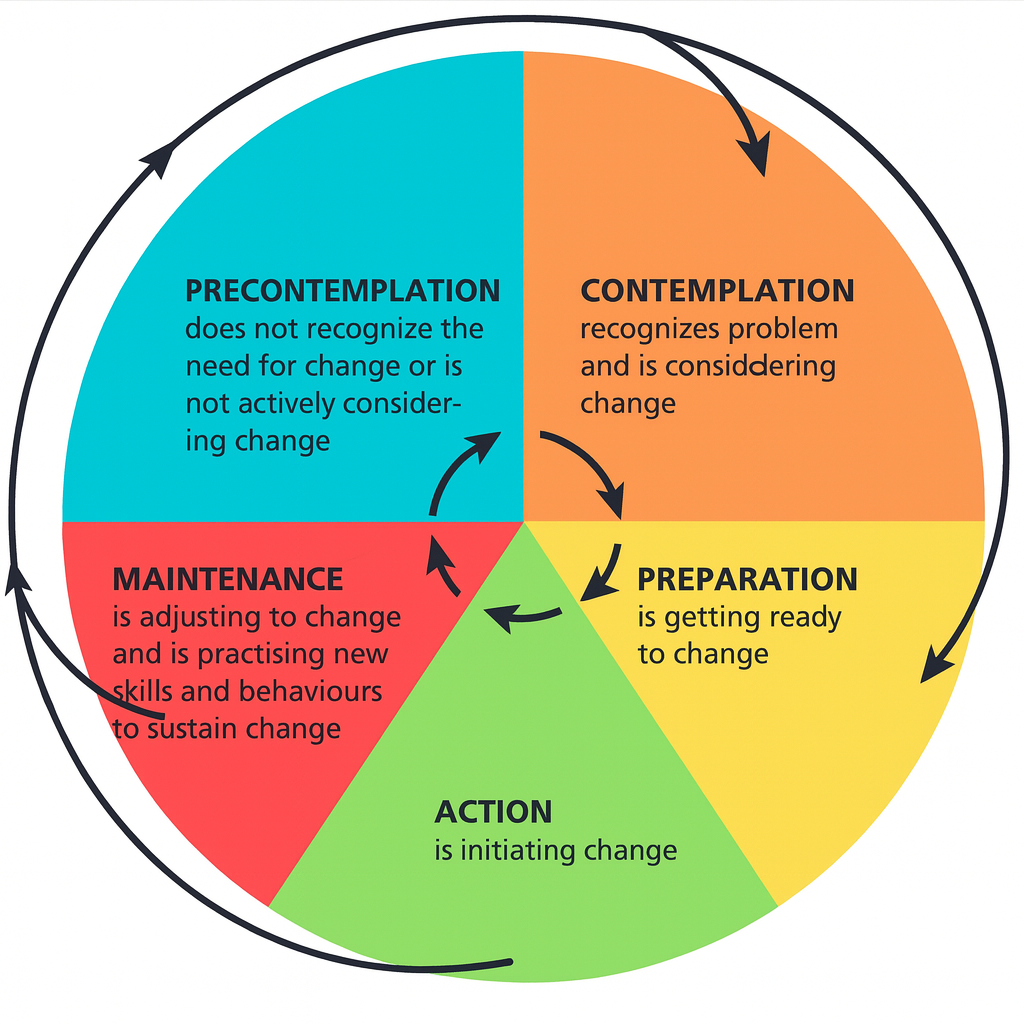
Click on the image above for full size image.

The Cycle of Change was developed by Prochaska and DiClemente in the 1980s looking at how smokers in America stopped smoking.

Prochaska and DiClemente identified that change happens in distinct stages and that these stages can be considered a cycle. They created a diagram to demonstrate this cycle, which I have recreated on the left.

Here is a more information about each stage:

1. Precontemplation
Precontemplation is the first stage in the Cycle of Change. If you are in this stage of change you don’t have any desire or thoughts around changing any of your thought or behavioural patterns.

2. Contemplation
In the contemplation stage you will be thinking about changing either a single thought or behavioural pattern or any number of them. You will be considering the good and bad aspects of the patterns. You will be thinking about how you could change the patterns and the impact you expect changes would have on you and others.

By the time you reach the end of the contemplation stage, you have made the decision to either change or not.

If you have decided to change, you progress to the next stage.

If you have decided not to change your behaviour then you go back to the precontemplative stage.

Some people can get stuck in the contemplation stage for a long time. Always try to be aware of which stage of change you are in and how long you have been there. This will prevent you from getting stuck in any stage of the change process for a prolonged period of time.

3. Preparation
The preparation stage is all about planning to make the change to your thought or behavioural patterns. You will begin to take some actions for the change you want, such as setting goals, making a plan, etc.

For example, say you wanted to change the amount of physical activity you undertake, by increasing it. In this stage you may:

  • Join a gym.
  • Join a local sports club.
  • Plan a new routine which will give you more time for physical activity.
  • Recruit a friend who will also take part in some or all of your physical activities.

4. Action
The action stage is where you stop the old patterns of thoughts or behaviours and start the new patterns. This stage of change is hard and initially takes a lot of conscious effort, energy and motivation.

However with repetition and the passage of time, the new patterns of thoughts or behaviours become easier, take less conscious effort, energy and motivation to complete.

5. Maintenance
In the maintenance stage, you maintain the new patterns of thoughts or behaviours by regular repetition. The aim is to make the new patterns become your new way of being and functioning.

Prochaska and DiClemente theorised that the maintenance stage takes 3-6 months to complete. After this time, what was once a change is the new normal for you.

Neuroscience suggests that it takes 3-6 months for neurons (brain cells) to reorganise and become fully established to support a new thought or behavioural pattern. This neuroscience idea is called Neuroplasticity. This means that neuroscience supports Prochaska and DiClemente’s theory that it takes 3-6 months for you to change thought or behavioural patterns.

Neuroscientists have discovered evidence to suggest that Neuroplasticity occurs throughout a person’s life. This means that no matter your stage of life or age, you can make changes to your thought or behavioural patterns at any time.

6. Lapse or Relapse
Prochaska and DiClemente described going back to old thoughts or behavioural patterns as an essential part of the process of how change happens.

They described a lapse as an event of going back to old thoughts or behavioural patterns for a short time, recognising that you have done this and still having a desire to change to the new patterns. In a lapse, you go back to the new thought or behavioural quickly.

Lapses are part of the process of change. A lapse can be a great learning opportunity for you. By reflecting on a lapse you can learn what triggered you to revert back to your old patterns and prevent it from happening again in the future. This can lead to your next attempt at change being more or completely successful.

Prochaska and DiClemente described a relapse as going back to the old thought or behavioural pattern in the longer term. The danger with a relapse is that you could lose your desire, energy or motivation for change and go back to the pre-contemplation stage of the cycle.

I give much more information, practical advice and tips for change in my book FINDING YOUR HAPPINESS:
The Three Stages of Change by Lewin

The Three Stages of Change by Lewin was developed in the 1940s. His theory consists of three distinct stages:
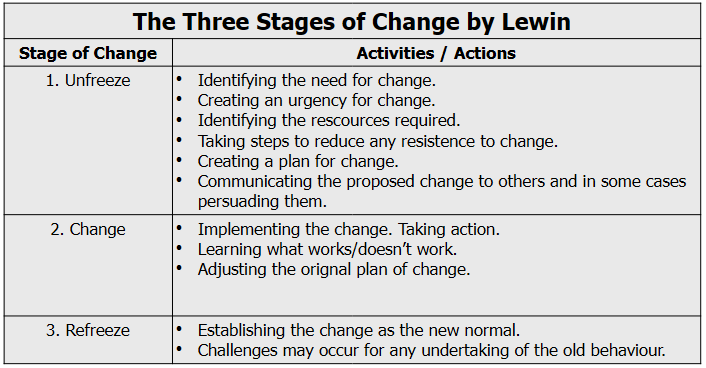
Both of these theories can help you change your thinking or behavioural patterns.

Write soon,

Antony

Share on Social Media:
Life, Thinking, , , , ,

Could substack Replace WordPress? I Don’t Think So And Here’s Why.

Reading Time: 5 minutes

I recently learned about the existence of substack. Substack is a platform that allows anyone to share creative content, including: written articles, images, audio (such as podcasts) and videos with the world. It allows people to subscribe to content creators accounts, in a model that allows both free and paid subscriptions.

Substack’s unique selling point (I hate that phrase!) seems to be that it is easy for creators to grow an audience and to make money from the content they create. Substack boasts that it only takes 10% of creators earnings from paid subscribers, giving the content creators 90% of their earnings. As substack is currently free for content creators to use, it means that substack only make money when content creators do.

As a Writer, I can see the advantages of substack, which include:

  • It is currently FREE, there is no monthly subscription cost, meaning that content creators won’t be left out of pocket. This means that content creators won’t have to pay for domain names, hosting, etc.
  • It appears quick and easy for content creators to set up, use and maintain.
  • No technical knowledge required by the content creators – no knowledge of website design and functionality.
  • It has features that are designed to grow a content creator’s audience, such as notification of new content to subscribers.
  • Substack claim tens of millions of content consumers every week, which in theory means a massive audience. However, they don’t state how many paid subscribers they have on the platform.
  • It allows a variety of different types of content in one post.
  • Substack allows quick reactions (love heart icon) to content, re-posting/sharing content on the platform and discussion via comments.

But substack also has a number of disadvantages, which include:

  • Substack isn’t the only company to have this idea. Patreon is its direct competitor, who have been around longer (Patreon launched in 2013, substack launched in 2017). In some cases Patreon takes less of a percentage of subscription earnings from content creators than substack.
  • The market for paid content through a subscription is uncertain. As is the amount of money that content creators could make. When I refer to content here, I refer to content that is not of an adult-only nature (by this I mean not pornographic). It is safe to say the market for adult-only content exists and that some content creators are currently making good money from this sort of content. However even with this sort of content, some content creators are saying that the market is saturated and that they are making less money than they used to.
  • Substack is a business with costs and a pressure to make a profit. This could mean that at some point it stops being free and content creators get a monthly subscription fee, even if content creators aren’t making any money from the platform.
  • Substack could may also decide to look for other ways to generate revenue, including but not limited to advertising.
  • Substack could go out of business and creators could loose the platform and possibly some or all of the content they created.
  • Substack allows any creator to post any content. This means that content posted on substack will have less credibility with the audience and may erode the content creators credibility and reputation.
  • Substack doesn’t have any quality controls. This means that content could be factually incorrect, biased, misleading or completely inappropriate.
  • Substack has a history (at least according to Wikipedia) of not taking enough steps to protect users data due to privacy breach in 2020 and then a security breach in late 2025.
  • Substack lacks the ability for content creators to customise much of how their content is viewed. This might not be that important for written words, but could be incredibly important for other types of content.
  • Substack appears to let AI generated content on its platform, which will significantly impact human content creators. AI content may also make a number of content consumers avoid the platform all together.

For both content creators and content consumers there are more disadvantages to using substack, than advantages. But in order for me to justify my opinion that substack won’t replace WordPress, I need to write about WordPress.

(Image From: WikiMedia, 2026)

WordPress

WordPress (WordPress.com & WordPress.org) was launched in 2003 as a blogging platform. It has grown and developed over the years. Today 40-60% of all websites use WordPress.

I have used WordPress for my personal blog and website since 2008, although I remember experimenting with it well before then. WordPress can do everything that substack can, although some functions/features would require plugins.

WordPress initially started as a community platform, but as it grew it became more commercialised as it pivoted towards business users. This brought paid themes and paid plugins. Later, it brought paid subscriptions for some themes and plugins, paid on either a monthly or annual basis.

The choice WordPress developers and other non-official developers made to pivot towards businesses meant that they could earn money from their work, which you could liken to a content creator. This is great, they should be paid for their work.

But it means that the core WordPress platform, without any of the paid themes or plugins is limited for content creators. Content creators, especially those trying to build an audience that are willing to pay for their content (like myself) just don’t have the money to spend to get the functionality/features currently being offered for free by platforms like substack.

I am a Writer. I write this blog, books, articles and short stories. I write this blog because I enjoy writing. Writing this blog is a hobbie and I am happy to give away the content for free.

But my more substantial content like my books, articles and short stories, take me a considerable amount of time, energy and work to create. I believe that they have monetary value and that it is fair to ask for a small amount of money in return for them.

I am truly appreciative of everyone who reads something that I write, whether that be on my blog, or through one of my books, articles or short stories.

But the WordPress platform, without the paid plugins makes it difficult or in some cases impossible for content creators to:

  • Help you to find your audience.
  • Help you to grow your audience.
  • Help you to keep in touch with your audience.
  • Help you to take payments for products (whether that be physical or digital).
  • Help you to offer subscription services.

WordPress has dominated the market when it comes to Writers, for a number of years. But one of my hopes, is that services like substack cause WordPress developers to add some functionality/features into the platform that address some of the difficulties faced by content creators who can’t afford to buy the paid plugins.

Conclusion

I use the WordPress platform through a self-hosting company and have a domain name to help people to find my website. This costs me £25 per month. But due to the lack of functionality/features in the WordPress platform (without paying more money for plugins), this website costs more to run than any money I’ve ever generated through it.

But despite WordPress’ limitations, I think it will be around long after substack is a distant memory. Substack appears very good at marketing to content creators. But to me its business model seems to have far too many flaws. Their business model is based on an idea that people are willing to pay for content. But there isn’t any good data on:

  1. Whether people are willing to pay for content.
  2. What sort of content people are willing to pay for.
  3. The number of people who are willing to pay for content.
  4. How much people are willing to pay (or can afford to pay given the global economy) for content.
  5. If substack can generate enough income to not only meet the costs of operating, but also make a profit.
  6. The impact AI will have on content creators and their audiences.

Blog soon,

Antony

Share on Social Media:
Creativity, Technology, The Web, Thinking, , , , , , , , , , , , , , , , , , , , , , , ,

The ‘Hospital Boss’ Arrest in relation to Lucy Letby Leaves Many Unanswered Questions

Reading Time: 2 minutes

It was reported in various news sources (see for example here on the BBC) that one of the hospital bosses in charge of the NHS Trust where Lucy Letby committed her crimes was arrested by the Police on suspicion of perverting the course of justice this week.

I have already given my thoughts on Lucy Letby’s case here: Lucy Letby: A Miscarriage of Justice?

The limited information about the ‘Hospital Boss’ have given me a lot of questions, including:

  1. Why wasn’t the individual named? Lucy Letby was named before being found guilty, so surely it can’t be about protecting the individual’s identity.
  2. Three other hospital bosses were arrested in June/June 2025 (see this previous BBC News report), but there has been no update. Why?
  3. Are any of these hospital bosses professionally registered, and if so, have they all informed their professional bodies (such as the General Medical Council, the Nursing & Midwifery Council, etc.) of the allegations made against them?
  4. Have any of these hospital bosses, who may have moved on to roles in other NHS Trusts/Other Employers, made their new employers aware of these allegations?
  5. What happened to the idea of having a regulating body for senior healthcare leaders who are not otherwise professionally regulated? This idea seems to have been completely forgotten about.
  6. Who are the Police using as professional advisors? They will require experts in the field to advise whether any evidence they discover is expected practice or not and if the evidence demonstrates corporate manslaughter or gross negligence. In Lucy Letby’s case the Police used a very questionable expert to help to convict Letby. I hope they don’t repeat this mistake.
  7. What does suspicion of perverting the course of justice mean in relation to this case?
  8. What support have the families been offered in relation to these on-going enquiries?
  9. Are the Police including only the cases that Lucy Letby was convicted on or looking at all cases of infant deaths on the neonatal unit? If so, what time period are they looking at? The reports indicate that the Police are investigating corporate manslaughter and gross negligence manslaughter, both of which could have been happening before the crimes of Lucy Letby. They could even still be continuing.
  10. What is the NHS Trust doing to ensure nothing like this ever happens again?
  11. What is the Care Quality Commission’s (CQC) role in all this? The CQC last inspected this NHS Trust in the end of 2023, rated most areas as Requires Improvement (in the areas of Safe, Effective, Responsive & Well-led). I want to be clear: This is not a criticism of the CQC. Just a question. An idea I have thought about is the CQC perhaps having legal set timeframe for returning to any healthcare organisation that has areas that Requires Improvement?
  12. Why hasn’t the Department for Health & Social Care released any statement about this or anything that is being done at the NHS Trust to improve? Surely, this would reassure local people.

I’m hoping that time will provide answers to at least some of these questions, if not all of them.

If you enjoyed this post, you may like my article: The History of the National Health Service in England (1858-2016).

Write soon,

Antony

mental-health-wisdom-banner
Share on Social Media:
Health, Thinking, , , , , , , , ,

Girls and Women – Learn The Lesson from The Gay Civil Rights Movement

Reading Time: < 1 minute

I saw an announcement on social media about a new law in the UK, one that in theory will help protect girls and women from harassment. I posted a comment stating that I hoped that this law would be applied regardless of gender.

I was making a simple, but important point: That the law should be applicable to and applied equally, regardless of gender.

I found myself under attack from well meaning women in the comments. I never disagreed that the safety of girls and women is an issue in our society. Nor that boys and men are usually the perpetrators of harassment towards girls and women.

I replied to each comment, encouraging girls and women learn the lesson from the gay civil rights movement. The lesson is this: The gay civil rights movement made changes happen because they gained allies. I encouraged these women to gain allies, rather than go on the attack.

To girls and women: Know that there are many boys and men that are not harassing you. Know that many boys and men don’t share the views, attitudes or behaviours of those that harass you or might do.

Write soon,

Antony

Share on Social Media:
The Web, Thinking, , , , ,
Scroll to Top
×